Home
Class 12
PHYSICS
Behind a thin converging lens having bot...

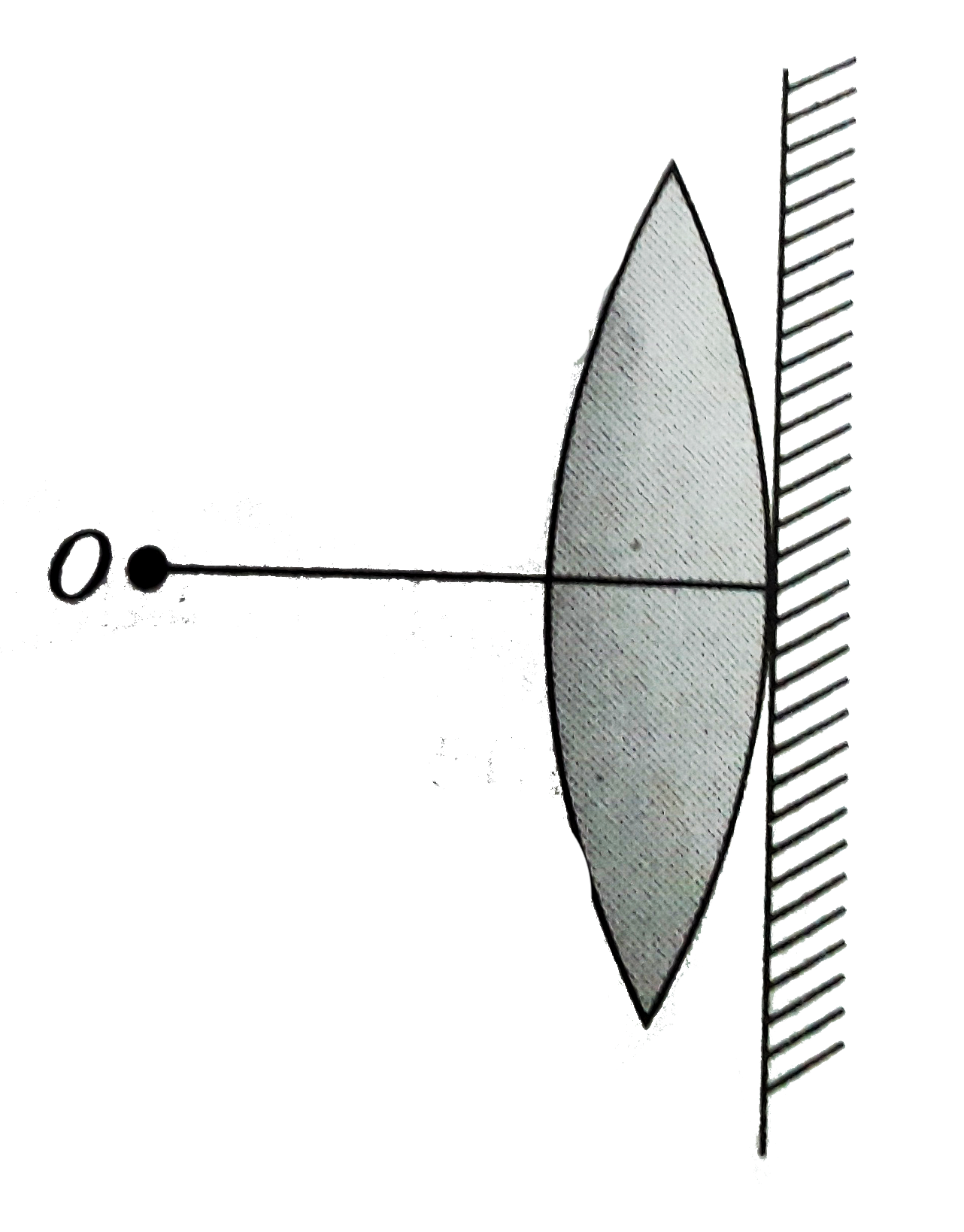
Behind a thin converging lens having both the surfaces of the same radius 10cm, a plane mirror has been placed. The image of an object at a distance of 40 cm from the lens is formed at the same position. What is the refractive index of the lens?

A

`1.5`

B

`5//3`

C

`9//8`

D

None of these

Text Solution

Verified by Experts

The correct Answer is:
c.

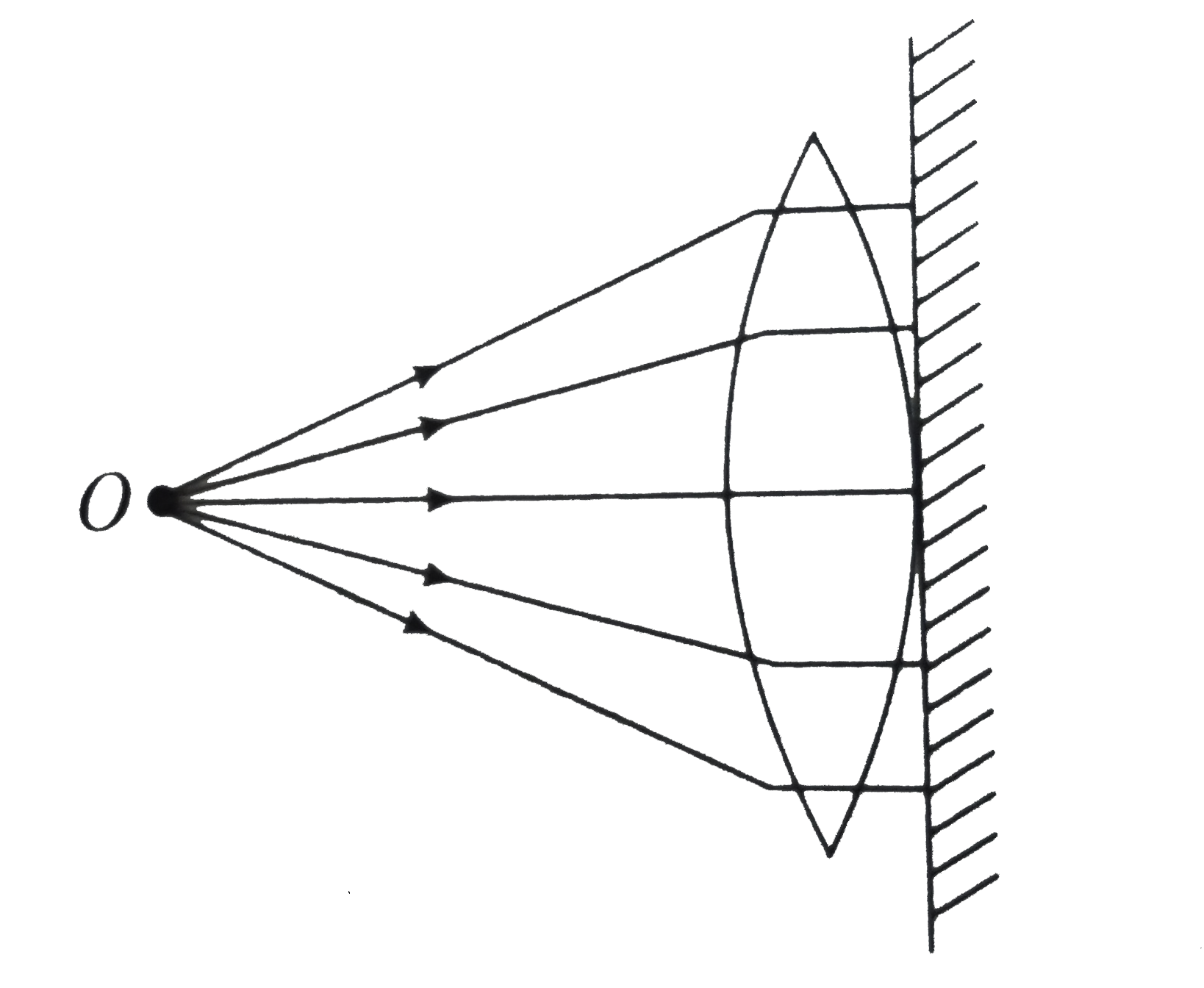
"O" act as the focal point.
Also, `(1)/(f)=(mu-1)((1)/R_(1)-(1)/R_(2))`
`rArr (1)/(40)=(mu-1)((1)/(10)+(1)/(10))`
`(1)/(40)=(mu-1)((2)/(10))`
`rArr mu=9//8`
Promotional Banner

Topper's Solved these Questions

  • GEOMETRICAL OPTICS

    CENGAGE PHYSICS ENGLISH|Exercise Assertion-Reasoninig|2 Videos
  • GEOMETRICAL OPTICS

    CENGAGE PHYSICS ENGLISH|Exercise Linked Comprehension|51 Videos
  • GEOMETRICAL OPTICS

    CENGAGE PHYSICS ENGLISH|Exercise Subjective|26 Videos
  • ELECTRON,PHONTS,PHOTOELECTRIC EFFECT & X-RAYS

    CENGAGE PHYSICS ENGLISH|Exercise dpp 3.3|15 Videos
  • HEATING EFFECT OF CURRENT

    CENGAGE PHYSICS ENGLISH|Exercise Thermal Power in Resistance Connected in Circuit|27 Videos

Similar Questions

Explore conceptually related problems

For an object placed at a distance 20 cm from a concave mirror, the image is formed at the same position. What is the focal length of the mirror?

A convex lens is placed in contact with a plane mirror. An axial point object at a distance of 20 cm from this combination, has its image coinciding with itself. What is the focal length of the convex lens ?

A point source of light is placed inside water and a thin converging lens of focal length f is placed just outside the surface of water. The image of source is formed at a distance of 50 cm from the surface of water. When the lens is placed just inside the water surface the image is formed at a distance of 40 cm from the surface of water. if focal length of the lens in air is f=(100k)/8 cm, then find the value of k. (given refractive index of lens is 3/2 and that of water is 4/3 and in both cases image is formed inside water for the viewer in air).

A convex lens of focal length 30 cm , a concave lens of focal length 120 cm , and a plane mirror are arranged as shown . For an object kept at a distance of 60 cm from the convex lens, the final image, formed by the combination , is a real image , at a distance of : |"Focal length" | = |"Focal length"| = 30 cm " " =120 cm

The plane surface of a plano-convex lens of focal length 60 cm is silvered. A point object is placed at a distance 20 cm from the lens. Find the position and nature of the final image formed.

Plane surface of a thin plano-convex lens is silvered. If a point object is placed on principal axis at a distance 60cm from the lens and fial image is formed at a distance 30cm from the lens on same side. What will be the distance of final imagge from the lens if the plane surface is not silvered.

A double convex lens made of glass of refractive index 1.56 has both radii of curvature of magnitude 20 cm . If an object is placed at a distance of 10 cm from this lens, find the position of image formed.

A plano-convex lens P and a concavo-convex lens Q are in contact as shown in figure. The refractive index o fthe material of the lens P and Q is 1.8 and 1.2 respectively. The radius of curvature of the concave surface of the lens Q is double the radius of curvature of the convex surface. The convex surface of Q is silvered. An object is placed on the placed on the principal axis at a distance 10 cm form the plane surface. The image is formed at a distance 40 cm from the plane surfaces on the same side. The focal length of the system is

A biconvex lens of focal length 15cm is in front of a plane mirror. The distance between the lens and the mirror is 10cm. A small object is kept at distance of 30cm from the lens. The final image is

A point object is placed at a distance of 12 cm from a convex lens of focal length 10 cm. On the other side of the lens, a convex mirror is placed at a distance of 10 cm from the lens such that the image formed by the combination coincides with the object itself. The focal length of the convex mirror is

CENGAGE PHYSICS ENGLISH-GEOMETRICAL OPTICS-Single Correct
  1. Light is incident on a glass block as shown in figure. If theta(1) is ...

    Text Solution

    |

  2. A thin equi-convex (mu = (3)/(2)) lens of focal length 10 cm is cut an...

    Text Solution

    |

  3. Behind a thin converging lens having both the surfaces of the same rad...

    Text Solution

    |

  4. What should be the value of distance d so that final image is formed o...

    Text Solution

    |

  5. A ray of light passes from glass, having a refractive index of 1.6, to...

    Text Solution

    |

  6. Consider an equiconvex lens of radius of curvature R and focal length ...

    Text Solution

    |

  7. A fish is vertically below a flying bird moving vertically down toward...

    Text Solution

    |

  8. What is the angle of incidence for an equilateral prism of refractive ...

    Text Solution

    |

  9. A cube of side 2m is placed in front of a concave mirror of focal l en...

    Text Solution

    |

  10. A plano-convex lens when silvered ono the plane side behaves like a co...

    Text Solution

    |

  11. Two thin lenses are placed 5cm apart along the same axis and illuminte...

    Text Solution

    |

  12. A lens forms a real image of an object. The distance from the object t...

    Text Solution

    |

  13. A plastic hemisphere has a radius of curvature of 8cm and an index of ...

    Text Solution

    |

  14. A ray of light on a transparent sphere with centre C as shown in the f...

    Text Solution

    |

  15. A circular beam of light of diameter d = 2 cm falls on a plane refract...

    Text Solution

    |

  16. Critical angle of glass is theta(1) and that of water is theta(2). The...

    Text Solution

    |

  17. Light is incident normally on face AB of a prism as shown in Figure. A...

    Text Solution

    |

  18. A ray of light is incident on a glass sphere of refractive index 3/2. ...

    Text Solution

    |

  19. Two identical glass (mu(g)=3//2) equiconvex lenses

    Text Solution

    |

  20. An object is kept at a distance of 16 cm from a thin lens and the imag...

    Text Solution

    |

