Home
Class 12
PHYSICS
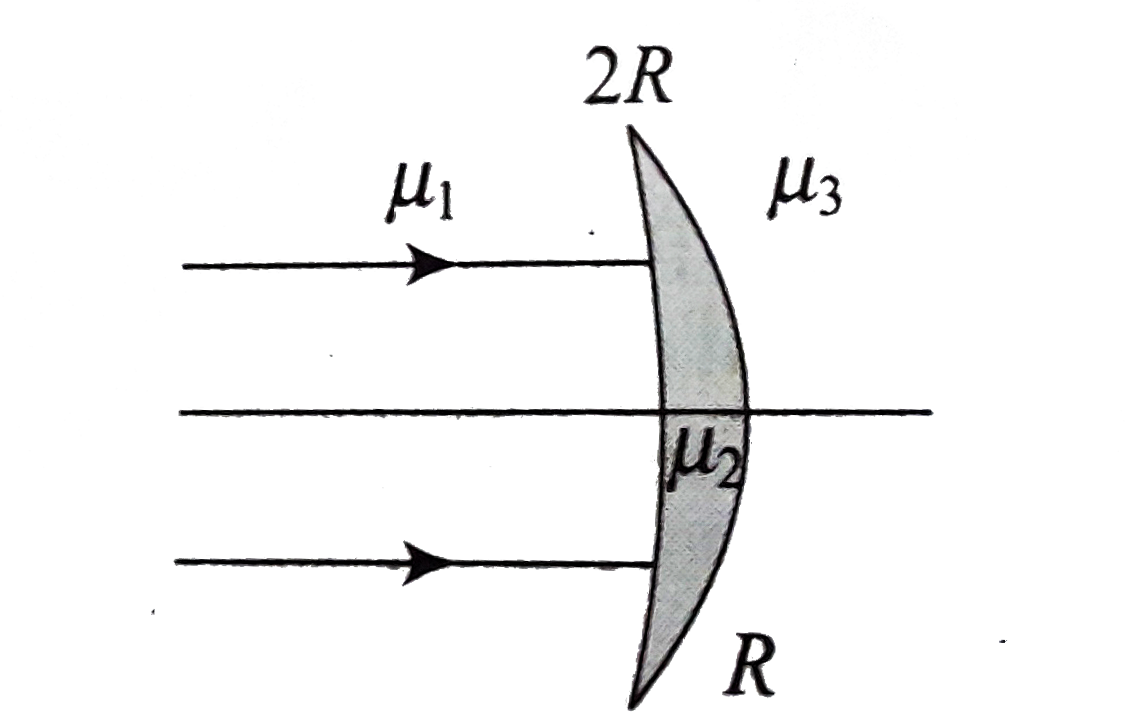
Figure, shows a concavo-convex lens mu(2...

Figure, shows a concavo-convex lens `mu_(2)`. What is the condition on the refractive indiecs so the at the lens is diverging?

A

`2mu_(3) lt mu_(1)+mu_(2)`

B

`2mu_(3) gt mu_(1)+mu_(2)`

C

`mu_(3) gt 2(mu_(1)-mu_(2))`

D

None of these

Text Solution

Verified by Experts

The correct Answer is:
b.

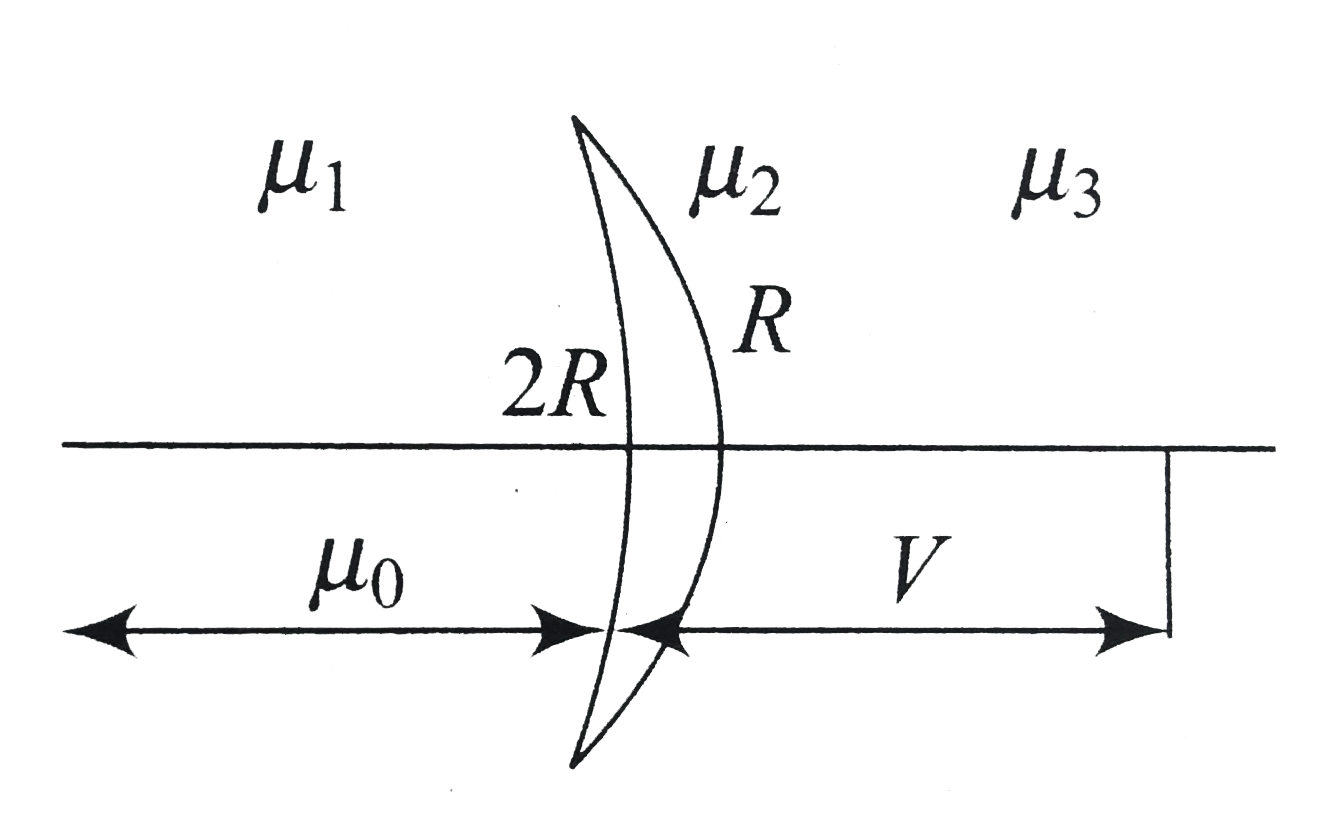
`(mu_(2))/(V)-(mu_(1))/(-u_(0))=(mu_(2)-mu_(1))/(-2R)`
`(mu_(3))/(V_(f))-(mu_(2))/(V)=(mu_(3)-mu_(2))/(-R)`
`(mu_(3))/(V_(f))+(mu_(1))/(u_(0))=(mu_(1)-mu_(2))/(2R)+(mu_(2)-mu_(3))/(R)`
`:. (mu_(1)-mu_(2))/(2) lt mu_(3)-mu_(2) rArr mu_(1)-mu_(2) gt 2mu_(3)-2mu_(2) rArr mu_(1)+mu_(2) lt 2mu_(3)`
Promotional Banner

Topper's Solved these Questions

  • GEOMETRICAL OPTICS

    CENGAGE PHYSICS ENGLISH|Exercise Assertion-Reasoninig|2 Videos
  • GEOMETRICAL OPTICS

    CENGAGE PHYSICS ENGLISH|Exercise Linked Comprehension|51 Videos
  • GEOMETRICAL OPTICS

    CENGAGE PHYSICS ENGLISH|Exercise Subjective|26 Videos
  • ELECTRON,PHONTS,PHOTOELECTRIC EFFECT & X-RAYS

    CENGAGE PHYSICS ENGLISH|Exercise dpp 3.3|15 Videos
  • HEATING EFFECT OF CURRENT

    CENGAGE PHYSICS ENGLISH|Exercise Thermal Power in Resistance Connected in Circuit|27 Videos

Similar Questions

Explore conceptually related problems

The figure shows an equi-convex lens. What should be the condition of the refractive indices so that the lens becomes diverging?

The figure shows an equi-convex lens. What should be the condition of the refractive indices so that the lens becomes diverging?

The diagram shows an equiconvex lens. What should be the condition on the refractive indices so that the lens becomes diverging?

A plano-convex lens P and a concavo-convex lens Q are in contact as shown in figure. The refractive index o fthe material of the lens P and Q is 1.8 and 1.2 respectively. The radius of curvature of the concave surface of the lens Q is double the radius of curvature of the convex surface. The convex surface of Q is silvered. An object is placed on the placed on the principal axis at a distance 10 cm form the plane surface. The image is formed at a distance 40 cm from the plane surfaces on the same side. The focal length of the system is

A plano-convex lens P and a concavo-convex lens Q are in contact as shown in figure. The refractive index o fthe material of the lens P and Q is 1.8 and 1.2 respectively. The radius of curvature of the concave surface of the lens Q is double the radius of curvature of the convex surface. The convex surface of Q is silvered.The focal lengthof combination is 8cm. The radius of curvature of common surface is

A plano-convex lens P and a concavo-convex lens Q are in contact as shown in figure. The refractive index o fthe material of the lens P and Q is 1.8 and 1.2 respectively. The radius of curvature of the concave surface of the lens Q is double the radius of curvature of the convex surface. The convex surface of Q is silvered. The radius of curvature of common surface is

Find the radius of curvature of the convex surface of a plan-convex lens, whose focal length is 0.3 m and the refractive index of the material of the lens is 1.5.

The radius of curvature of the convex face of a plano convex lens is 12cm and the refractive index of the material of the lends 1.5. Then, the focal length of the lens is

The effective focal length of the lens combination shown in figure is -60 cm. The radius of curvature of the curved surfaces of the plano-convex lenses are 12 cm each and refractive index of the material of the lens is 1.5. The refractive index of the liquid is

If in a planoconvex lens, the radius of curvature of the convex surface is 10cm and the focal length is 30 cm , the refractive index of the material of the lens will be

CENGAGE PHYSICS ENGLISH-GEOMETRICAL OPTICS-Single Correct
  1. The focal length of the lens used in question 118 is

    Text Solution

    |

  2. In question 118, if m(1) and m(2) are the magnifications for two posit...

    Text Solution

    |

  3. Figure, shows a concavo-convex lens mu(2). What is the condition on th...

    Text Solution

    |

  4. The image produced by a concave mirror is one-quarter the size of obje...

    Text Solution

    |

  5. Light traveling trhought three transparent substances follows the path...

    Text Solution

    |

  6. A linear object AB is placed along the axis of a concave mirror. This...

    Text Solution

    |

  7. A mango tree is at the bank of a river and one of the branch of tree e...

    Text Solution

    |

  8. In the figure ABC is the cross-section of a right angled prism and BCD...

    Text Solution

    |

  9. A bird is flying up at an angle sin^(-1)(3//5) with the horizontal. A ...

    Text Solution

    |

  10. A point object 'O' is at the center of curvature of a concave mirror. ...

    Text Solution

    |

  11. Refractive index of a prism is sqrt(7//3) and the angle of prism is 60...

    Text Solution

    |

  12. For a prism kept in air, it is found that for an angle of incidence 6...

    Text Solution

    |

  13. A transparent cylinder has its right half polished so as to act as a m...

    Text Solution

    |

  14. In the given figure a plano-concave lens is placed on a paper on which...

    Text Solution

    |

  15. The distance between an object and the screen is 100cm. A lens produce...

    Text Solution

    |

  16. In a thick glass slab of thicknes l, and refractive index n(1), a cubo...

    Text Solution

    |

  17. In Figure, a point object O is placed in air. A spherical boundary sep...

    Text Solution

    |

  18. A square ABCD of side 1mm is kept at distance 15 cm infront of the con...

    Text Solution

    |

  19. A point object is kept in front of a plane mirror. The plane mirror is...

    Text Solution

    |

  20. In Figure, find the total magnification after two successive reflectio...

    Text Solution

    |

