Home
Class 12
PHYSICS
Light traveling trhought three transpare...

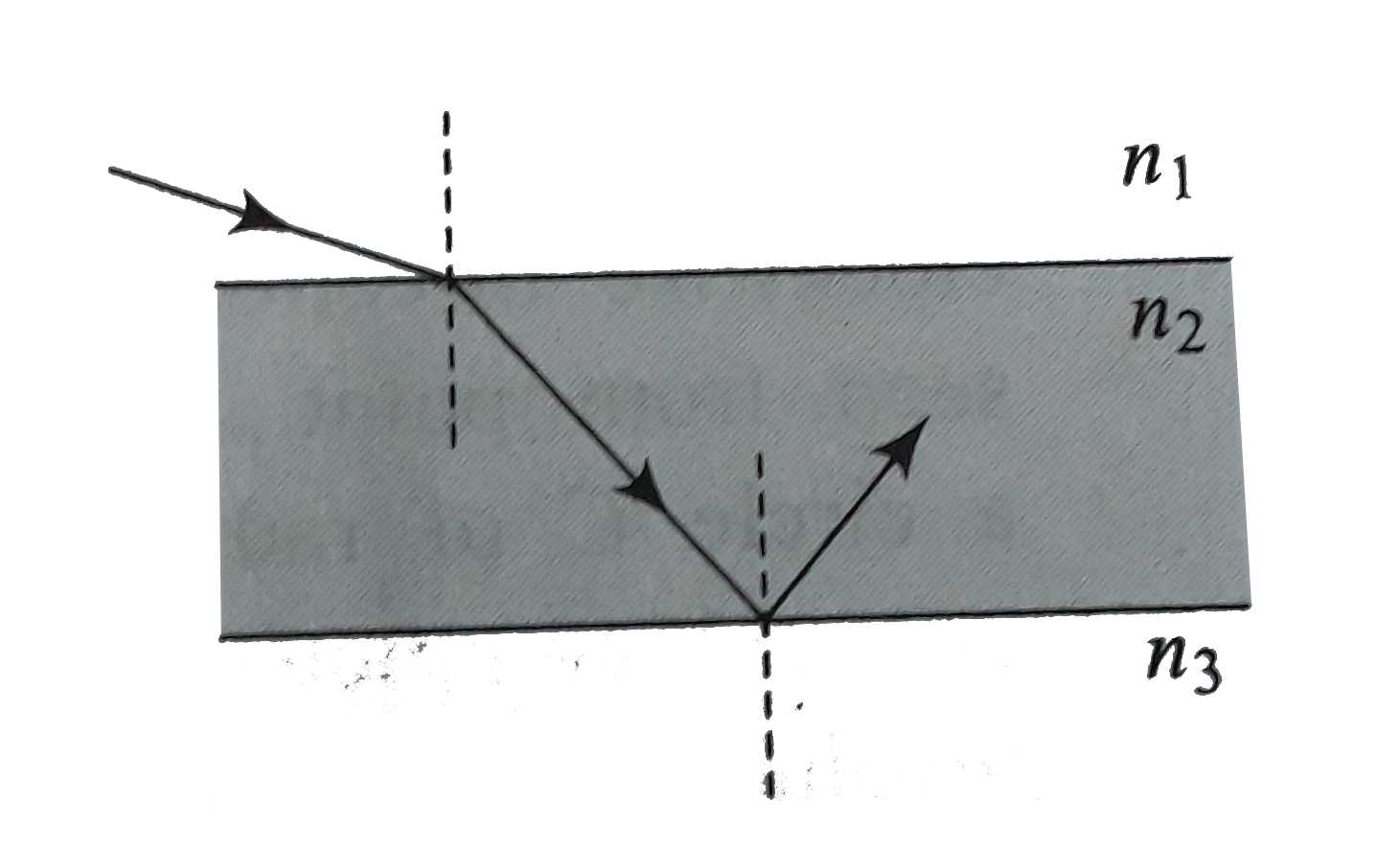
Light traveling trhought three transparent substances follows the path shown in figure. Arrange the indices of refraction in order from smallest to largest. Not the total internal reflection does occur on the bottom surface of medium 2.

A

`n_(1) lt n_(2) lt n_(3)`

B

`n_(2) lt n_(1) lt n_(3)`

C

`n_(1) lt n_(3) lt n_(2)`

D

`n_(3) lt n_(1) lt n_(2)`

Text Solution

Verified by Experts

The correct Answer is:

D

As the ray moves toward the normal while entering medium 2 from 1, we have `n_(2) gt n_(1)`
For total internal reflection at interface of 2 and 3, `n_(2) gt n_(3)`.
Besides `n_(3)` should also be less than `n_(1)` or else ray would have emerged in medium 3, parallel to its parth in medium 1.
Hence, `n_(3) lt n_(1) lt n_(2)` is the correct order.
Promotional Banner

Topper's Solved these Questions

  • GEOMETRICAL OPTICS

    CENGAGE PHYSICS ENGLISH|Exercise Assertion-Reasoninig|2 Videos
  • GEOMETRICAL OPTICS

    CENGAGE PHYSICS ENGLISH|Exercise Linked Comprehension|51 Videos
  • GEOMETRICAL OPTICS

    CENGAGE PHYSICS ENGLISH|Exercise Subjective|26 Videos
  • ELECTRON,PHONTS,PHOTOELECTRIC EFFECT & X-RAYS

    CENGAGE PHYSICS ENGLISH|Exercise dpp 3.3|15 Videos
  • HEATING EFFECT OF CURRENT

    CENGAGE PHYSICS ENGLISH|Exercise Thermal Power in Resistance Connected in Circuit|27 Videos

Similar Questions

Explore conceptually related problems

Light travelling through three transparent substances follows the path shown in the figure. Assuming that total internal reflection does take place on the bottom surface of medium 2, arrange the refractive index in the increasing order.

A light ray falls on a rectangular glass slab as shown. The index of refraction of the glass, if total internal reflection is to occur at the vertical face, is

Consider the situation shown in figure. Find the maximum angle theta for which the light suffers total internal reflection at the vertical surface.

A light wave travels through three transparent materials of equal thickness rank in order from the highest to lowest the indices of refraction n_(1),n_(2) and n_(3) .

A ray of light travelling in a transparent medium falls on a surface separating the medium from air at an angle of incidence of 45^(@) . The ray undergoes total internal reflection. If n is the refractive index of the medium with respect to air, select the possible value of n from the following.

A ray of light travels from water to air as shown in the diagram given below: State the condition so that total internal reflection occurs in the above diagram.

Fill in the blanks: Q: Total internal reflection occurs only when a ray of light passes from a _____medium to a ____medium.

A ray of light is incident on the left vertical face of glass cube of refractive index n_2, as shown in figure. The plane of incidence is the plane of the page, and the cube is surrounded by liquid (refractive index =n_1 ). What is the largest angle of incidence theta_1 for which total internal reflection occurs at the top surfaces?

The path of a ray of light passing through an equilateral glass prism ABC is shown in figure. The ray of light is incident on face BC at the critical angle for just total internal reflection. The total internal reflection. The total angle of deviation after the refraction at face AC is 108^@ . Calculate the refractive index of the glass.

Monochramatic light is incident on the pLane interface AB between two media of refractive indices mu_1 and mu_2(mu_2gtmu_1) at an angle of incidence theta as shown in figure. The angle theta is infinitesimally greater thannte critical angle for the two media so thast total internal reflection takes place. Now, if a transparent slab DEFG of uniform thickness and of refractive inde mu_2 is introduced on theinterface (as shown in figure ) , show that for any value of mu_2 all light will ultimately be reflected back into medium II.

CENGAGE PHYSICS ENGLISH-GEOMETRICAL OPTICS-Single Correct
  1. Figure, shows a concavo-convex lens mu(2). What is the condition on th...

    Text Solution

    |

  2. The image produced by a concave mirror is one-quarter the size of obje...

    Text Solution

    |

  3. Light traveling trhought three transparent substances follows the path...

    Text Solution

    |

  4. A linear object AB is placed along the axis of a concave mirror. This...

    Text Solution

    |

  5. A mango tree is at the bank of a river and one of the branch of tree e...

    Text Solution

    |

  6. In the figure ABC is the cross-section of a right angled prism and BCD...

    Text Solution

    |

  7. A bird is flying up at an angle sin^(-1)(3//5) with the horizontal. A ...

    Text Solution

    |

  8. A point object 'O' is at the center of curvature of a concave mirror. ...

    Text Solution

    |

  9. Refractive index of a prism is sqrt(7//3) and the angle of prism is 60...

    Text Solution

    |

  10. For a prism kept in air, it is found that for an angle of incidence 6...

    Text Solution

    |

  11. A transparent cylinder has its right half polished so as to act as a m...

    Text Solution

    |

  12. In the given figure a plano-concave lens is placed on a paper on which...

    Text Solution

    |

  13. The distance between an object and the screen is 100cm. A lens produce...

    Text Solution

    |

  14. In a thick glass slab of thicknes l, and refractive index n(1), a cubo...

    Text Solution

    |

  15. In Figure, a point object O is placed in air. A spherical boundary sep...

    Text Solution

    |

  16. A square ABCD of side 1mm is kept at distance 15 cm infront of the con...

    Text Solution

    |

  17. A point object is kept in front of a plane mirror. The plane mirror is...

    Text Solution

    |

  18. In Figure, find the total magnification after two successive reflectio...

    Text Solution

    |

  19. A partical revolves in clockwise direction (as seen from point A) in a...

    Text Solution

    |

  20. The given lens is broken into four parts rearranged as shown. If the i...

    Text Solution

    |
