Home
Class 12
PHYSICS
In the given figure a plano-concave lens...

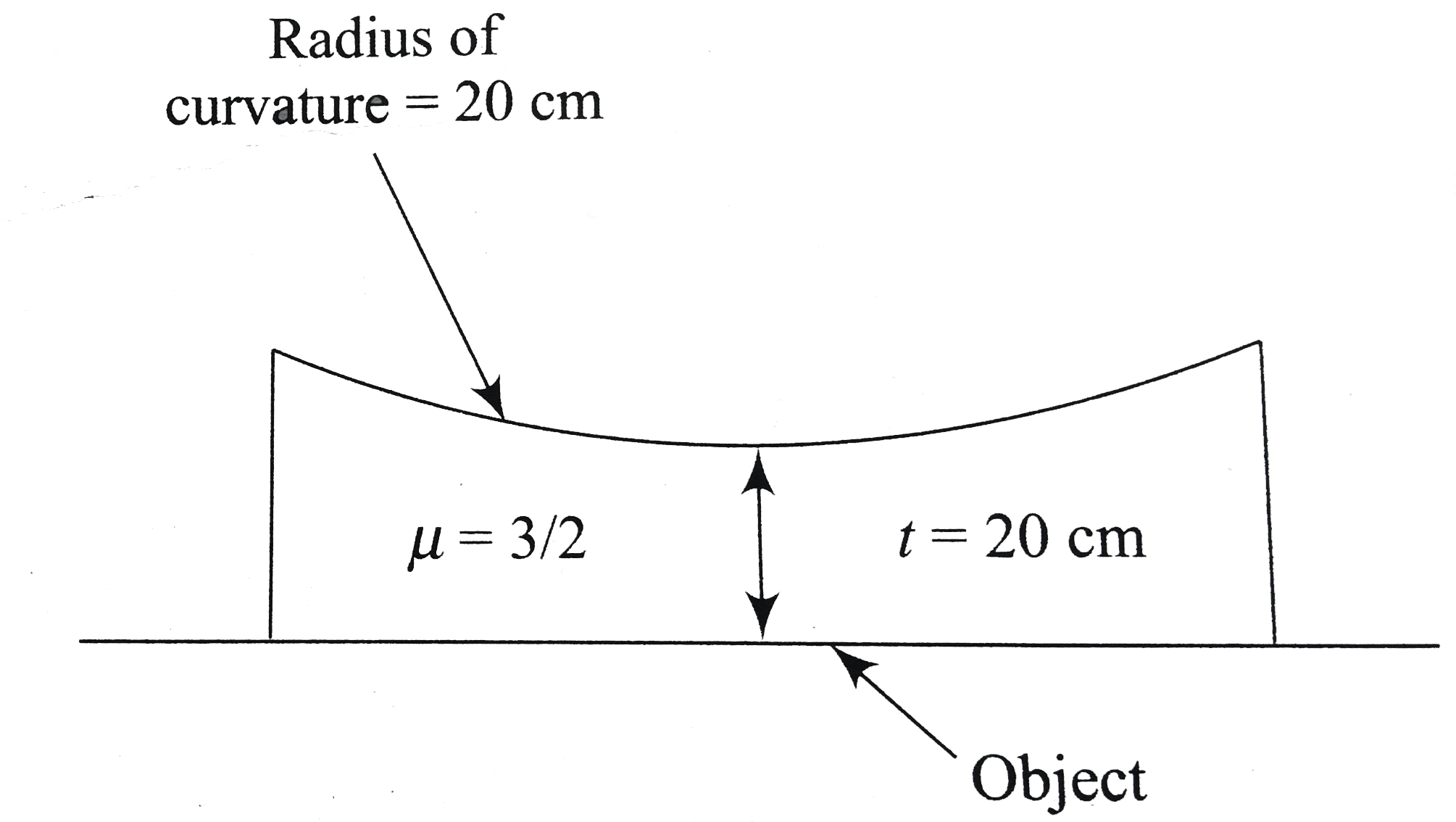
In the given figure a plano-concave lens is placed on a paper on which a flower is drawn. How far above its actual position does the flower appear to be ?

A

10cm

B

15cm

C

50cm

D

None of these

Text Solution

Verified by Experts

The correct Answer is:
a.

Considering refraction at the curved surface,
`u=-20, mu_(2)=1`
`mu_(1)=3//2, R=+20`
Applying `(mu_(2))/(v)-(mu_(1))/(u)=(mu_(2)-mu_(1))/(R)`
`(1)/(v)-(3//2)/(-20)=(1-3//2)/(20)rArr v=-10`
i.e. 10cm below the curved surface or 10cm above the actual position of flower.
Promotional Banner

Topper's Solved these Questions

  • GEOMETRICAL OPTICS

    CENGAGE PHYSICS ENGLISH|Exercise Assertion-Reasoninig|2 Videos
  • GEOMETRICAL OPTICS

    CENGAGE PHYSICS ENGLISH|Exercise Linked Comprehension|51 Videos
  • GEOMETRICAL OPTICS

    CENGAGE PHYSICS ENGLISH|Exercise Subjective|26 Videos
  • ELECTRON,PHONTS,PHOTOELECTRIC EFFECT & X-RAYS

    CENGAGE PHYSICS ENGLISH|Exercise dpp 3.3|15 Videos
  • HEATING EFFECT OF CURRENT

    CENGAGE PHYSICS ENGLISH|Exercise Thermal Power in Resistance Connected in Circuit|27 Videos

Similar Questions

Explore conceptually related problems

If the lens is placed in water instead of air, how does its focal length change?

In Figure, a fish watcher watches a fish through a 3.0 cm thick glass wall of a fish tank. The watcher is in level with the fish, the index of refraction of the glass is 8//5 and that of the water 4//3 . a. To the fish, how far away does the watcher appear to be ? b. To the watcher, how far away does the fish appear to be ?

Which part of a flower does protect its reproductive organs within a bud?

In the given figure, the radius of curvature of curved surface for both the plano-convex and plano-concave lens is 10 cm and refractive index for both is 1.5 . The location of the final image after all the refractions through lenses is

A hemispherieal paper weight contains a small flower on its axis of symmetry at a distance of 4 cm from its flat surface. Where is the flower appears to an observer when he looks at it along the axis of symmetry from the top? (Index of refraction of glass = 1.5) A.15 cm from top B.20 cm from top C.5 cm from top D.25 cm from top

A thin plano-convax lens fits exactly into a plano concave lens with their plane surface parallel to each other as shown in the figure.the radius of the curvature of the curved surface R=30cm The lens are made of different material having refractive index mu_(1)=(3)/(2) and mu_(2)=(5)/(4) as shown in the figure (i) if plane surface of the plano -convex lens is silvered,then calculate the equivalent focal length of this system and also calculate the nature of this equivalent mirror . (ii) An object having transverse length 5cm is placed on the axis of equivalent mirror(in part1) at a distance 15cm from the equivalent mirror along principal axis.Find the transverse magnification produced by equivalents mirror.

The given figure shows a convergent lens placed inside a cell filled with liquid. The lens has focal length +20 cm when in air , and its metrial has refractive index 1.50 . If the liquid has refractive index 1.60 , then focal length of the lens in the cell is

If red and far red lights are given, how do they affect flowering in plants?

Where does triple fusion take place in a flowering plant? Why is it so called? Mention its significance.

An object is placed 50cm from a screen as shown in figure. A converging lens is moved such that line MN is its principal axis. Sharp images are formed on the screen in two positions of lens separated by 30cm. Find the focal length of the lens in cm.

CENGAGE PHYSICS ENGLISH-GEOMETRICAL OPTICS-Single Correct
  1. For a prism kept in air, it is found that for an angle of incidence 6...

    Text Solution

    |

  2. A transparent cylinder has its right half polished so as to act as a m...

    Text Solution

    |

  3. In the given figure a plano-concave lens is placed on a paper on which...

    Text Solution

    |

  4. The distance between an object and the screen is 100cm. A lens produce...

    Text Solution

    |

  5. In a thick glass slab of thicknes l, and refractive index n(1), a cubo...

    Text Solution

    |

  6. In Figure, a point object O is placed in air. A spherical boundary sep...

    Text Solution

    |

  7. A square ABCD of side 1mm is kept at distance 15 cm infront of the con...

    Text Solution

    |

  8. A point object is kept in front of a plane mirror. The plane mirror is...

    Text Solution

    |

  9. In Figure, find the total magnification after two successive reflectio...

    Text Solution

    |

  10. A partical revolves in clockwise direction (as seen from point A) in a...

    Text Solution

    |

  11. The given lens is broken into four parts rearranged as shown. If the i...

    Text Solution

    |

  12. Let r and r^(') denote the angles iniside an equilateral prism, as usu...

    Text Solution

    |

  13. For a prism kept in air, it is found that for an angle of incidence 60...

    Text Solution

    |

  14. Choose the correct mirror image of

    Text Solution

    |

  15. An object is approaching a fixed plane mirror with velocity 5ms^(-1) m...

    Text Solution

    |

  16. A point source of light S is placed in front of a perfectly reflecting...

    Text Solution

    |

  17. A point source of light is placed in front of a plane mirror as shown ...

    Text Solution

    |

  18. A concave refractive surface of a medium having refractive index mu pr...

    Text Solution

    |

  19. A convex spherical refracting surface with radius R separates a medium...

    Text Solution

    |

  20. A concave spherical refractive surface with radius R separates a mediu...

    Text Solution

    |

