Home
Class 12
PHYSICS
In Figure, a point object O is placed in...

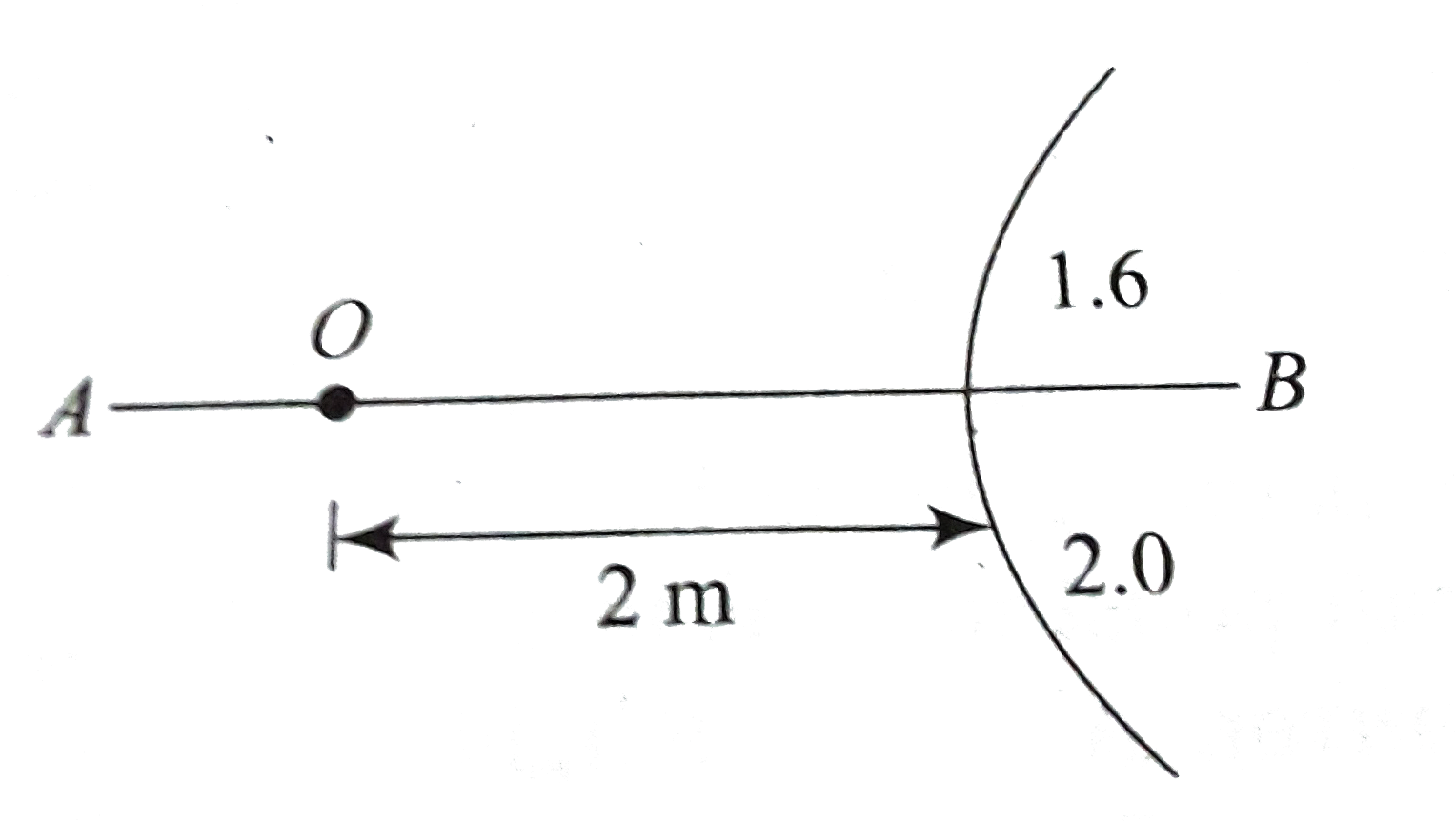
In Figure, a point object O is placed in air. A spherical boundary separates two media. Ab is the principall axis. The refractive index above AB is 1.6 and below AB is 2.0. The separation between the images formed due to refraction at a the spherical surface is (assume the radius of curvature (R) to be 1 unit)

A

12m

B

20m

C

14m

D

10m

Text Solution

Verified by Experts

The correct Answer is:

a.

Use refraction formulae separately, that is for air and `mu=1.6,` and for air and `mu=2.0` and positions of the two images.
Promotional Banner

Topper's Solved these Questions

  • GEOMETRICAL OPTICS

    CENGAGE PHYSICS ENGLISH|Exercise Assertion-Reasoninig|2 Videos
  • GEOMETRICAL OPTICS

    CENGAGE PHYSICS ENGLISH|Exercise Linked Comprehension|51 Videos
  • GEOMETRICAL OPTICS

    CENGAGE PHYSICS ENGLISH|Exercise Subjective|26 Videos
  • ELECTRON,PHONTS,PHOTOELECTRIC EFFECT & X-RAYS

    CENGAGE PHYSICS ENGLISH|Exercise dpp 3.3|15 Videos
  • HEATING EFFECT OF CURRENT

    CENGAGE PHYSICS ENGLISH|Exercise Thermal Power in Resistance Connected in Circuit|27 Videos

Similar Questions

Explore conceptually related problems

In the figure, a point object O is placed in air. A spherical boundry separates two media of radius of curvature 1.0 m. AB is principal axis. The separation between the images formed due to refraction at spherical surface is

Trace the rays of light showing the formation of an image due to a point object placed on the axis of a spherical surface separating the two media of refractive indices n_(1) and n_(2) . Establish the relation between the distance of the object, the image and the radius of curvature from the central point of the spherical surface. Hence derive the expression of the lens maker's formula

A parallel narrow beam of light is incident on the surface of a transparent hemisphere of radius R and refractive index mu=1.5 as shown. The position of the image formed by refraction at the image formed by refraction at the spherical surface only as

Figure below shows a parallel beam of monochromatic light incident on a convex spherical surface, radius of curvature R = 30 cm, which separates glass (refractive index - 1 6) from air. Find the position of the image formed due to refraction of light at this single spherical surface.

In the figure shown , a point object O is placed in air on the principal axis. The radius of curvature of the spherical surfaces is 60 cm. I is the final image formed after all reflections and refractions.

(a) A point object, O is on the principle axis of a spherical surface having a radius of curvature, R. Draw a diagram to obtain the relation between the object and image distances, the refractive indicess of the media and the radius of curvature of the spherical surface.

Two refracting media are separated by a spherical interfaces as shown in the figure. AB is the principal axis, mu_1 and mu_2 are the refractive indices of medium of incidence and medium of refraction respectively. Then,

An object is placed 10cm away form a glass piece (n = 1.5) of length 20cm bounded by spherical surfaces of radii of curvaure 10cm . Find the position of final image formed after two refractions at the spherical surfaces.

A spherical surface of radius R ssparates two media of refractive indices mu_(1) and mu_(1) as shown in figure., Where should an object be placed in medium 1 so that a real image is formed in medium 2 at the same distance?

When an object is placed 60 cm in front of a diverging lens, a virtual image is formed 20 cm from the lens. The lens is made of a refractive index mu=1.65 and its two spherical surfaces have the same radius of curvature. What is the value of this radius?

CENGAGE PHYSICS ENGLISH-GEOMETRICAL OPTICS-Single Correct
  1. The distance between an object and the screen is 100cm. A lens produce...

    Text Solution

    |

  2. In a thick glass slab of thicknes l, and refractive index n(1), a cubo...

    Text Solution

    |

  3. In Figure, a point object O is placed in air. A spherical boundary sep...

    Text Solution

    |

  4. A square ABCD of side 1mm is kept at distance 15 cm infront of the con...

    Text Solution

    |

  5. A point object is kept in front of a plane mirror. The plane mirror is...

    Text Solution

    |

  6. In Figure, find the total magnification after two successive reflectio...

    Text Solution

    |

  7. A partical revolves in clockwise direction (as seen from point A) in a...

    Text Solution

    |

  8. The given lens is broken into four parts rearranged as shown. If the i...

    Text Solution

    |

  9. Let r and r^(') denote the angles iniside an equilateral prism, as usu...

    Text Solution

    |

  10. For a prism kept in air, it is found that for an angle of incidence 60...

    Text Solution

    |

  11. Choose the correct mirror image of

    Text Solution

    |

  12. An object is approaching a fixed plane mirror with velocity 5ms^(-1) m...

    Text Solution

    |

  13. A point source of light S is placed in front of a perfectly reflecting...

    Text Solution

    |

  14. A point source of light is placed in front of a plane mirror as shown ...

    Text Solution

    |

  15. A concave refractive surface of a medium having refractive index mu pr...

    Text Solution

    |

  16. A convex spherical refracting surface with radius R separates a medium...

    Text Solution

    |

  17. A concave spherical refractive surface with radius R separates a mediu...

    Text Solution

    |

  18. Two lenses shown in figure. Are illuminated by a beam of parallel ligh...

    Text Solution

    |

  19. In the arrangement shown in figure., the image of the extended object ...

    Text Solution

    |

  20. The table below shows object and image distances for four objects pla...

    Text Solution

    |
