Home
Class 12
PHYSICS
It is found that all electromagnetic sig...

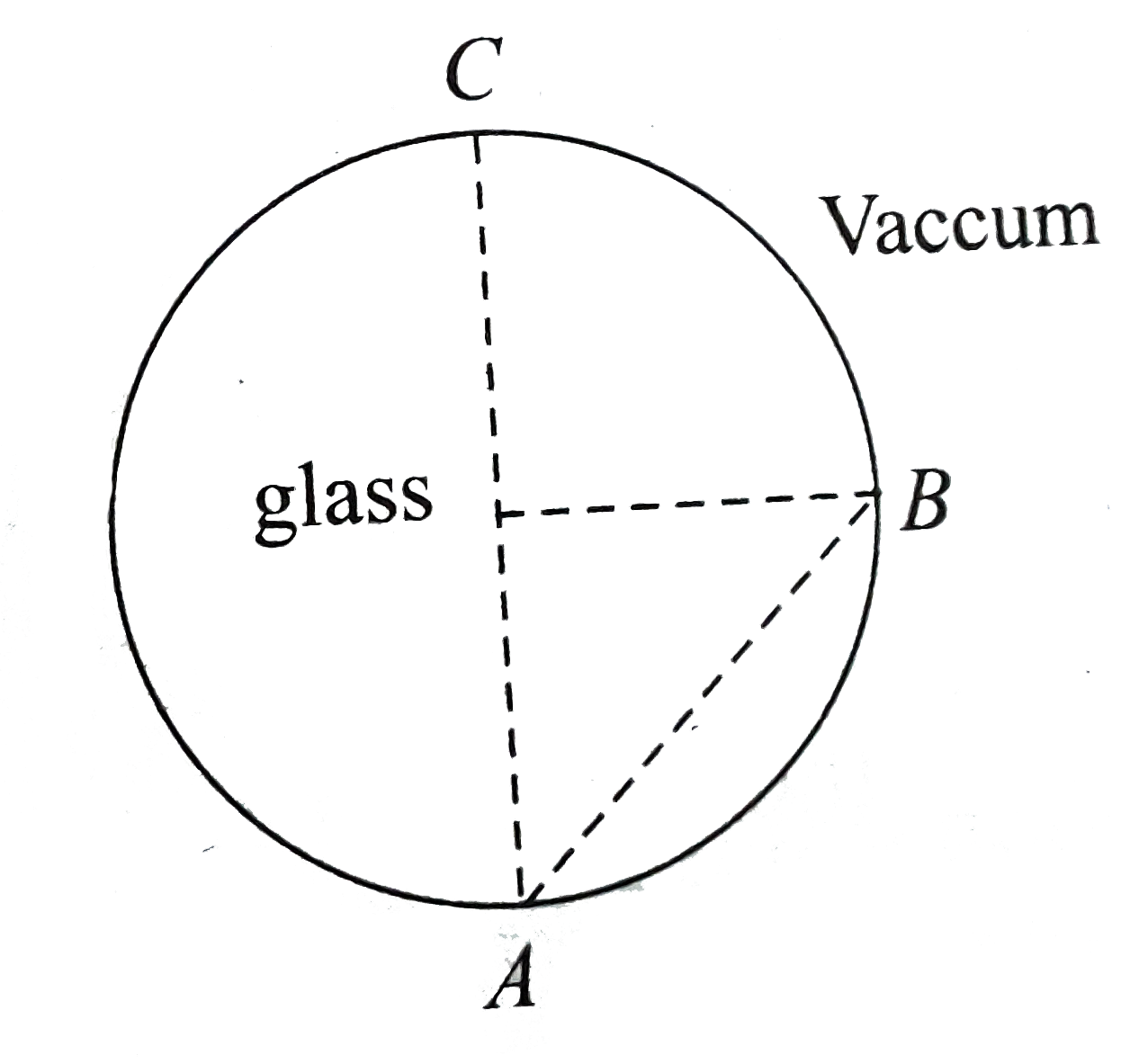
It is found that all electromagnetic signals sent from A towards B reach point C inside the glass sphere, as shown in figure. The speed of electromagnetic signals in glass cannot be:

A

`1.0xx10^(8)ms^(-1)`

B

`2.4xx10^(8)ms^(-1)`

C

`2xx10^(7)ms^(-1)`

D

`4xx10^(7)ms^(-1)`

Text Solution

Verified by Experts

The correct Answer is:
b.

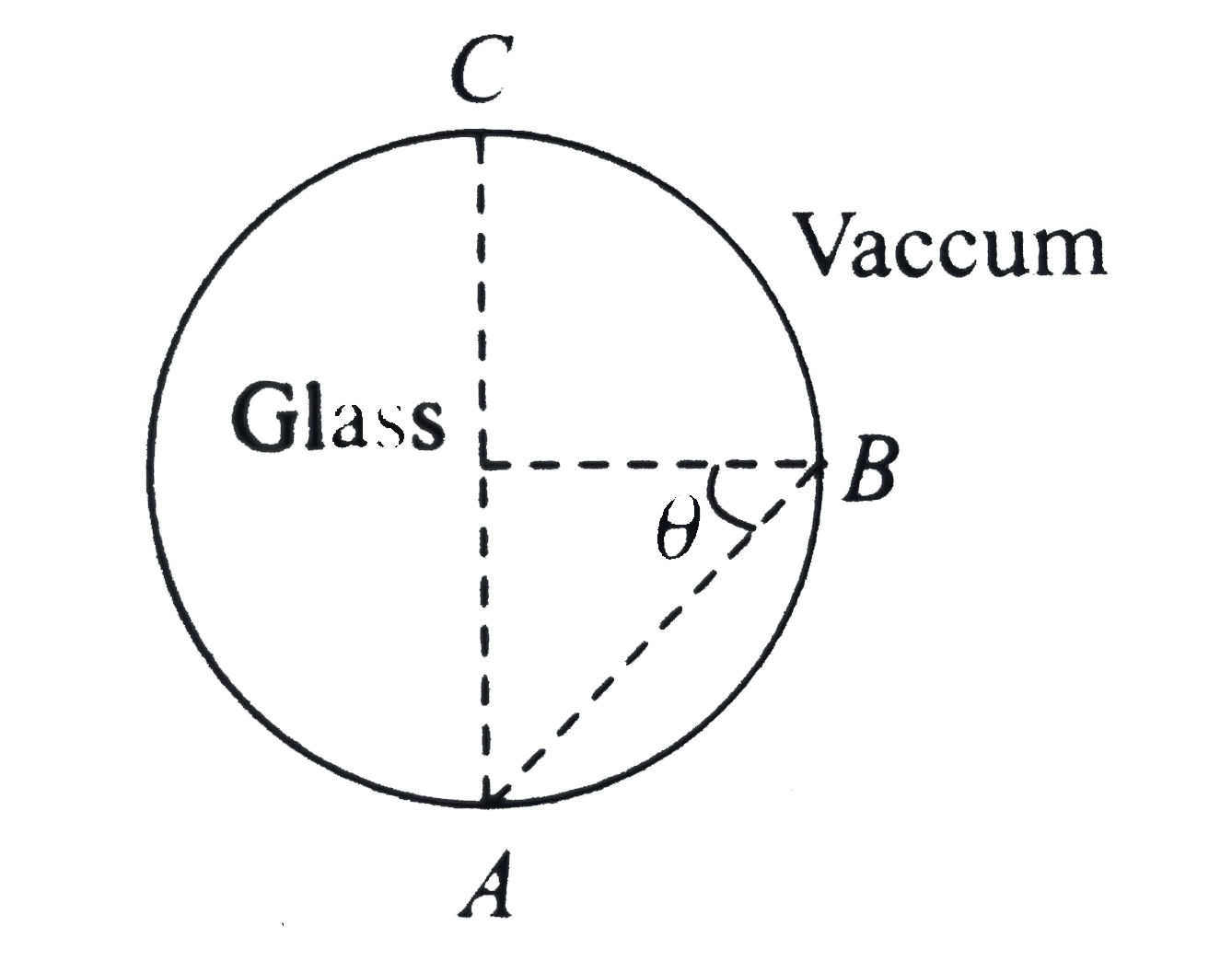
This is a case of total internal reflection .
Here `theta=45^(@)` and `theta gt theta_(C)`
`rArr 45^(@) gt theta_(C)rArrsin45^(@) gt sintheta_(C)`
`rArr (1)/(sqrt(2)) gt (1)/(mu)`
`rArr mu gt sqrt(2)" " ("As " v=c/mu)`
`rArr (c)/(v) gt sqrt(2)`
`v lt (c)/(sqrt(2))=(3xx10^(8))/(sqrt(2))rArrvlt2.1xx10^(8)`
Only (b) is not possible.
Promotional Banner

Topper's Solved these Questions

  • GEOMETRICAL OPTICS

    CENGAGE PHYSICS ENGLISH|Exercise Assertion-Reasoninig|2 Videos
  • GEOMETRICAL OPTICS

    CENGAGE PHYSICS ENGLISH|Exercise Linked Comprehension|51 Videos
  • GEOMETRICAL OPTICS

    CENGAGE PHYSICS ENGLISH|Exercise Subjective|26 Videos
  • ELECTRON,PHONTS,PHOTOELECTRIC EFFECT & X-RAYS

    CENGAGE PHYSICS ENGLISH|Exercise dpp 3.3|15 Videos
  • HEATING EFFECT OF CURRENT

    CENGAGE PHYSICS ENGLISH|Exercise Thermal Power in Resistance Connected in Circuit|27 Videos

Similar Questions

Explore conceptually related problems

It is found that electromagnetic signals sent inside glass sphere from A towards B reach point C. the speed of electromagnetic signals in glass cannot be:

A ball of mass m is released from A inside a smooth wedge of mass m as shown in figure. What is the speed of the wedge when the ball reaches point B?

A cavity of radius r is made inside a solid sphere. The volume charge density of the remaining sphere is rho . An electron (charge e, mass m) is released inside the cavity from point P as shown in figure. The centre of sphere and center of cavity are separated by a distance a. The time after which the electron again touches the sphere is

A point object O is placed slightly above the centre C of a glass sphere as shown in figure. If it is viewed almost normally from above the sphere, its image is seen

A smooth sphere (mass 10kg. negligible radius) rolls on a smooth curved surface from the point A with a speed of 10m//s as shown in figure. The sphere reaches the point D passing through point B . If the ground is taken as reference . Then [ Take g=10m//s^(2)] The total energy of the sphere at the point A .

A smooth sphere ( mass 10kg. negligible radius ) rolls on a smooth curved surface from the point A with a speed of 10m//s as shown in figure. The sphere reaches the point D passing through point B . If the ground is taken as reference . Then [ Take g=10m//s^(2)] The kinetic energy at C

A smooth sphere ( mass 10kg. negligible radius ) rolls on a smooth curved surface from the point A with a speed of 10m//s as shown in figure. The sphere reaches the point D passing through point B . If the ground is taken as reference . Then [ Take g=10m//s^(2)] Will the sphere go beyond D ?

A smooth sphere ( mass 10kg. negligible radius ) rolls on a smooth curved surface from the point A with a speed of 10m//s as shown in figure. The sphere reaches the point D passing through point B . If the ground is taken as reference . Then [ Take g=10m//s^(2)] The kinetic energy at D ,

A monochromatic point source of light O is seen through a rectangular glass block ABCD. Paths of two rays, in and outside the block, are shown in the figure below. For the same rectangular glass block, which colour from the visible spectra will produce the maximum shift?

A man in a car at location Q on a straight highway is moving with speed v He decides to reach a point P in a field at a distance d from the highway (point M) as shown in th e figure . Speed of the car in the field is half to that on the highway what should be the distacne RM so that the time taken to reach P is minimum ?

CENGAGE PHYSICS ENGLISH-GEOMETRICAL OPTICS-Single Correct
  1. A lens of focal length 20.0 cm and aperture radius 2.0cm is placed at ...

    Text Solution

    |

  2. An object is placed at 21 cm in front of a concave mirror of radius of...

    Text Solution

    |

  3. It is found that all electromagnetic signals sent from A towards B rea...

    Text Solution

    |

  4. A diverging lens of focal length 10cm is placed 10cm in front of a pla...

    Text Solution

    |

  5. An object starts moviing at an angle of 45^(@) with the principal axis...

    Text Solution

    |

  6. A concave mirror of radius of curvature 40cm forms an image of an obje...

    Text Solution

    |

  7. A converging beam of rays is incident on a diverging lens. Having pass...

    Text Solution

    |

  8. Consider a sphere of radius R made of glass of refractive index mu. A ...

    Text Solution

    |

  9. A ray of light AO is incident on a diverging lens as shown in figure. ...

    Text Solution

    |

  10. In the arrangement shown in figure, O is the object. An observer is to...

    Text Solution

    |

  11. The observer at O views two closely spaced spots on a vertical wall th...

    Text Solution

    |

  12. An equiconcave diverging lens of focal length F is cut into two equal ...

    Text Solution

    |

  13. In a optics experiment, with the positive of the object fixed, a stude...

    Text Solution

    |

  14. The lens in an overhead projector forms an image P^(') of a point P on...

    Text Solution

    |

  15. A convex lens of focal length 20cm and another plano convex lens of fo...

    Text Solution

    |

  16. A light ray hits the pole of a thin biconvex lens as shown in fig. The...

    Text Solution

    |

  17. In a vessel, as shown in Figure., point P is just visible when no liqu...

    Text Solution

    |

  18. In the previous problem what will be refractive index of the liquid so...

    Text Solution

    |

  19. A concave mirror of radius of curvature h is placed at the bottom of a...

    Text Solution

    |

  20. A cylindrical vessel of diameter 12 cm contains 800pi cm^3of water. A ...

    Text Solution

    |

