Home
Class 12
PHYSICS
In Figure, light is incident at an angle...

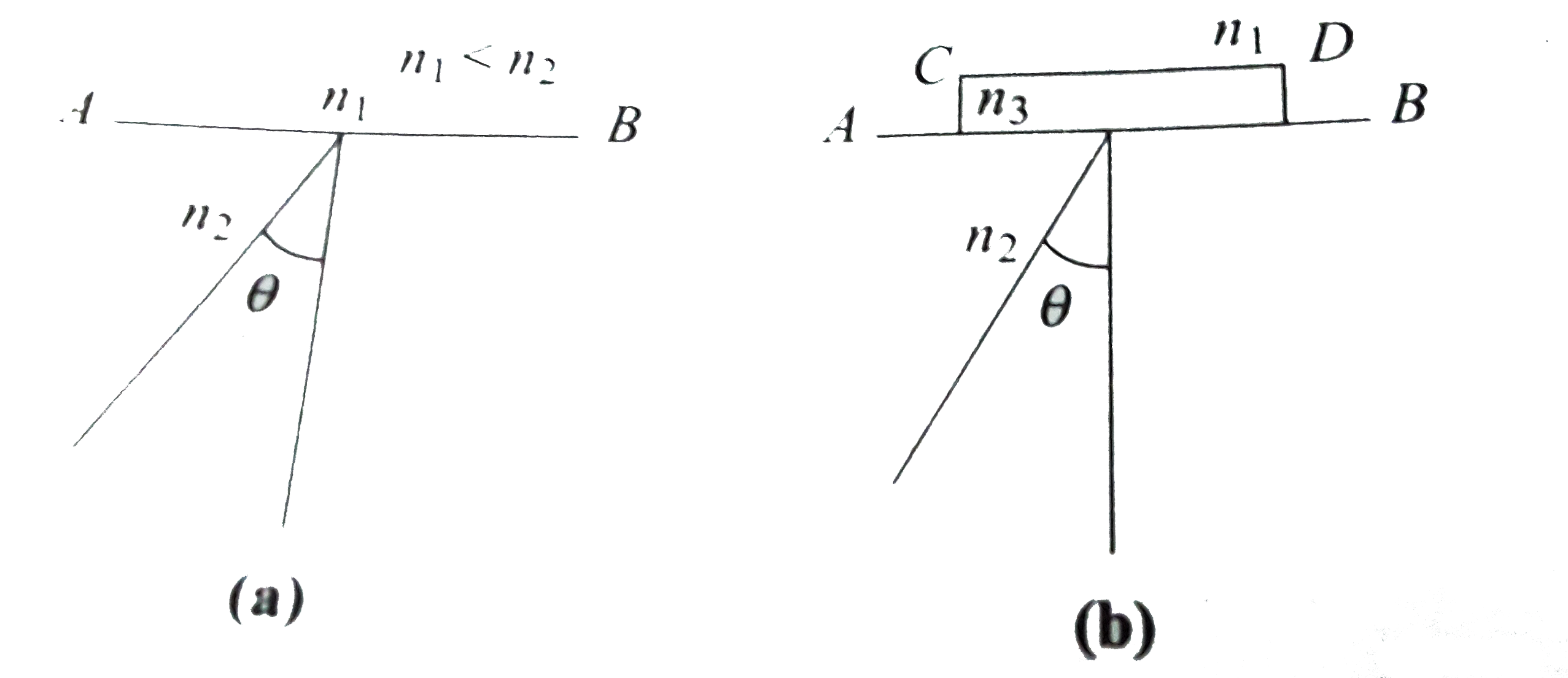
In Figure, light is incident at an angle `theta` which is slightly greater than the critical angle. Now, keeping the incident angle fixed a parallel slab or refractive index `n_(3)` is placed on surface AB. Which of the following statements are correct?

A

Total internal reflection occurs at AB for `n_(3) lt n_(1)`

B

Total internal reflection occurs at AB for `n_(3) gt n_(1)`

C

The ray will returen back to the same medium for all values of `n_(3)`

D

Total internal reflection occurs at CD for `n_(3) lt n_(1)`

Text Solution

Verified by Experts

The correct Answer is:

a, c.

(a) `rarr n_(3) lt n_(1)` so critical angle decreases. Therefore, TIR will take place at AB.
(b) `rarr n_(3) gt n_(1)`, so critical angle increases. Therefore, TIR will not take place.
(c) `rarr n_(3) gt n_(2)`, then TIR will take place CD and if `n_(3) gt n_(1)` , then TIR will take place at AB.
(d) `rarr` TIR will not take place at face CD for `n_(3) lt n_(1)` because ray is going from rarer to denser medium.
Promotional Banner

Topper's Solved these Questions

  • GEOMETRICAL OPTICS

    CENGAGE PHYSICS ENGLISH|Exercise Assertion-Reasoninig|2 Videos
  • GEOMETRICAL OPTICS

    CENGAGE PHYSICS ENGLISH|Exercise Linked Comprehension|51 Videos
  • GEOMETRICAL OPTICS

    CENGAGE PHYSICS ENGLISH|Exercise Subjective|26 Videos
  • ELECTRON,PHONTS,PHOTOELECTRIC EFFECT & X-RAYS

    CENGAGE PHYSICS ENGLISH|Exercise dpp 3.3|15 Videos
  • HEATING EFFECT OF CURRENT

    CENGAGE PHYSICS ENGLISH|Exercise Thermal Power in Resistance Connected in Circuit|27 Videos

Similar Questions

Explore conceptually related problems

A green light is incident from the water to the air - water interface at the critical angle (theta) . Select the correct statement.

Light is incident on a glass surface at polarising angle of 57.5^(@) Then the angle between the incident ray and the refracted ray is

A ray OP of monochromatic light is incident on the face AB of prism ABCD mear vertex B at an incident angle of 60degree (see figure). If the refractive index of the material of the prism is sqrt3 , which of the following is (are) are correct?

In the diagram shown, light is incident on the interface between media 1 (refractive index n_(1) ) and 2 (refractive index n_(2) ) at angle slightly greater than the critical angle, and is totally reflected. The light is then also totally reflected at the interface between media 1 and 3 (refractive index n_(3) ), after which it travels in a direction opposite to its initial direction, The media must have a refractive indices such that. .

Unpolarised light is incident from air on a plane surface of a material of refractive index mu . At a particular angle of incidence i , it is found that the reflected and refracted rays are perpendicular to each other. Which of the following options is correct for this situation?

Unpolarised light is incident from air on a plane surface of a material of refractive index .mu. . At a particular angle of incidence .I., it is found that the reflected and refracted rays are perpendicular to each other. Which of the following options is correct for this situation?

A ray of light travelling in water is incident on its surface open to air. The angle of incidence is theta , which is less than the critical angle. Then there will be

A ray of light is incident on the surface of a glass plate of refractive index sqrt(3) at the polarising angle . The angle of incidence and angle of refraction of the ray is

A ray of light incident at an angle theta on a refracting face of a prism emerges from the other face normally. If the angle of the prism is 5^@ and the prism is made of a material of refractive index 1.5 , the angle of incidence is.

A ray of light incident at an angle theta on a refracting face of a prism emerges from the other face normally. If the angle of the prism is 5^@ and the prism is made of a material of refractive index 1.5 , the angle of incidence is.

CENGAGE PHYSICS ENGLISH-GEOMETRICAL OPTICS-Single Correct
  1. Shown an object and its image formed by a thin lens. Then the nature a...

    Text Solution

    |

  2. Figure shows an object located at point P, 0.25 meter from concave sph...

    Text Solution

    |

  3. In Figure, light is incident at an angle theta which is slightly great...

    Text Solution

    |

  4. Figure, a light ray is incident on the lower medium boundary at an ang...

    Text Solution

    |

  5. In displacement method, the distance between object and screen is 96cm...

    Text Solution

    |

  6. The distance between an electric lamp and a screen is d=1m. A converge...

    Text Solution

    |

  7. A lense of focal length f is placed in between an object and screen at...

    Text Solution

    |

  8. An image of a bright square is obtained on a screen with the aid of a ...

    Text Solution

    |

  9. Consider the rays shown in figure, as paraxial. The image of the virtu...

    Text Solution

    |

  10. A glass prism is immersed in a hypothetical liquid. The curves showing...

    Text Solution

    |

  11. An object AB is placed parallel and close to the optical axis between ...

    Text Solution

    |

  12. Which of the following statement is // are correct about the refracti...

    Text Solution

    |

  13. A luminous point object is placed at O, whose image is formed at I as ...

    Text Solution

    |

  14. Mark the correct statement(s) w.r.t. a concave spherical mirror.

    Text Solution

    |

  15. Mark the correct statement(s) from the following:

    Text Solution

    |

  16. When a real object is placed 25cm from a lens, a real image if formed....

    Text Solution

    |

  17. Two converging lenses of focal lengths f(1)=10cm and f(2)=20cm are pla...

    Text Solution

    |

  18. A real object is moving toward a fixed spherical mirror. The image

    Text Solution

    |

  19. A real point source is 5cm away from a plane mirror whose reflectinig ...

    Text Solution

    |

  20. A plane mirror M is arranged parallel to a wall W at a distance l from...

    Text Solution

    |
