Home
Class 12
PHYSICS
A plane mirror M is arranged parallel to...

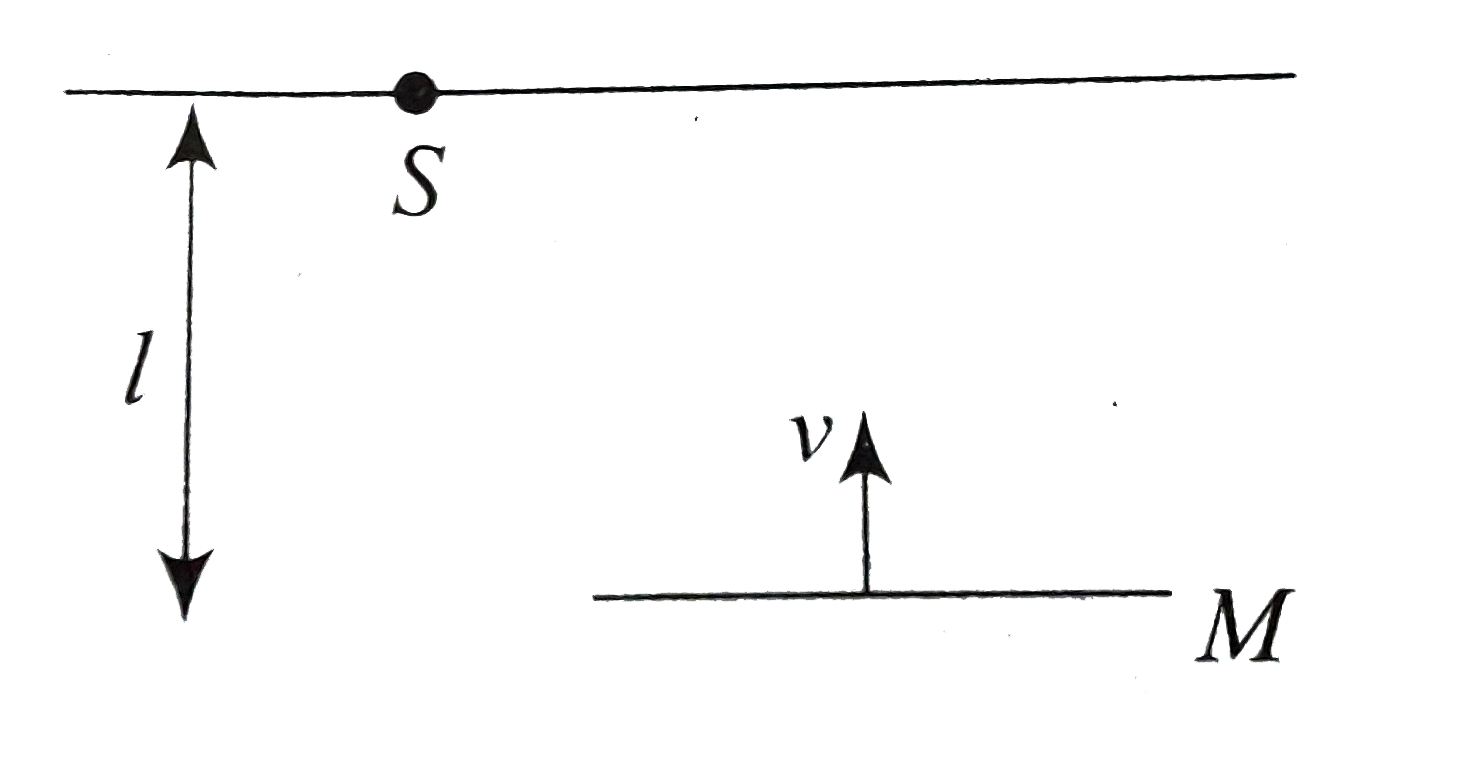
A plane mirror M is arranged parallel to a wall W at a distance l from it. The light produced by a point source S kept on the wall is reflected by the mirror and produces a patch of light on the wall. The mirroo moves with velocity v towards the wall.
Which of the following statement(s) is`//`are correct?

A

The patch of light will move with speed v on the wall

B

The patch of light will not move on the wall

C

As the mirror comes closer, the patch of light will become larger and shift away from the wall with speed larger than v

D

The size of the patch of light on the wall remains the same

Text Solution

Verified by Experts

The correct Answer is:
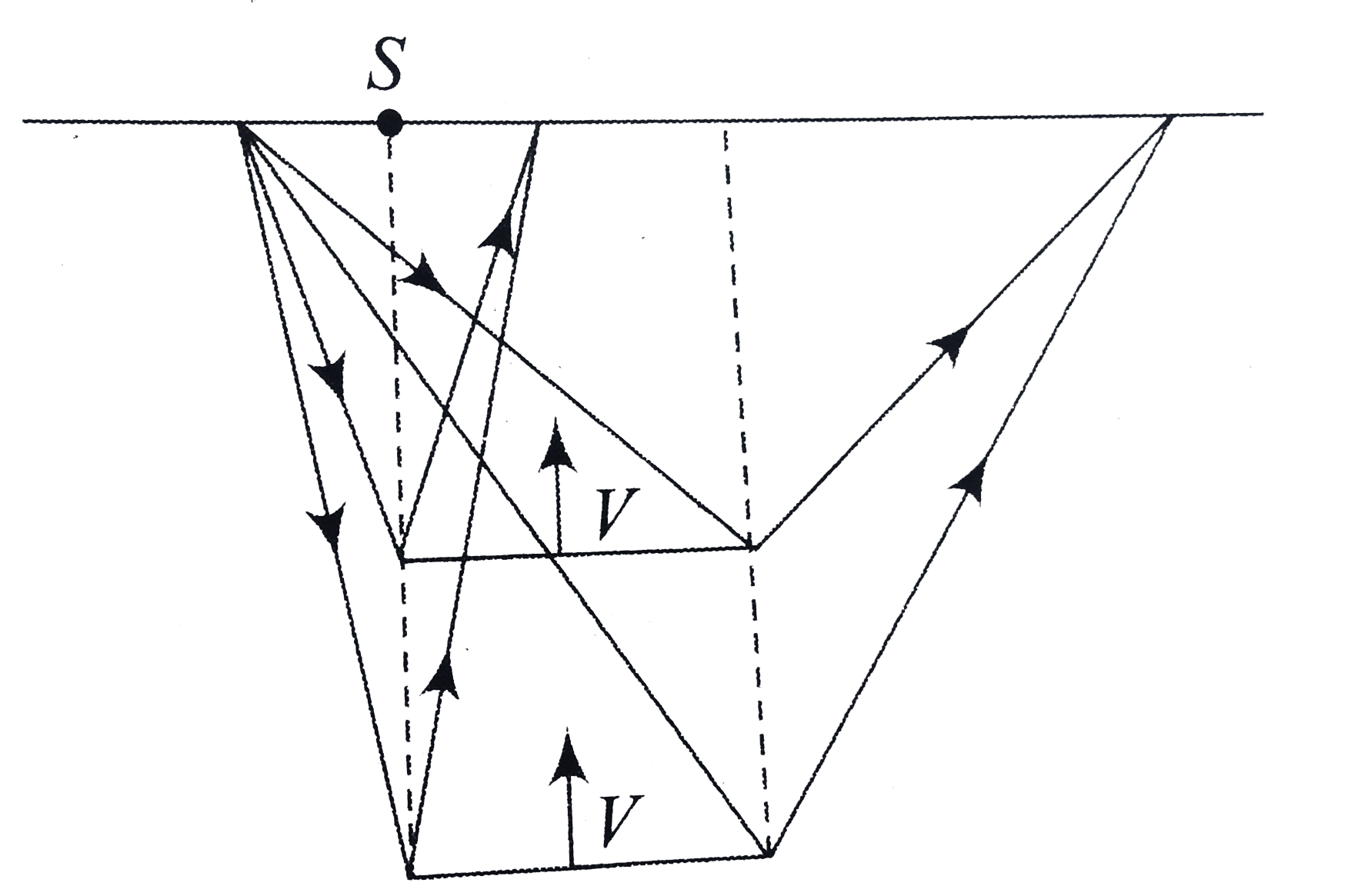
b.,d.

From the above ray diagram, it is clear that the option (b) and (d) are correct.
Promotional Banner

Topper's Solved these Questions

  • GEOMETRICAL OPTICS

    CENGAGE PHYSICS ENGLISH|Exercise Assertion-Reasoninig|2 Videos
  • GEOMETRICAL OPTICS

    CENGAGE PHYSICS ENGLISH|Exercise Linked Comprehension|51 Videos
  • GEOMETRICAL OPTICS

    CENGAGE PHYSICS ENGLISH|Exercise Subjective|26 Videos
  • ELECTRON,PHONTS,PHOTOELECTRIC EFFECT & X-RAYS

    CENGAGE PHYSICS ENGLISH|Exercise dpp 3.3|15 Videos
  • HEATING EFFECT OF CURRENT

    CENGAGE PHYSICS ENGLISH|Exercise Thermal Power in Resistance Connected in Circuit|27 Videos

Similar Questions

Explore conceptually related problems

Figure shows a torch sending a parallel beam of light fixed on a wall and a plane mirror which forms a spot on the wall. As the mirror moves towards the wall, the spot on the wall moves

A point source of light S is placed in front of two large mirrors as shown. Which of the following observes will see only one image of S?

In a dark room, a parallel beam of light falls on a plane mirror and another parallel beam of light falls on a white wall. The light reflected by the mirror can be seen only in a certain direction, but the reflected light from the wall can be seen from anywhere. Give reason.

On a particle moving on a circular path with constant speed v , light is thrown from a projectors placed at the centre of the circular path. The shadow of the particle is formed on the wall. The velocity of shadow up the wall is

A point source of light S is placed on the major optical axis of the concave mirror at a distance of 60 cm. At what distance from the concave mirror should a flat mirror be placed for the rays to converge again at the point S having been reflected from the concave mirror and then from the flat one? Will the position of the point where the rays meet change if they are first reflected from the flat mirror? The radius of the concave mirror is 80 cm.

A mirror and a source of light are situated at the origin O and at a point on O X , respectively. A ray of light from the source strikes the mirror and is reflected. If the direction ratios of the normal to the plane are 1,-1,1, then find the D C s of the reflected ray.

A light ray I is incident on a plane mirror M .The mirror is rotated in the direction as shown in the figure by an arrow at frequency (9)/(pi) "rev"//"sec" ,The light reflected by the mirror is received on the wall W at a distance 10m from the axis of rotation .When the angle of incidence becomes 37^(@) find the speed of the spot (a point) on the wall?

A particle of mass m moving at a velocity v strikes with the wall at an angle alpha with the wall and leaves ball making same angle with the wall. Choose the correct statemet (s) from the following.

Spotlight S rotates in a horizontal plane with constant angular velocity of 0.1 rad/s The spot of light P moves along the wall at a distance of 3 m The velocity of the spot P when θ = 45 is m/s (see - fig. ) is ……….. m//s

There is a source of sound (a tuning fork) moving towards a reflecting wall will a speed of 30 ms^(-1) . The velocity of the sound in air is 330 ms^(-1) and the frequency of the tuning fork is 600 Hz. The observer is between the source and the wall and is moving with some velocity V_(1) towards the wall. The beat frequency heard by the observer is 4 Hz. If the tuning fork is waxed, the frequency beats heard by the observer becomes 3 Hz. If the new frequency of tuning fork is k then k//50 is

CENGAGE PHYSICS ENGLISH-GEOMETRICAL OPTICS-Single Correct
  1. A real object is moving toward a fixed spherical mirror. The image

    Text Solution

    |

  2. A real point source is 5cm away from a plane mirror whose reflectinig ...

    Text Solution

    |

  3. A plane mirror M is arranged parallel to a wall W at a distance l from...

    Text Solution

    |

  4. A thin, symmetric double convex lens of power P is cut into three part...

    Text Solution

    |

  5. A diverging lens of focal length f(1) is placed in front of and coaxia...

    Text Solution

    |

  6. A converging lens of focal length f(1) is placed in front of and coaxi...

    Text Solution

    |

  7. Which of the following statements are correct?

    Text Solution

    |

  8. A fish F, in the pond is at a depth of 0.8m from the water surface and...

    Text Solution

    |

  9. In the previous question,

    Text Solution

    |

  10. Figure, shows variation of magnification m (produced by a thin convex ...

    Text Solution

    |

  11. An object is placed in front of a converging lens at a distance equal ...

    Text Solution

    |

  12. Converging rays strike a spherical convex mirror such that they can fo...

    Text Solution

    |

  13. In the above question, if the rays were to converge between F and C of...

    Text Solution

    |

  14. In the above question, if the rays were to converge beyond C, then fin...

    Text Solution

    |

  15. A concave mirror forms an image of the sun at a distance of 12 cm from...

    Text Solution

    |

  16. A real object is placed infront of a convex mirror (focal length f). I...

    Text Solution

    |

  17. An object is moving towards a convex mirror with a constant velocity. ...

    Text Solution

    |

  18. A person is looking at the flat surface of a transparent hemisphere of...

    Text Solution

    |

  19. Refractive index of an equilateral prism is sqrt(2)

    Text Solution

    |

  20. A convex lens made of glass (mu(0) = 3//2) hs focal length f in air. T...

    Text Solution

    |

