Home
Class 12
PHYSICS
A thin, symmetric double convex lens of ...

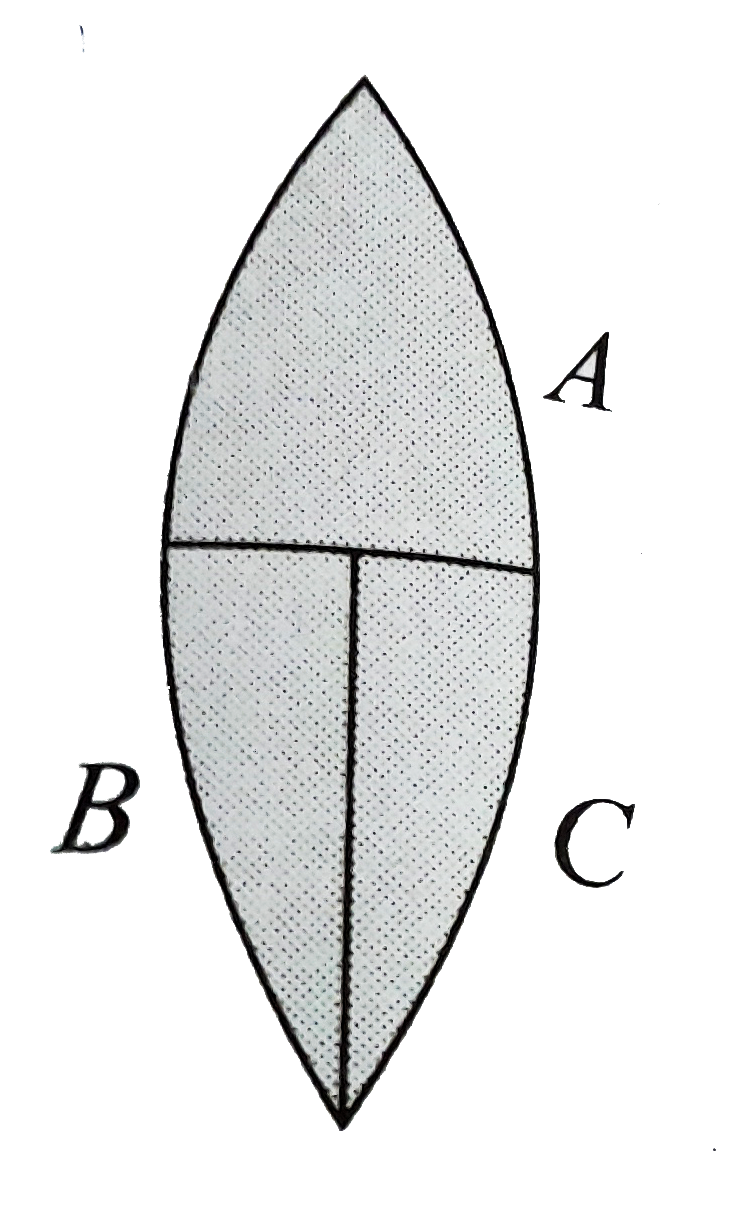
A thin, symmetric double convex lens of power P is cut into three parts A, B, and C as shown in Figure. The power of

A

A is P

B

A is 2P

C

B is `P//2`

D

C is `P//4`

Text Solution

Verified by Experts

The correct Answer is:

a.,c.

In case of part A, radii of the two surfaces will remain same. Hence, focal length of part A will be same as that of complete lens, i.e., power of part A will remain unchanged, i.e., power of A is P.
In case of part B, radius of one surface will remain same while that of other plane surface will be `oo` . Hence, focal length of part B will be double that of whole lens,i.e., power of part B is `P//2`
Promotional Banner

Topper's Solved these Questions

  • GEOMETRICAL OPTICS

    CENGAGE PHYSICS ENGLISH|Exercise Assertion-Reasoninig|2 Videos
  • GEOMETRICAL OPTICS

    CENGAGE PHYSICS ENGLISH|Exercise Linked Comprehension|51 Videos
  • GEOMETRICAL OPTICS

    CENGAGE PHYSICS ENGLISH|Exercise Subjective|26 Videos
  • ELECTRON,PHONTS,PHOTOELECTRIC EFFECT & X-RAYS

    CENGAGE PHYSICS ENGLISH|Exercise dpp 3.3|15 Videos
  • HEATING EFFECT OF CURRENT

    CENGAGE PHYSICS ENGLISH|Exercise Thermal Power in Resistance Connected in Circuit|27 Videos

Similar Questions

Explore conceptually related problems

A thin symmetrical double convex lens of power P is cut into three parts, as shown in the figure. Power of A is

A symmetric double convex lens is cut in two equal parts by a plane perpendiculr to the pricipal axis. If the power of the original lens was 4D, the power of a cut lens will be a.2D b.3D c.4D d.5D

A symmetric double convex lens is cut in two equal parts by a plane perpendicular to the principal axis. If the power of the original lens was 4D, the power of a cut lens will be

In the circuit shown in figure, the power consumed is .

A thin double convex lens is cut into two equal pieces A and B by a plane containing principal axis. The piece B is further cut into two more pieces pieces C and D by another plane perpendicular to the principal axis. If the focal power of the original lens is P, then thos of A and C are

The power dissipated in the circuit shown in the figure is 30 W. The value of R is

A convex lens of power +2.5 D is in contact with a concave lens of focal length 25 cm. The power of combination is

A thin convex lens of focal length 'f' is put on a plane mirror as shown in the figure . When an object is kept at a distance 'a' from the lens - mirror combination , its image is formed at a distance (a)/(3) in front of the combination . The value of 'a' is :-

An unsymmeterical double convex thin lens forms the image of a point object on its axis. Will the position of the image change if the lens is reversed ?

The power factor of the circuit as shown in figure is

CENGAGE PHYSICS ENGLISH-GEOMETRICAL OPTICS-Single Correct
  1. A real point source is 5cm away from a plane mirror whose reflectinig ...

    Text Solution

    |

  2. A plane mirror M is arranged parallel to a wall W at a distance l from...

    Text Solution

    |

  3. A thin, symmetric double convex lens of power P is cut into three part...

    Text Solution

    |

  4. A diverging lens of focal length f(1) is placed in front of and coaxia...

    Text Solution

    |

  5. A converging lens of focal length f(1) is placed in front of and coaxi...

    Text Solution

    |

  6. Which of the following statements are correct?

    Text Solution

    |

  7. A fish F, in the pond is at a depth of 0.8m from the water surface and...

    Text Solution

    |

  8. In the previous question,

    Text Solution

    |

  9. Figure, shows variation of magnification m (produced by a thin convex ...

    Text Solution

    |

  10. An object is placed in front of a converging lens at a distance equal ...

    Text Solution

    |

  11. Converging rays strike a spherical convex mirror such that they can fo...

    Text Solution

    |

  12. In the above question, if the rays were to converge between F and C of...

    Text Solution

    |

  13. In the above question, if the rays were to converge beyond C, then fin...

    Text Solution

    |

  14. A concave mirror forms an image of the sun at a distance of 12 cm from...

    Text Solution

    |

  15. A real object is placed infront of a convex mirror (focal length f). I...

    Text Solution

    |

  16. An object is moving towards a convex mirror with a constant velocity. ...

    Text Solution

    |

  17. A person is looking at the flat surface of a transparent hemisphere of...

    Text Solution

    |

  18. Refractive index of an equilateral prism is sqrt(2)

    Text Solution

    |

  19. A convex lens made of glass (mu(0) = 3//2) hs focal length f in air. T...

    Text Solution

    |

  20. In the situation as shown in Figure, (cos53^(@)=(3)/(5))

    Text Solution

    |
