Home
Class 12
PHYSICS
A person is looking at the flat surface ...

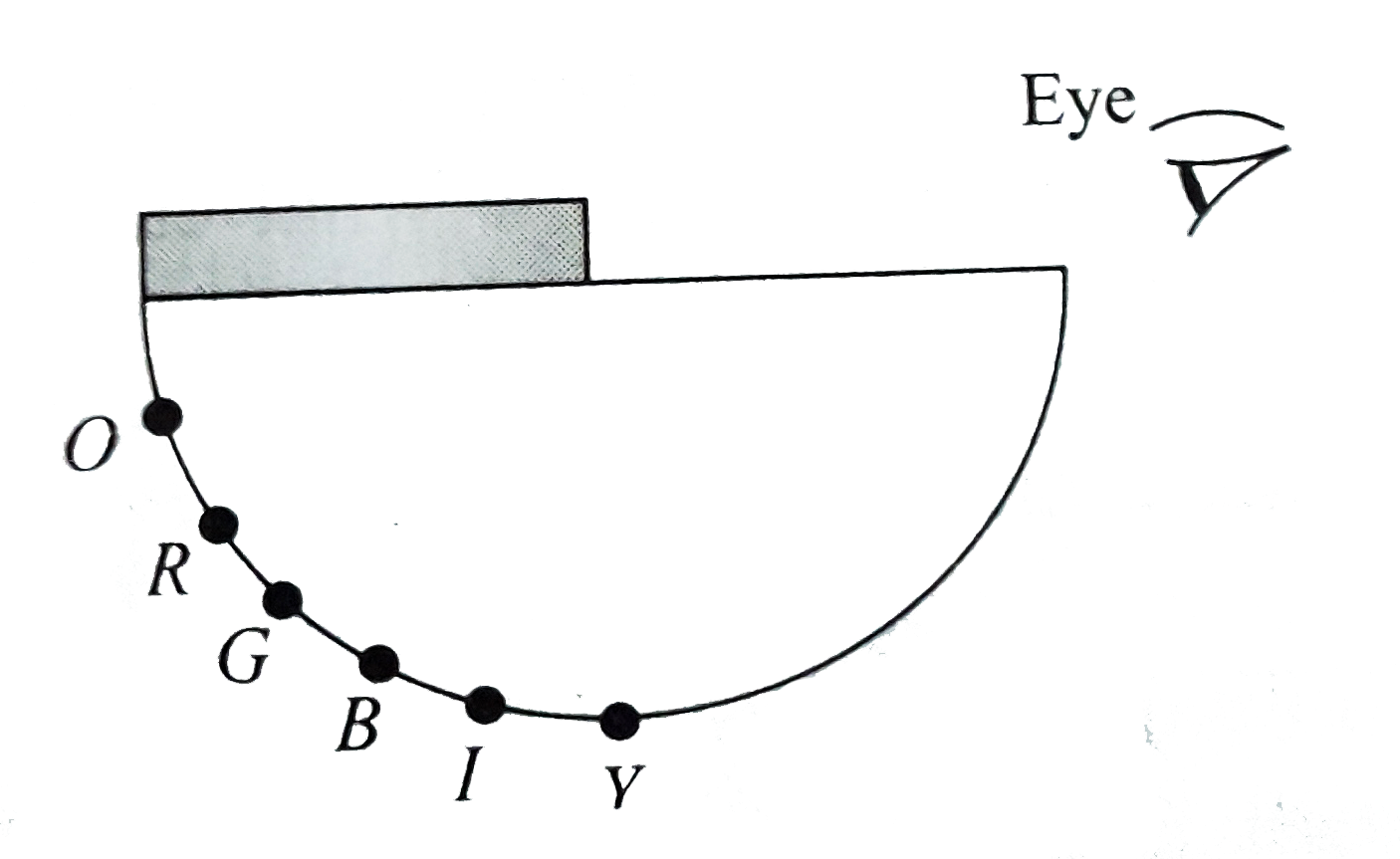
A person is looking at the flat surface of a transparent hemisphere of refractive index `mu=sqrt(2)` . Half of the flat surface is coloured black and half of curved surface is coloured in six equally spaced strips as shown in Figure. Then

A

the person can see green, orange and red

B

the person can see only yellow, indigo and blue

C

the ray coming from red and organge strips will be totally reflected

D

the ray coming from yellow, indigo and blue stips will be totally reflected

Text Solution

Verified by Experts

The correct Answer is:
b.,c.

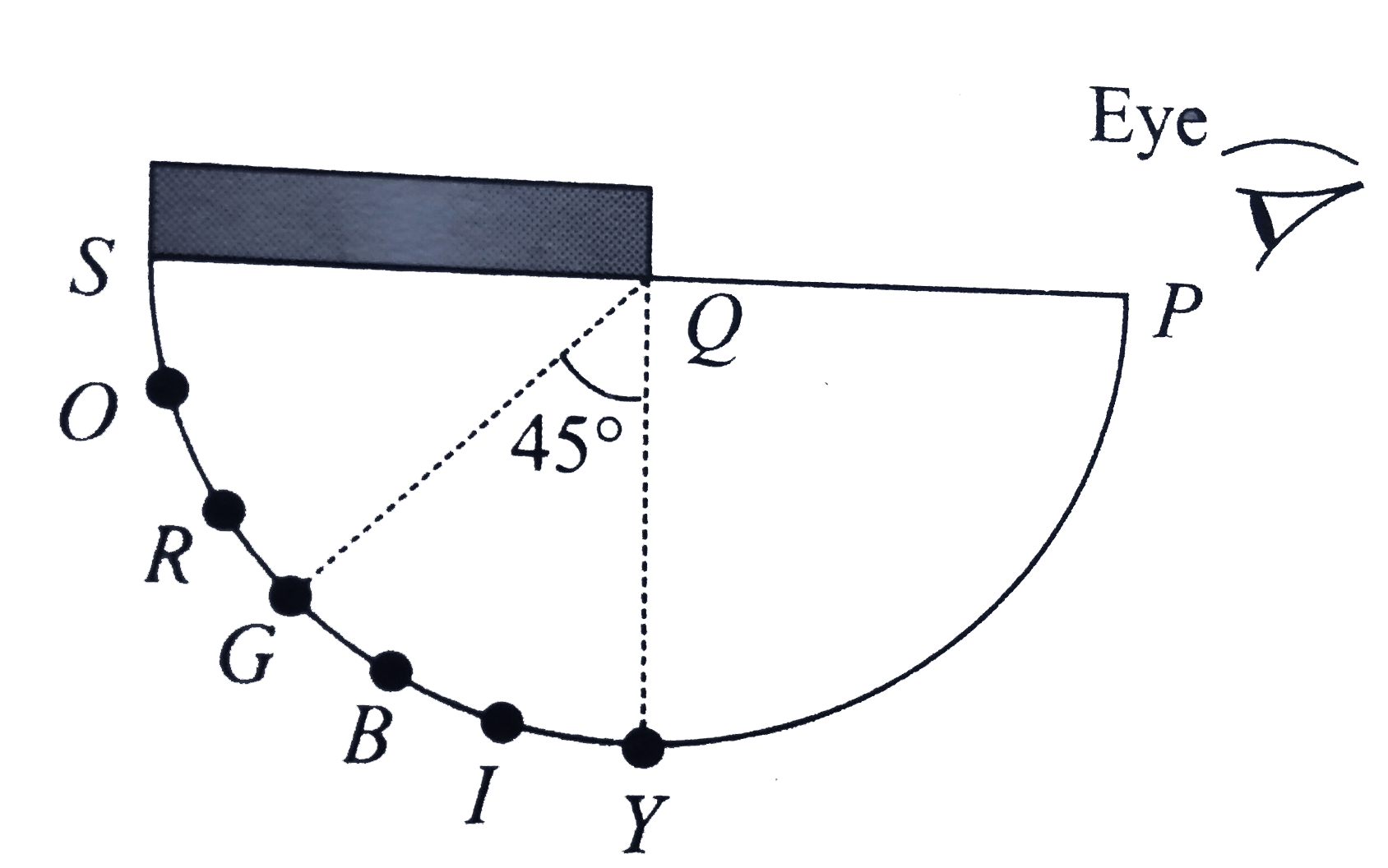
Let C be the critical angle: ` sinC=(1)/(mu)=(1)/(sqrt(2))`
`C=45^(@)`
For Y,I and B, angle of incidence at a point on QP can be less than C, so they will be refracted from QP and can be seen by person
But for G,R and O, angle of incidence at a point on QP will be more than C. Hence, they will be internally reflected.
Promotional Banner

Topper's Solved these Questions

  • GEOMETRICAL OPTICS

    CENGAGE PHYSICS ENGLISH|Exercise Assertion-Reasoninig|2 Videos
  • GEOMETRICAL OPTICS

    CENGAGE PHYSICS ENGLISH|Exercise Linked Comprehension|51 Videos
  • GEOMETRICAL OPTICS

    CENGAGE PHYSICS ENGLISH|Exercise Subjective|26 Videos
  • ELECTRON,PHONTS,PHOTOELECTRIC EFFECT & X-RAYS

    CENGAGE PHYSICS ENGLISH|Exercise dpp 3.3|15 Videos
  • HEATING EFFECT OF CURRENT

    CENGAGE PHYSICS ENGLISH|Exercise Thermal Power in Resistance Connected in Circuit|27 Videos

Similar Questions

Explore conceptually related problems

Consider a transparent homogenous hemisphere of refractive index n=2 in front of which a small object is placed in air as shown in figure.

A parallel narrow beam of light is incident on the surface of a transparent hemisphere of radius R and refractive index mu=1.5 as shown. The position of the image formed by refraction at the image formed by refraction at the spherical surface only as

A ray of light is incident on the surface of a sphere of refractive index sqrt(7)/(2) other half of sphere is silvered. After refraction it is reflected and then refracted out of sphere again such that the total deviation is minimum then total deviation of the ray will be (sin41_(0)-sqrt((3)/(7)))

Find the distance of object placed in the slab of refractive index mu from point P of the curved surface of radius R so that image is formed at infinity:

A ray of light is incident on the surface of a transparent sphere of R.I. mu = (sqrt(7))/(2) . After refraction is is internally reflected and refracted out of the sphere as shown in the figure. Find the angle of incidence 'I' so that the total deviation produced is minimum. 'C' is the centre of the sphere. .

A right angled triangular prism of refractive index mu_(1) is kept floating on a liquid (surface) having refractive index mu_(2) . The condition such tat light incident normally passes through base of prism as shown in figure.

Light ray is incident on a prism of angle A=60^(@) are refractive index mu=sqrt(2) . The angle of incidence which the emergent rays grazes the surface is given

Two transparent media of refractive indices mu_(1) and mu_(3) have a solid lens shaped transparent material of refractive index mu_(2) between them as shown in figures in Column II . A ray traversing these media is also shown in the figures . In Column I different relationships between mu_(1) , mu_(2) "and" mu_(3) are given . Match them to the ray diagrams shown in Column II .

A hollow sphere made of a transparent material of refractive index 1.5 has a small mark on its surface as shown. The mark is observed from the farther side. Find the distance of the image of mark from the centre of the sphere.

A parallel beam of light is incident normally on the flat surface of a hemisphere of radius 6 cm and refractive index 1.5 , placed in air as shown in figure (i). Assume paraxial ray approxiamtion. .

CENGAGE PHYSICS ENGLISH-GEOMETRICAL OPTICS-Single Correct
  1. A concave mirror forms an image of the sun at a distance of 12 cm from...

    Text Solution

    |

  2. A real object is placed infront of a convex mirror (focal length f). I...

    Text Solution

    |

  3. An object is moving towards a convex mirror with a constant velocity. ...

    Text Solution

    |

  4. A person is looking at the flat surface of a transparent hemisphere of...

    Text Solution

    |

  5. Refractive index of an equilateral prism is sqrt(2)

    Text Solution

    |

  6. A convex lens made of glass (mu(0) = 3//2) hs focal length f in air. T...

    Text Solution

    |

  7. In the situation as shown in Figure, (cos53^(@)=(3)/(5))

    Text Solution

    |

  8. A plano-convex lens (f = 20 cm) is silvered at plane surface. The foca...

    Text Solution

    |

  9. For a concave mirror

    Text Solution

    |

  10. A linear object of size 1.5 cm is placed at 10 cm from a lens of focal...

    Text Solution

    |

  11. Assertion:Although the surfaces of goggle lens are curved, It does not...

    Text Solution

    |

  12. Statement I: A beam of white light enters the curved surface of a semi...

    Text Solution

    |

  13. Statement I: A ray is incident from outside on a glass sphere surround...

    Text Solution

    |

  14. Statement I: Keeping a point object fixed, if a plane mirror is moved,...

    Text Solution

    |

  15. Statement I: Lights of different colors travel with different speeds i...

    Text Solution

    |

  16. Statement I: A beam of light rays has been reflected from a rough sur...

    Text Solution

    |

  17. STATEMENT-1 A virtual image can be photographed. STATEMENT- 2 Only a...

    Text Solution

    |

  18. STATEMENT-1 The focal length of a lens does not depend on the medium i...

    Text Solution

    |

  19. STATEMENT-1 We cannot produce a real image by plane or convex mirror u...

    Text Solution

    |

  20. Statement I: A light ray is incident on a glass slab. Some portion of ...

    Text Solution

    |

