Home
Class 12
PHYSICS
The convex surface of a thin concave-con...

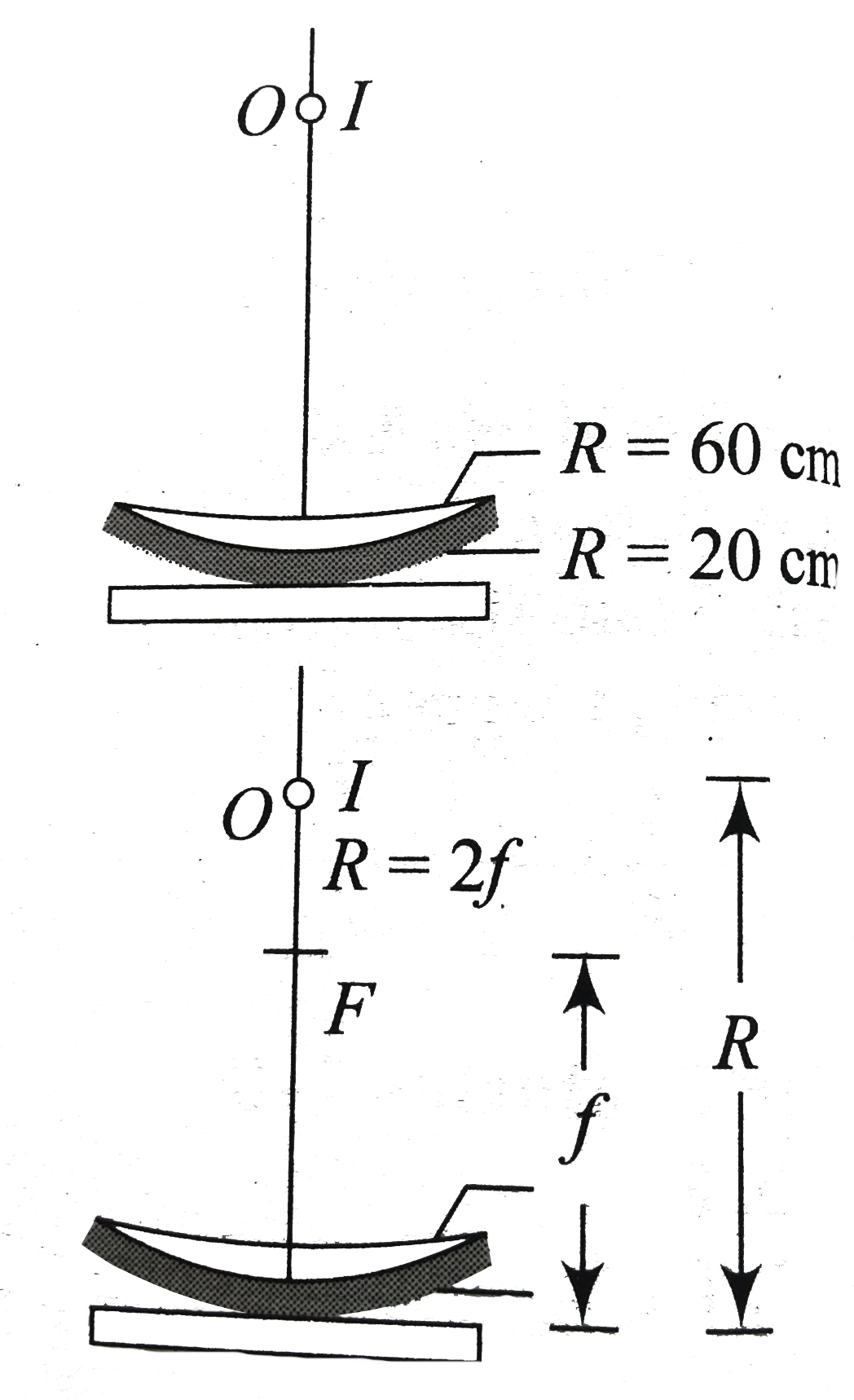
The convex surface of a thin concave-convex lens of glass of refractive index 1.5 has a radius of curvature 20 cm. The concave surface has a radius of curvature 60 cm. The convex side is silvered and placed on a horizontal surface as shown in figure. (a) Where should a pin be placed on the axis so that its image is formed at the same place ? (b) If the concave part is filled with water (mu = 4/3), find the distance through which the pin should be moved so that the image of the pin again coincides with the pin.

A

`x=5cm`

B

`x=20cm`

C

`x=15cm`

D

`x=25cm`

Text Solution

Verified by Experts

The correct Answer is:
C

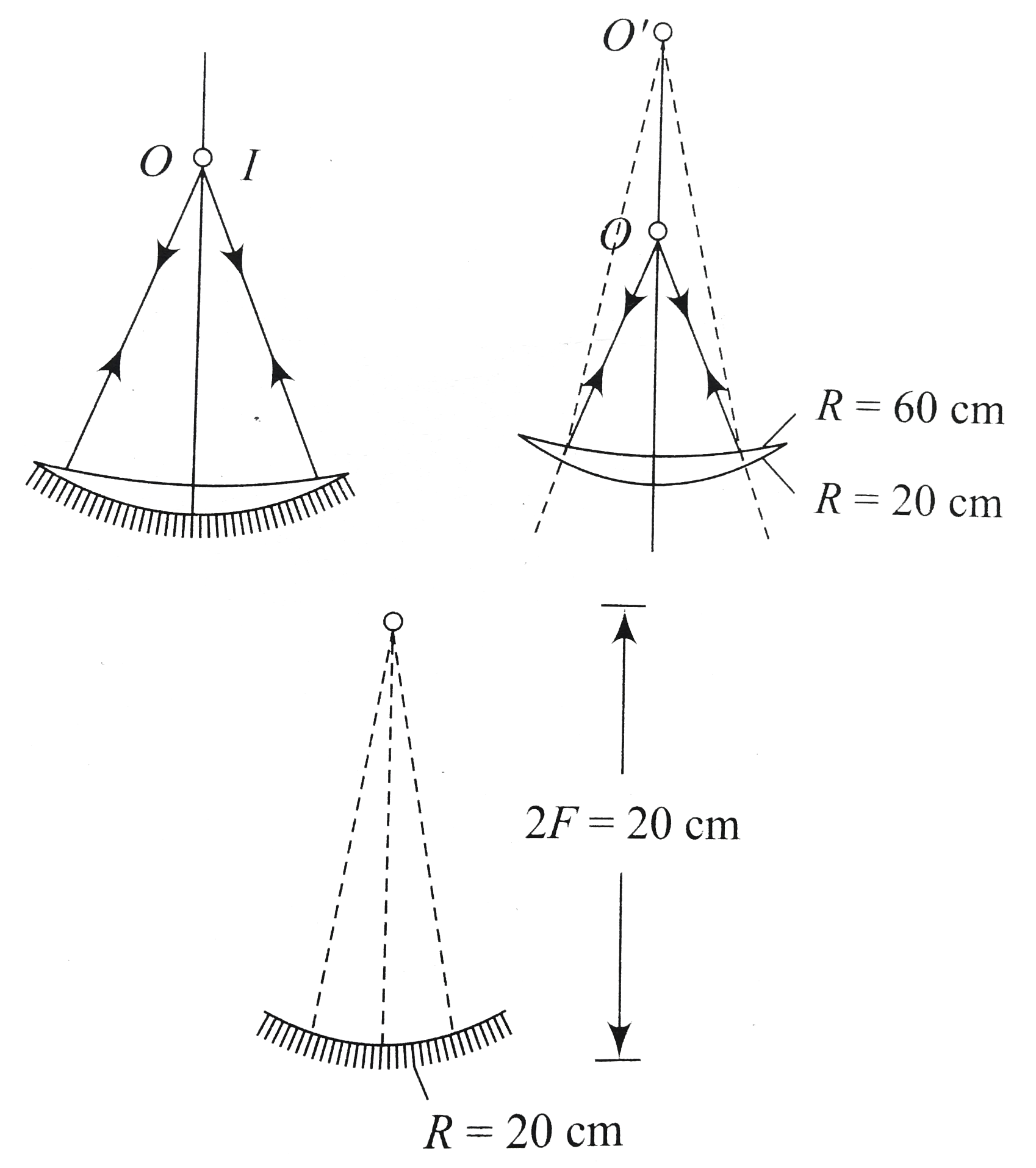
Method 1: The optical arrangement is equivalent to the concave mirror of focal length F given by
`(1)/(F)=(1)/(f_(g))+(1)/(f_(m))+(1)/(f_(g))`
where `f_(x)` is th efocal length of the lens without silvering and `f_(m)` is the focal length of the mirror.
`(1)/(f_(g))=(n-1)((1)/(R_(1))-(1)/(R_(2)))`
`=(1.5-1)((1)/(20)-(1)/(+60))=(1)/(60)`
`f_(g)=60cm`
`f_(g)=R_(1)//2=20//2=10cm`
`(1)/(F)=(1)/(60)+(1)/(10)+(1)/(60)=(8)/(60)`
`F=(60)/(8)=7.5cm`
For the image to be formed at the place of the object,
`X=R=2F=7.5xx2`
`=15cm`

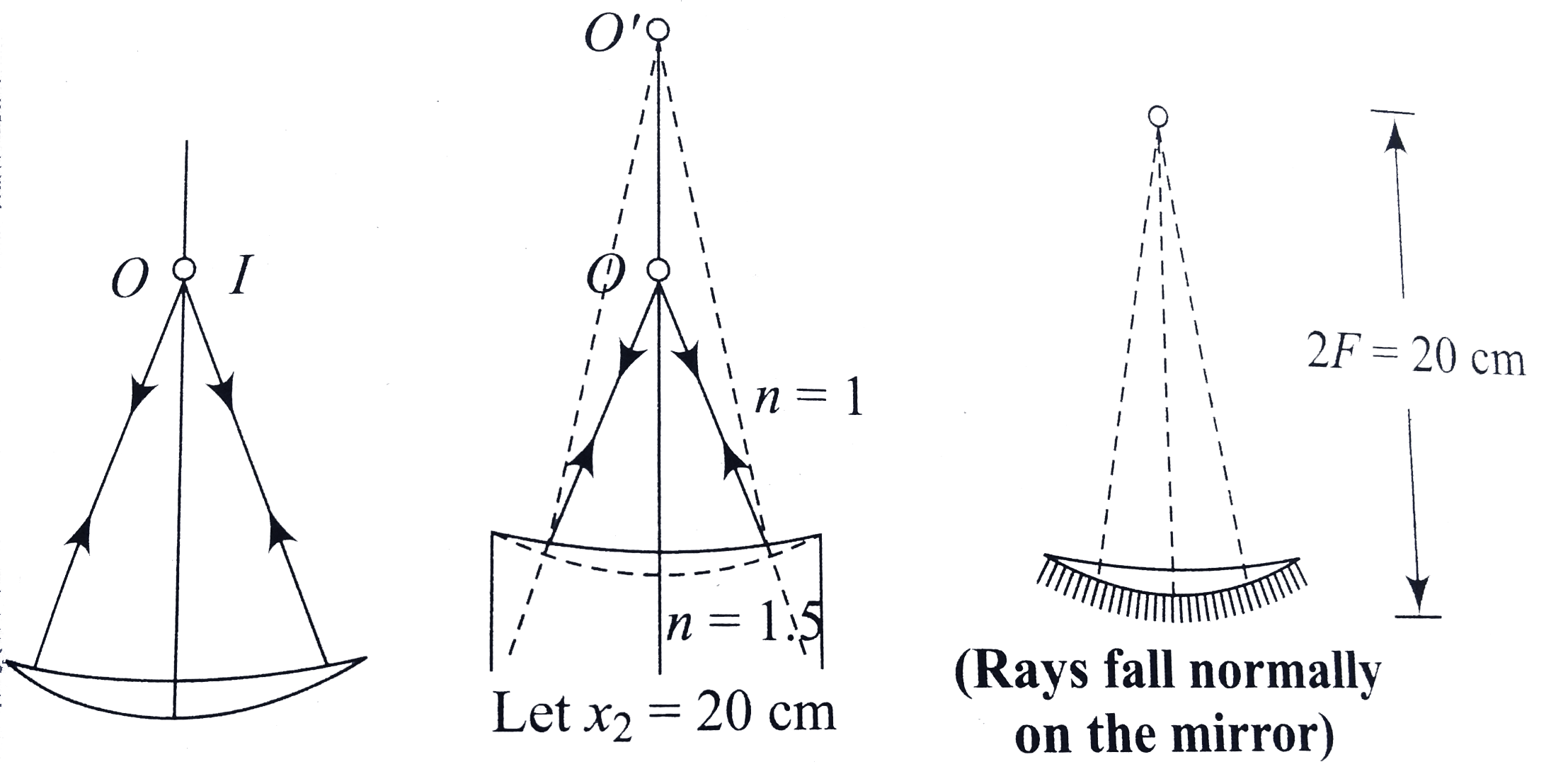
Method2: We use the relation
`(n_(2))/(x_(2))-(n_(1))/(x_(1))=(n_(2)-n_(1))/(R)`
For the object and the image to coincide, the rays fall normal on the reflecting surface. i.e., on the silvered face of the lens.
Then, the rays retrace backward and meet at the object point again (optical reversibility).
For the refraction at the upper surface of the lens,
`n_(1)=1.0, n_(2)=1.5, x_(1)=20, R=+60`
`(x_(2)=+20 ` ensures that the rays fall on the silvered face normally. )
`(1.5)/(20)-(1.0)/(x_(1))=(1.5-1.0)/(+60)`
`(1.0)/(x_(1))=(1.5)/(20)-(0.5)/(60)=(3.0)/(60)`
`x_(1)=15cm`

Method 3: We use lensmaker's formula and the equation
`(1)/(f)=(1)/(x_(2))-(1)/(x_(1))`
The given optical arrangement can be visualised as a convex lens of focal length 60cm and a concave mirror of focal length 10cm kept in contact as shown in the figure.
If the rays fall normally on the mirror after the refraction through the lens, they will retrace backward and meet at the point of the pin again.
For the lens, `x_(1)=?`
`x_(2)=+20` (for normal incidence on the mirror )
`f=-60` (using cartesian-coordinate sign convention)
`(1)/(-60)=(1)/(+20)-(1)/(x_(1))`
Promotional Banner

Topper's Solved these Questions

  • GEOMETRICAL OPTICS

    CENGAGE PHYSICS ENGLISH|Exercise Integer|15 Videos
  • GEOMETRICAL OPTICS

    CENGAGE PHYSICS ENGLISH|Exercise Archives|7 Videos
  • GEOMETRICAL OPTICS

    CENGAGE PHYSICS ENGLISH|Exercise Assertion-Reasoninig|2 Videos
  • ELECTRON,PHONTS,PHOTOELECTRIC EFFECT & X-RAYS

    CENGAGE PHYSICS ENGLISH|Exercise dpp 3.3|15 Videos
  • HEATING EFFECT OF CURRENT

    CENGAGE PHYSICS ENGLISH|Exercise Thermal Power in Resistance Connected in Circuit|27 Videos

Similar Questions

Explore conceptually related problems

A plano convex lens is made of glass of refractive index 1.5. The radius of curvature of its convex surface is R. Its focal length is

A plano-convex lens has refractive index 1.6 and radius of curvature 60 cm. What is the focal length of the lens?

The convex side of a thin concavo-convex lens of glass of refractive index 1.5 has a radius of curvature of 20cm. The concave surface has a radius of curvature of 60cm. What is the focal length of the lens? The convex side is silvered and placed on a horizontal surface. What is the effective focal length of the silvered lens? The concave part is filled with water with refractive index 1.33. What is the effective focal length of the combined glass and water lens? If the convex side is silvered what is the new effective focal length of the silvered compound lens?

The concave and convex surface of a thin concavo-convex lens of refractive index 1.5 has radius of curvature 50 cm and 10 cm respectively. The concave side is slivered then if the equivalent focal length of the silvered lends is -5x cm then find x.

A double convex lens is made of glass of refractive index 1.55 with both faces of same radius of curvature. Find the radius of curvature required, if focal length is 20 cm .

A double convex lens is made of glass of refractive index 1.55 with both faces of same radius of curvature. Find the radius of curvature required, if focal length is 20 cm .

A double convex lens is made of glass of refractive index 1.55 with both faces of same radius of curvature. Find the radius of curvature required, if focal length is 20 cm .

A concavo-convex lens is made of glass of refractive index 1.5. The radii of curvature of its two surfaces are 30 cm and 50 cm. Its focal length when placed in a liquid of refractive index 1.4 is

The radius curvature of each surface of a convex lens of refractive index 1.5 is 40 cm. Calculate its power.

The plane surface of a plano-convex lens of refracting index 1.5, is silvered. The radius of curvature of curved surface is R. Find the focal length of the mirror thus formed.

CENGAGE PHYSICS ENGLISH-GEOMETRICAL OPTICS-Linked Comprehension
  1. A point object is placed at a distance of 0.3 m from a convex lens (fo...

    Text Solution

    |

  2. A point object is placed at a distance of 0.3 m from a convex lens (fo...

    Text Solution

    |

  3. The convex surface of a thin concave-convex lens of glass of refractiv...

    Text Solution

    |

  4. The convex surface of a thin concave-convex lens of glass of refractiv...

    Text Solution

    |

  5. Two thin convex lenses of focal lengths f(1) and f(2) are separated by...

    Text Solution

    |

  6. Two thin convex lenses of focal lengths f(1) and f(2) are separated by...

    Text Solution

    |

  7. A parallel beam of light falls successively on a thin convex lens of ...

    Text Solution

    |

  8. A parallel beam of light falls successively on a thin convex lens of ...

    Text Solution

    |

  9. Two identical plano-convex lenses L(1)(mu(1)-1.4) and L(2)(mu(2)-1.5) ...

    Text Solution

    |

  10. Two identical plano-convex lenses L(1)(mu(1)-1.4) and L(2)(mu(2)-1.5) ...

    Text Solution

    |

  11. A beam of light converges towards a point O, behind a convex mirror of...

    Text Solution

    |

  12. A beam of light converges towards a point O, behind a convex mirror of...

    Text Solution

    |

  13. A ray of light enters a spherical drop of water of refractive index mu...

    Text Solution

    |

  14. A ray of light enters a spherical drop of water of refractive index mu...

    Text Solution

    |

  15. A ray of light enters a spherical drop of water of refractive index mu...

    Text Solution

    |

  16. The ciliary muscles of eye control the curvature of the lens in the ey...

    Text Solution

    |

  17. The ciliary muscles of eye control the curvature of the lens in the ey...

    Text Solution

    |

  18. The ciliary muscles of eye control the curvature of the lens in the ey...

    Text Solution

    |

  19. The ciliary muscles of eye control the curvature of the lens in the ey...

    Text Solution

    |

  20. The ciliary muscles of eye control the curvature of the lens in the ey...

    Text Solution

    |