Home
Class 12
PHYSICS
Two thin convex lenses of focal lengths ...

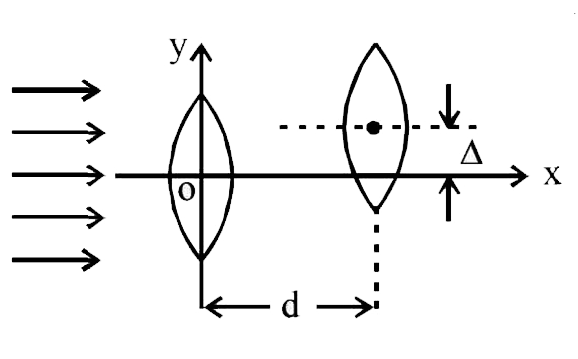
Two thin convex lenses of focal lengths `f_(1)` and `f_(2)` are separated by a horizontal distance d (where`dltf_(1)`,`dltf_(2)`) and their centres are displaced by a vertical separation `triangle` as shown in the fig.
Taking the origin of coordinates O, at the centre of the first lens the x and y coordinates of the focal point of this lens system, for a parallel beam of rays coming form the left, are given by: `

A

`((f_(1)+d)Delta)/((f_(1)+f_(2)-d))`

B

`(2(f_(1)+d))/((f_(1)+f_(2)-d))`

C

`(2(f_(1)-d)Delta)/((f_(1)+f_(2)+d))`

D

`((f_(1)-d)Delta)/((f_(1)+f_(2)-d))`

Text Solution

Verified by Experts

The correct Answer is:
c

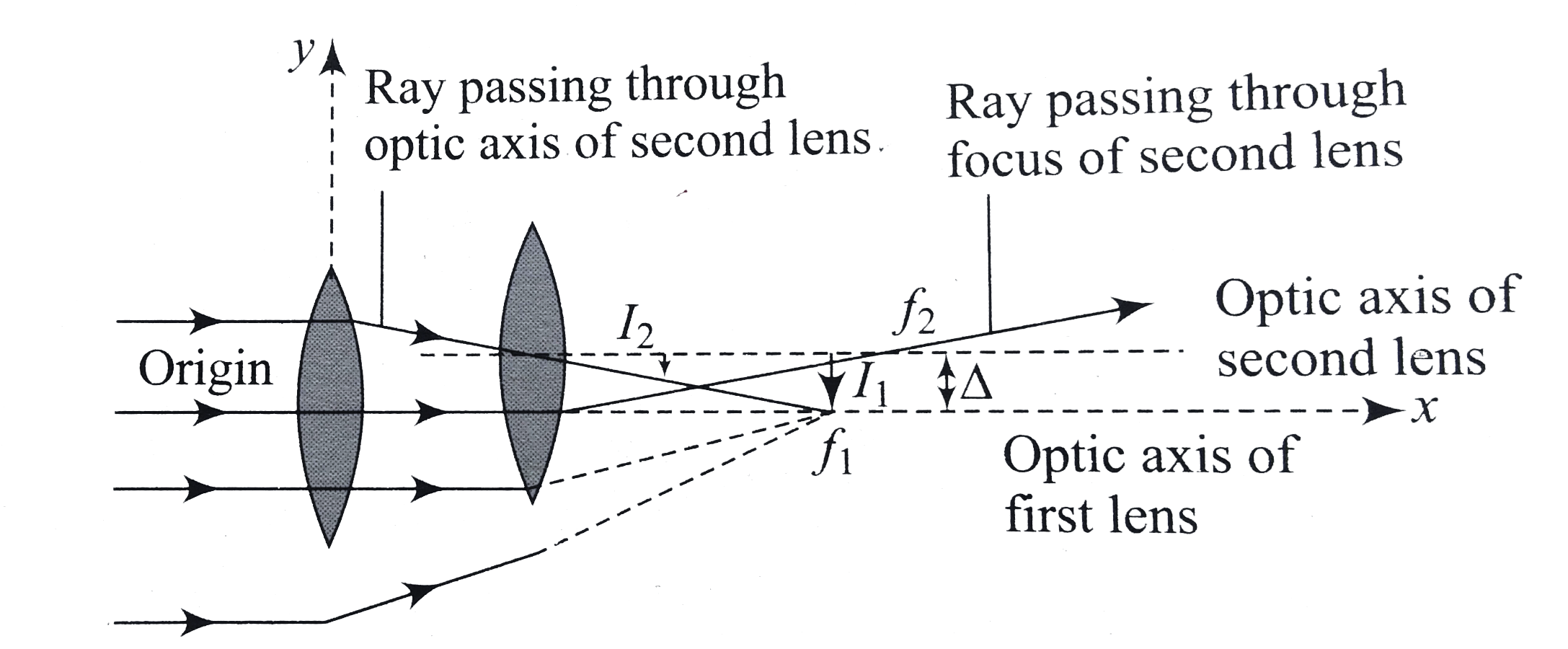
The parallel rays will be focussed at the focal point of the first lens. The first image lies at I, at a distance `f_(1)` from the origin. This image`I_(1)` will act as an object for refraction through the second lens. The object distance for the second, `u=(f_(1)-d)`.
From lens equation, `(1)/(upsilon)-(1)/(+(f_(1)-d))=(1)/(f_(2))`
`upsilon=(f_(2)(f_(1)-d))/((f_(1)+f_(2)-d))`
Hence, the x-coordinate of final image `I_(2)` is
`x=d+u=(d+f_(2)(f_(1)-d))/((f_(1)+f_(2)-d))=(d(f_(1)-d)+f_(1)f_(2))/((f_(1)+f_(2)-d))`
Imagine an arrow tip is at `f_(1):` its image from lens `f_(1)` is the final image.
Magnification, `m+(upsilon)/(u)=(I_(2))/(O)=(I_(2))/(Delta)`
`I_(2)=((upsilon)/(u))Delta=(f_(2))/((f_(1)+f_(2)-d))Delta`
Thus, y-coordinate of tip of `I_(2)` is
`Delta-I_(2)=Delta[1-(f_(1))/((f_(1)+f_(2)-d))]=((f_(1)-d)Delta)/((f_(1)+f_(2)-d))`
Promotional Banner

Topper's Solved these Questions

  • GEOMETRICAL OPTICS

    CENGAGE PHYSICS ENGLISH|Exercise Integer|15 Videos
  • GEOMETRICAL OPTICS

    CENGAGE PHYSICS ENGLISH|Exercise Archives|7 Videos
  • GEOMETRICAL OPTICS

    CENGAGE PHYSICS ENGLISH|Exercise Assertion-Reasoninig|2 Videos
  • ELECTRON,PHONTS,PHOTOELECTRIC EFFECT & X-RAYS

    CENGAGE PHYSICS ENGLISH|Exercise dpp 3.3|15 Videos
  • HEATING EFFECT OF CURRENT

    CENGAGE PHYSICS ENGLISH|Exercise Thermal Power in Resistance Connected in Circuit|27 Videos

Similar Questions

Explore conceptually related problems

Two thin lenses of focal lengths f_(1) and f_(2) are in contact. The focal length of this combination is

Two thin lenses of focal length f_(1) and f_(2) are in contact and coaxial. The power of the combination is

Find the focal length of the lens shown in Fig.

Two converging lenses of focal lengths f_(1)=10cm and f_(2)=20cm are placed at some separation. A parallel beam of light is incident on first lens. Then,

Find the focal length of the lens shown in the Fig..

Two converging lenses of the same focal length f are separated by a distance 2f. The axis of the second lens is inclined at angle theta=60^@ with respect to the axis of the first lens. A parallel paraxial beam of light is incident from left side of the lens. Find the coordinates of the final image with respect to the origin of the first lens.

A convex lens of focal length f_(1) is kept in contact with a concave lens of focal length f_(2) . Find the focal length of the combination.

A convex lens of focal length f cut into parts first horizontally and then vertically. Find the focal length of part A of the lens, as shown:

A small object is placed 50 cm to the left of a thin convex lens of focal length 30 cm. A convex spherical mirror of radius of curvature 100 cm is placed to the right of the lens at a distance of 50 cm. The mirror is tilted such that the axis of the mirror is at an angle theta =30degree to the axis of the lens, as shown in the figure If the origin of the coordinate system is taken to be at the centre of the lens, the coordinates (in cm) of the point (x,y) at which the image is formed are

Calculate the focal length of the thin lens shown infigure. The pionts C_1 and C_2 denote the centres of curvature.

CENGAGE PHYSICS ENGLISH-GEOMETRICAL OPTICS-Linked Comprehension
  1. The convex surface of a thin concave-convex lens of glass of refractiv...

    Text Solution

    |

  2. The convex surface of a thin concave-convex lens of glass of refractiv...

    Text Solution

    |

  3. Two thin convex lenses of focal lengths f(1) and f(2) are separated by...

    Text Solution

    |

  4. Two thin convex lenses of focal lengths f(1) and f(2) are separated by...

    Text Solution

    |

  5. A parallel beam of light falls successively on a thin convex lens of ...

    Text Solution

    |

  6. A parallel beam of light falls successively on a thin convex lens of ...

    Text Solution

    |

  7. Two identical plano-convex lenses L(1)(mu(1)-1.4) and L(2)(mu(2)-1.5) ...

    Text Solution

    |

  8. Two identical plano-convex lenses L(1)(mu(1)-1.4) and L(2)(mu(2)-1.5) ...

    Text Solution

    |

  9. A beam of light converges towards a point O, behind a convex mirror of...

    Text Solution

    |

  10. A beam of light converges towards a point O, behind a convex mirror of...

    Text Solution

    |

  11. A ray of light enters a spherical drop of water of refractive index mu...

    Text Solution

    |

  12. A ray of light enters a spherical drop of water of refractive index mu...

    Text Solution

    |

  13. A ray of light enters a spherical drop of water of refractive index mu...

    Text Solution

    |

  14. The ciliary muscles of eye control the curvature of the lens in the ey...

    Text Solution

    |

  15. The ciliary muscles of eye control the curvature of the lens in the ey...

    Text Solution

    |

  16. The ciliary muscles of eye control the curvature of the lens in the ey...

    Text Solution

    |

  17. The ciliary muscles of eye control the curvature of the lens in the ey...

    Text Solution

    |

  18. The ciliary muscles of eye control the curvature of the lens in the ey...

    Text Solution

    |

  19. A parallel beam of light falls on a solid tranparent sphere. Q. W...

    Text Solution

    |

  20. A parallel beam of light falls on a solid tranparent sphere. Q. I...

    Text Solution

    |

