Home
Class 12
PHYSICS
A parallel beam of light falls successi...

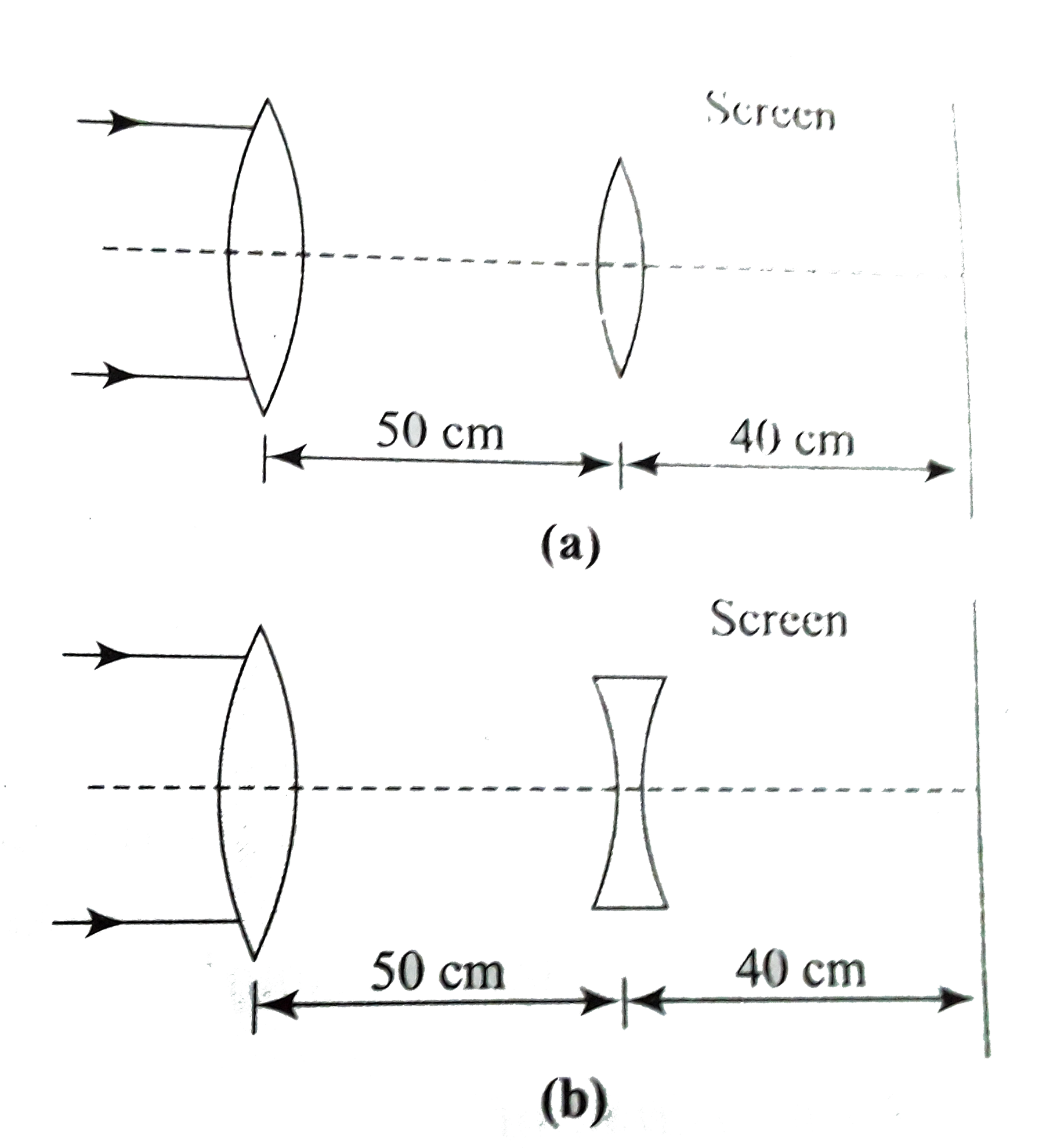
A parallel beam of light falls successively on a thin convex lens of focal length 40 cm and then ono a thini convex lens of focal length 10cm as shown in figure.
In figure, the second lens is an equiconcave lens of focal length 10cm and made of a material of refractive index 1.5. In both the cases, the second lens has an aperture equal to 1cm.

Q. Now, a liquid of refractive index `mu` is filled to the right of the second lens in case B such that the area illuminated in both the cases is the same. Determing the refractive index of the liquid.

A

1

B

2.5

C

3

D

1.5

Text Solution

Verified by Experts

The correct Answer is:
c.

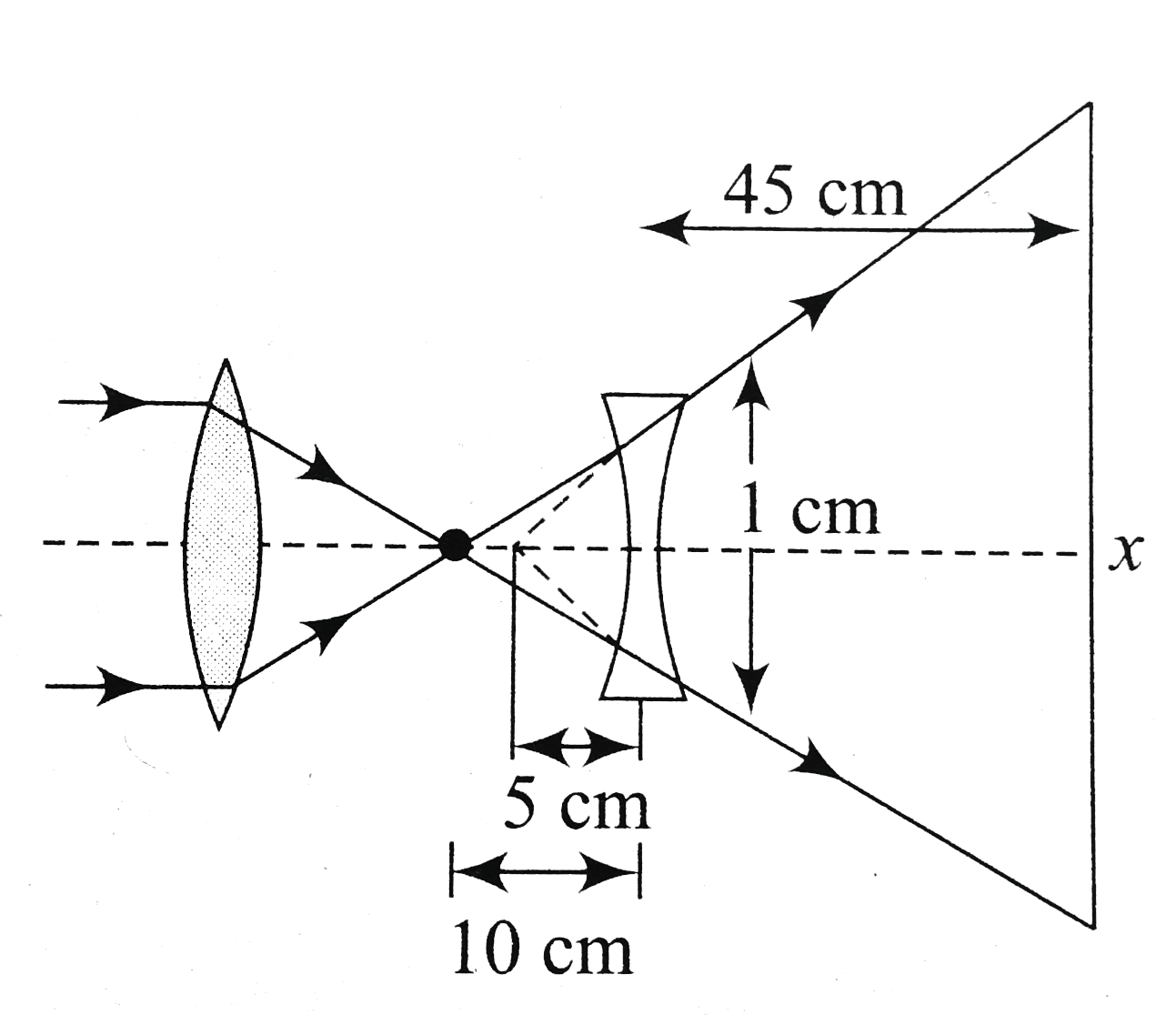
In case (a), the incident parallel beam emerges as a parallel beam. So area illuminated,
`A_(1)=pi(1)^(2)=picm^(2)`
In case (b), let x be the diameter of the area illuminated.
Then,
`(x)/(45)=(1)/(5)rArr x=9cm`
`A_(2)=pi((9)/(2))^(2)=(81)/(4)picm^(2)`
`(A_(2))/(A_(1))=(81)/(4)`
When liquid of refractive index `mu` is filled to the right of this lens, the first surface of the lens (radius of curvature `=10cm)` forms the imag at the object only. Considering the refraction at the second surface.
`(mu)/(oo)-(1.5)/(-10)=(mu-1.5)/(10)` (therefore, same area `rArr upsilonrarroo)`
`rArr mu=3`
Promotional Banner

Topper's Solved these Questions

  • GEOMETRICAL OPTICS

    CENGAGE PHYSICS ENGLISH|Exercise Integer|15 Videos
  • GEOMETRICAL OPTICS

    CENGAGE PHYSICS ENGLISH|Exercise Archives|7 Videos
  • GEOMETRICAL OPTICS

    CENGAGE PHYSICS ENGLISH|Exercise Assertion-Reasoninig|2 Videos
  • ELECTRON,PHONTS,PHOTOELECTRIC EFFECT & X-RAYS

    CENGAGE PHYSICS ENGLISH|Exercise dpp 3.3|15 Videos
  • HEATING EFFECT OF CURRENT

    CENGAGE PHYSICS ENGLISH|Exercise Thermal Power in Resistance Connected in Circuit|27 Videos

Similar Questions

Explore conceptually related problems

A parallel beam of light falls successively on a thin convex lens of focal length 40 cm and then ono a thin convex lens of focal length 10cm as shown in figure. In figure, the second lens is an equi-concave lens of focal length 10cm and made of a material of refractive index 1.5. In both the cases, the second lens has an aperture equal to 1cm. Q. Compare the area illuminated by the beam of light on the screen, which passes through the second lens in the two cases. The ratio (A_(2)//A_(1)) will be

A convex lens of focal length 40 cm is in contact with a concave lens of focal length 25 cm. The power of the combination is

A convex lens of focal length 80 cm and a concave lens of focal length 50 cm are combined toghether. What will be their resulting power ?

A thin convex lens of focal length 20 cm is kept in contact with a thin concave lens of focal length 15 cm. Find the focal length and the nature of the combination.

A converging lens of focal length 40 cm is kept in contact with a diverging lens of focal length 30 cm. Find the focal length of the combination.

A convex lens A of focal length 20cm and a concave lens B of focal length 10 cm are kept along the same axis with a distance d between them. If a parallel beam, then d is

A convex lens A of focal length 20cm and a concave lens B of focal length 10 cm are kept along the same axis with a distance d between them. If a parallel beam, then d is

A convex lens of power +2.5 D is in contact with a concave lens of focal length 25 cm. The power of combination is

What is the focal length of a convex lens of focal length 30 cm in contact with a concave lens of focal length 20 cm . Is the system a converging or a diverging lens ? Ignore thickness of the lenses.

An eye specialist prescribes spectacles having combination of convex lens of focal length 40cm in contact with a concave lens of focal length 25cm. The power of this lens combination in diopters is

CENGAGE PHYSICS ENGLISH-GEOMETRICAL OPTICS-Linked Comprehension
  1. Two thin convex lenses of focal lengths f(1) and f(2) are separated by...

    Text Solution

    |

  2. A parallel beam of light falls successively on a thin convex lens of ...

    Text Solution

    |

  3. A parallel beam of light falls successively on a thin convex lens of ...

    Text Solution

    |

  4. Two identical plano-convex lenses L(1)(mu(1)-1.4) and L(2)(mu(2)-1.5) ...

    Text Solution

    |

  5. Two identical plano-convex lenses L(1)(mu(1)-1.4) and L(2)(mu(2)-1.5) ...

    Text Solution

    |

  6. A beam of light converges towards a point O, behind a convex mirror of...

    Text Solution

    |

  7. A beam of light converges towards a point O, behind a convex mirror of...

    Text Solution

    |

  8. A ray of light enters a spherical drop of water of refractive index mu...

    Text Solution

    |

  9. A ray of light enters a spherical drop of water of refractive index mu...

    Text Solution

    |

  10. A ray of light enters a spherical drop of water of refractive index mu...

    Text Solution

    |

  11. The ciliary muscles of eye control the curvature of the lens in the ey...

    Text Solution

    |

  12. The ciliary muscles of eye control the curvature of the lens in the ey...

    Text Solution

    |

  13. The ciliary muscles of eye control the curvature of the lens in the ey...

    Text Solution

    |

  14. The ciliary muscles of eye control the curvature of the lens in the ey...

    Text Solution

    |

  15. The ciliary muscles of eye control the curvature of the lens in the ey...

    Text Solution

    |

  16. A parallel beam of light falls on a solid tranparent sphere. Q. W...

    Text Solution

    |

  17. A parallel beam of light falls on a solid tranparent sphere. Q. I...

    Text Solution

    |

  18. A parallel beam of light falls on a solid tranparent sphere. Q. F...

    Text Solution

    |

  19. Pulfrich refractometer is used to measure the refractive index of soli...

    Text Solution

    |

  20. Pulfrich refractometer is used to measure the refractive index of soli...

    Text Solution

    |

