Home
Class 12
PHYSICS
Two identical plano-convex lenses L(1)(m...

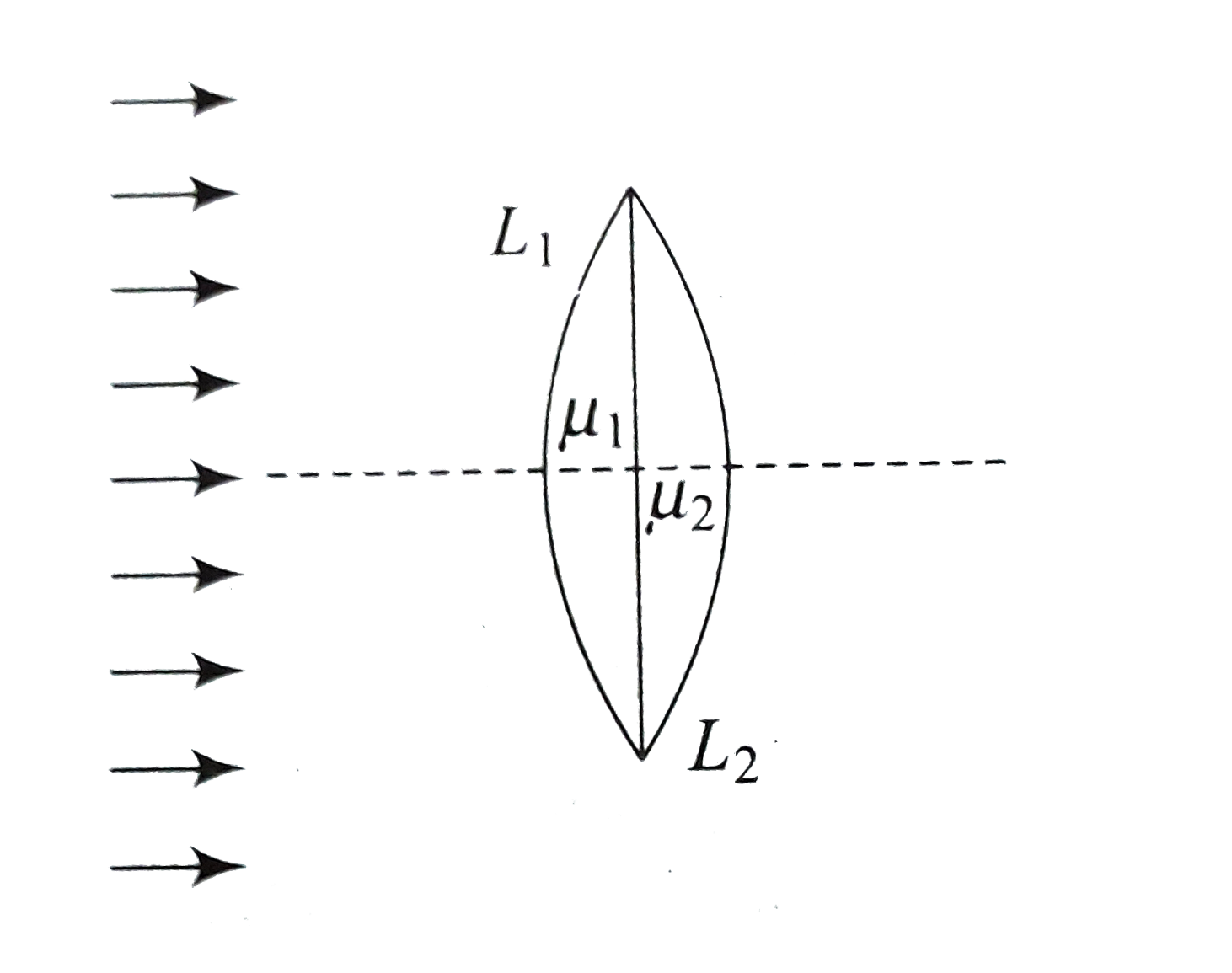
Two identical plano-convex lenses `L_(1)(mu_(1)-1.4)` and `L_(2)(mu_(2)-1.5)`
of radii of curvature `R=20cm` are placed as shown in Figure.

Q. Find the position of the image of the parallel beam of light relative to the common principal axis.

A

`100//7cm`

B

`200//9`

C

`31.2cm`

D

`21.8cm`

Text Solution

Verified by Experts

The correct Answer is:
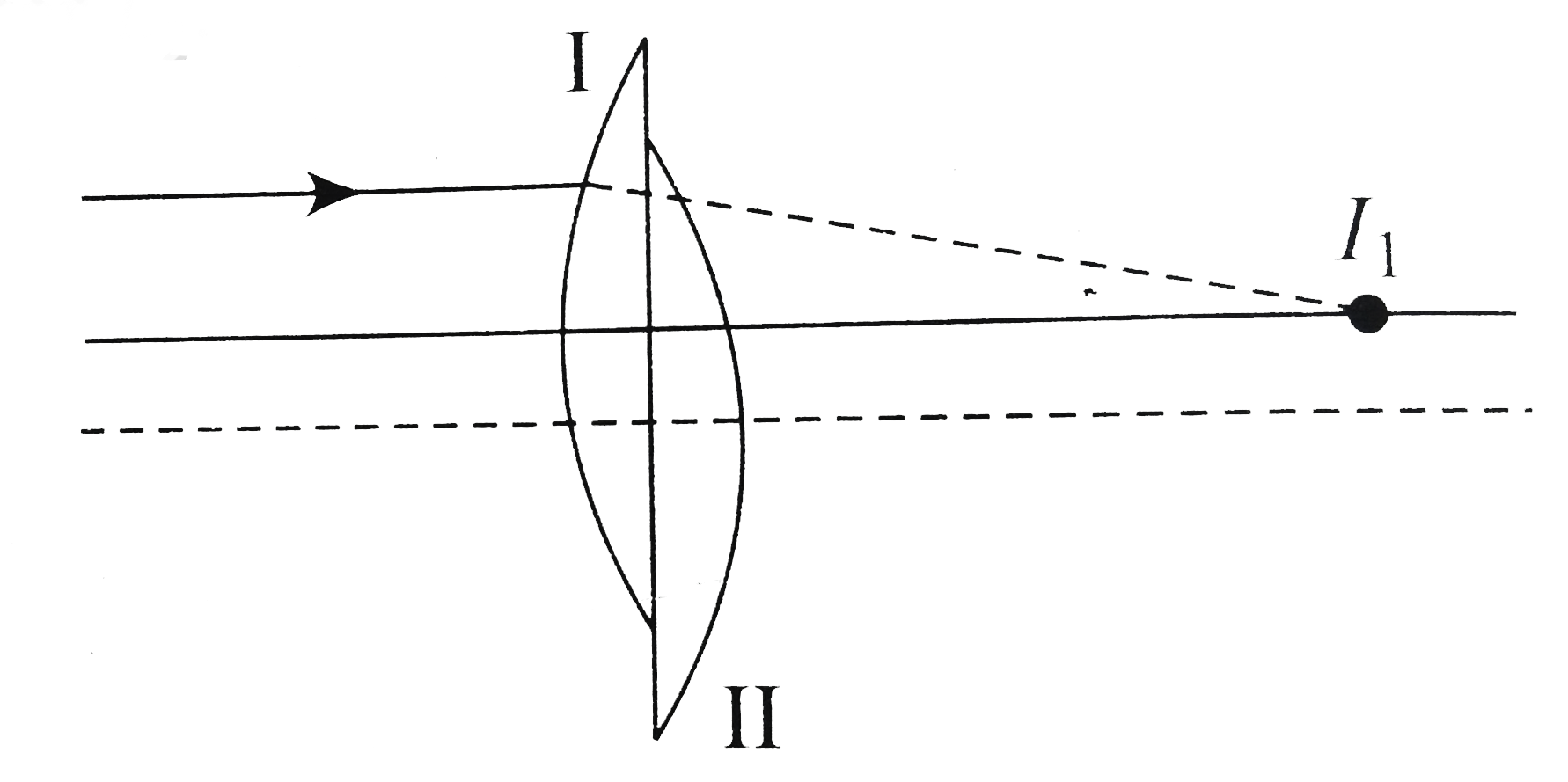
b.

a. Focal lengths of lenses `L_(1)` and `L_(2)` are, respectively, given by
`(1)/(f_(1))=(mu-1)((1)/(R)-(1)/(oo))rArrf_(1)=50cm`
`(1)/(f_(2))=(mu-1)[(1)/(oo)-(-(1)/(R))]rArrf_(2)=40cm`
The equivalent focal length f of the combination is given by
`(1)/(f)=(1)/(f_(1))+(1)/(f_(2))rArrf=(200)/(9)cm`
Hence, the image of the parallel beam is formed on the common principal axis at a distance of 22.22cm from the combination on the right side.
b. Image formed by `L_(1)` is at a distance of 50cm behind the lens. This image lies on the principal axis of `L_(1)` and will act as an object for `L_(2)`
For `L_(2)`, object distance, `u=+50cm`
`f_(2)=+40cm`
`(1)/(upsilon)-(1)/(u)=(1)/(f)rArrmu=(200)/(9) cm`
Magnification caused by `L_(2), m=(upsilon)/(u)=(4)/(9)`
For `L_(2)` object `I_(1)` is at a distance of 4.5mm above its principal axis.
Hence, distance of image `I_(2)` of the object (virtual) `I_(1)` is at a distance `(4//9)xx4.5=2mm` above the principal axis of `L_(2)`
`[:. "height of image" `=mxx` "height of object" ]`
Hence, final image is at a distance of 22.22cm behind the combination at a distance of 2.5mm below the principal axis of `L_(1)`.
Promotional Banner

Topper's Solved these Questions

  • GEOMETRICAL OPTICS

    CENGAGE PHYSICS ENGLISH|Exercise Integer|15 Videos
  • GEOMETRICAL OPTICS

    CENGAGE PHYSICS ENGLISH|Exercise Archives|7 Videos
  • GEOMETRICAL OPTICS

    CENGAGE PHYSICS ENGLISH|Exercise Assertion-Reasoninig|2 Videos
  • ELECTRON,PHONTS,PHOTOELECTRIC EFFECT & X-RAYS

    CENGAGE PHYSICS ENGLISH|Exercise dpp 3.3|15 Videos
  • HEATING EFFECT OF CURRENT

    CENGAGE PHYSICS ENGLISH|Exercise Thermal Power in Resistance Connected in Circuit|27 Videos

Similar Questions

Explore conceptually related problems

Two identical plano-convex lenses L_(1)(mu_(1)-1.4) and L_(2)(mu_(2)-1.5) of radii of curvature R=20cm are placed as shown in Figure. Q. Now, the secocnd lens is shifted vertically downward by a small distance 4.5mm and the extended parts of L_(1) and L_(2) are blackened as shown in figure. Find the new position of the image of the parallel beam.

Figure below shows a parallel beam of monochromatic light incident on a convex spherical surface, radius of curvature R = 30 cm, which separates glass (refractive index - 1 6) from air. Find the position of the image formed due to refraction of light at this single spherical surface.

The radius of curvature of the curved surface of a plano-convex lens is 20 cm . If the refractive index of the material of the lens be 1.5 , it will

A plano-convex glass lens (mu_(g)=3//2) of radius of curvature R=10cm is placed at a distance of b from a concave lens of focal length 20cm. What should be the distance a of point object O from the plano-convex lens so that position of final image is independent of b?

If the optic axis of convex and concave lenses are separated by a distance 5 mm as shown in the figure. Find the coordinate of the final image formed by the combination if parallel beam of light is incident on lens. Origin is at the optical centre of convex lens

A biconvex lens (mu=1.5) has radius of curvature 20cm (both). find its focal length.

An object of height 1mm is placed inside a sphere of refractive index mu=2 and radius of curvature 20 cm as shown in the figure. Find the position, size, and nature of image, for the situation shown in Figure. Draw ray diagram.

Two identical glass rods S_(1) and S_(2) (refractive index=1.5) have one convex end of radius of curvature 10 cm. They are placed with the curved surfaces at a distance d as shown in the figure, with their axes (shown by the dashed line) aligned. When a point source of light P is placed inside rod S_(1) on its axis at a distance of 50 cm from the curved face, the light rays emenating from it are found to be parallel to the axis inside S_(2) . The distance d is

A double convex lens made of glass of refractive index 1.56 has both radii of curvature of magnitude 20 cm . If an object is placed at a distance of 10 cm from this lens, find the position of image formed.

A cylindrical tube filled with water (mu_(w)=(4)/(3)) is closed at its both ends by two thin, silvered plano - convex lenses, as shown in the figure. Refractive index of lenses L_(1) and L_(2) and 2.0 and 1.5, while their radii of curvatures are 5 cm and 9 cm, respectively. A point O on the axis of the cylindrical tube. If it is found that all the images formed by multiple refractions and reflections coincide with the object, then the distance between both the lenses is

CENGAGE PHYSICS ENGLISH-GEOMETRICAL OPTICS-Linked Comprehension
  1. A parallel beam of light falls successively on a thin convex lens of ...

    Text Solution

    |

  2. A parallel beam of light falls successively on a thin convex lens of ...

    Text Solution

    |

  3. Two identical plano-convex lenses L(1)(mu(1)-1.4) and L(2)(mu(2)-1.5) ...

    Text Solution

    |

  4. Two identical plano-convex lenses L(1)(mu(1)-1.4) and L(2)(mu(2)-1.5) ...

    Text Solution

    |

  5. A beam of light converges towards a point O, behind a convex mirror of...

    Text Solution

    |

  6. A beam of light converges towards a point O, behind a convex mirror of...

    Text Solution

    |

  7. A ray of light enters a spherical drop of water of refractive index mu...

    Text Solution

    |

  8. A ray of light enters a spherical drop of water of refractive index mu...

    Text Solution

    |

  9. A ray of light enters a spherical drop of water of refractive index mu...

    Text Solution

    |

  10. The ciliary muscles of eye control the curvature of the lens in the ey...

    Text Solution

    |

  11. The ciliary muscles of eye control the curvature of the lens in the ey...

    Text Solution

    |

  12. The ciliary muscles of eye control the curvature of the lens in the ey...

    Text Solution

    |

  13. The ciliary muscles of eye control the curvature of the lens in the ey...

    Text Solution

    |

  14. The ciliary muscles of eye control the curvature of the lens in the ey...

    Text Solution

    |

  15. A parallel beam of light falls on a solid tranparent sphere. Q. W...

    Text Solution

    |

  16. A parallel beam of light falls on a solid tranparent sphere. Q. I...

    Text Solution

    |

  17. A parallel beam of light falls on a solid tranparent sphere. Q. F...

    Text Solution

    |

  18. Pulfrich refractometer is used to measure the refractive index of soli...

    Text Solution

    |

  19. Pulfrich refractometer is used to measure the refractive index of soli...

    Text Solution

    |

  20. Pulfrich refractometer is used to measure the refractive index of soli...

    Text Solution

    |

