Home
Class 12
PHYSICS
Two identical plano-convex lenses L(1)(m...

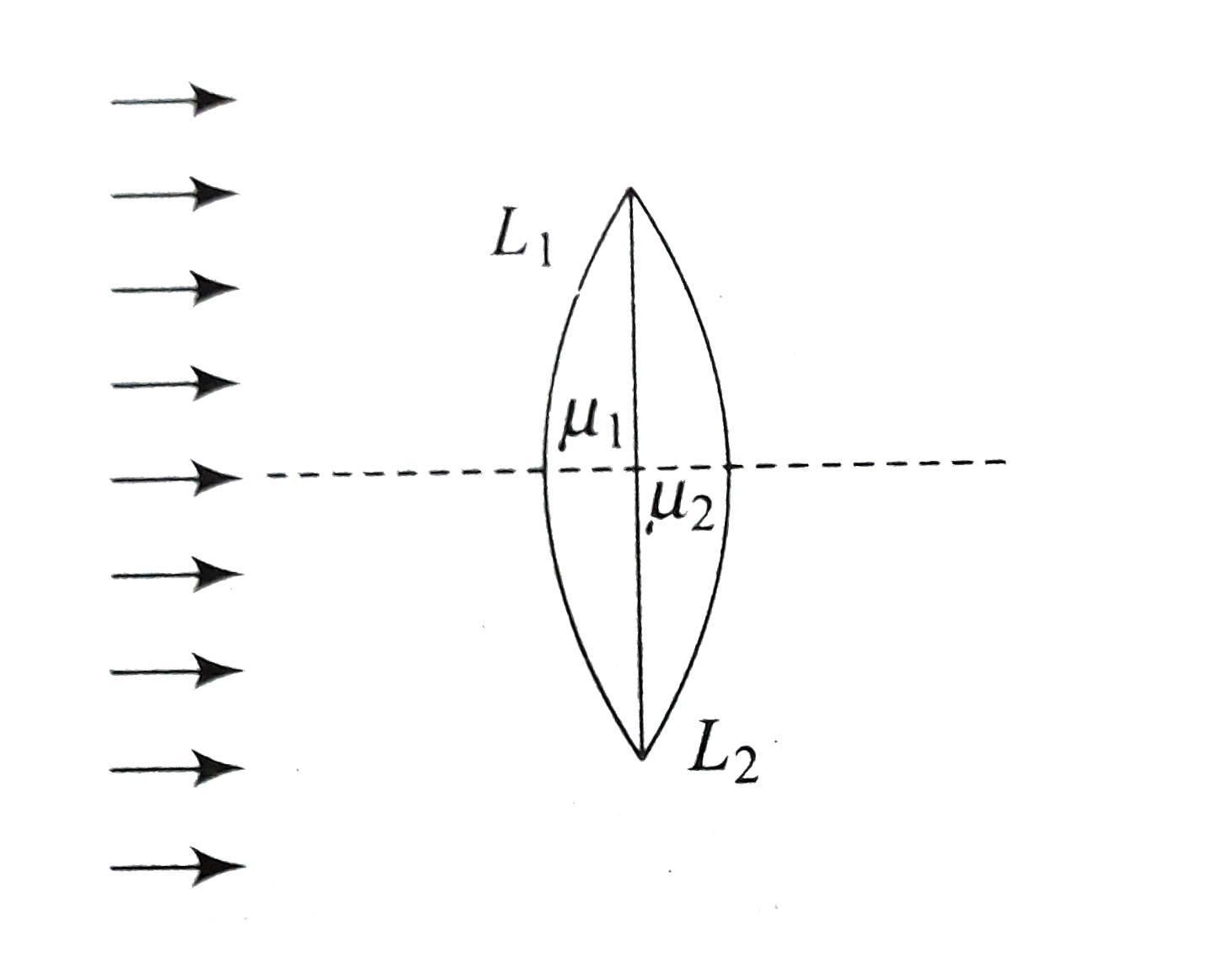
Two identical plano-convex lenses `L_(1)(mu_(1)-1.4)` and `L_(2)(mu_(2)-1.5)` of radii of curvature `R=20cm` are placed as shown in Figure.

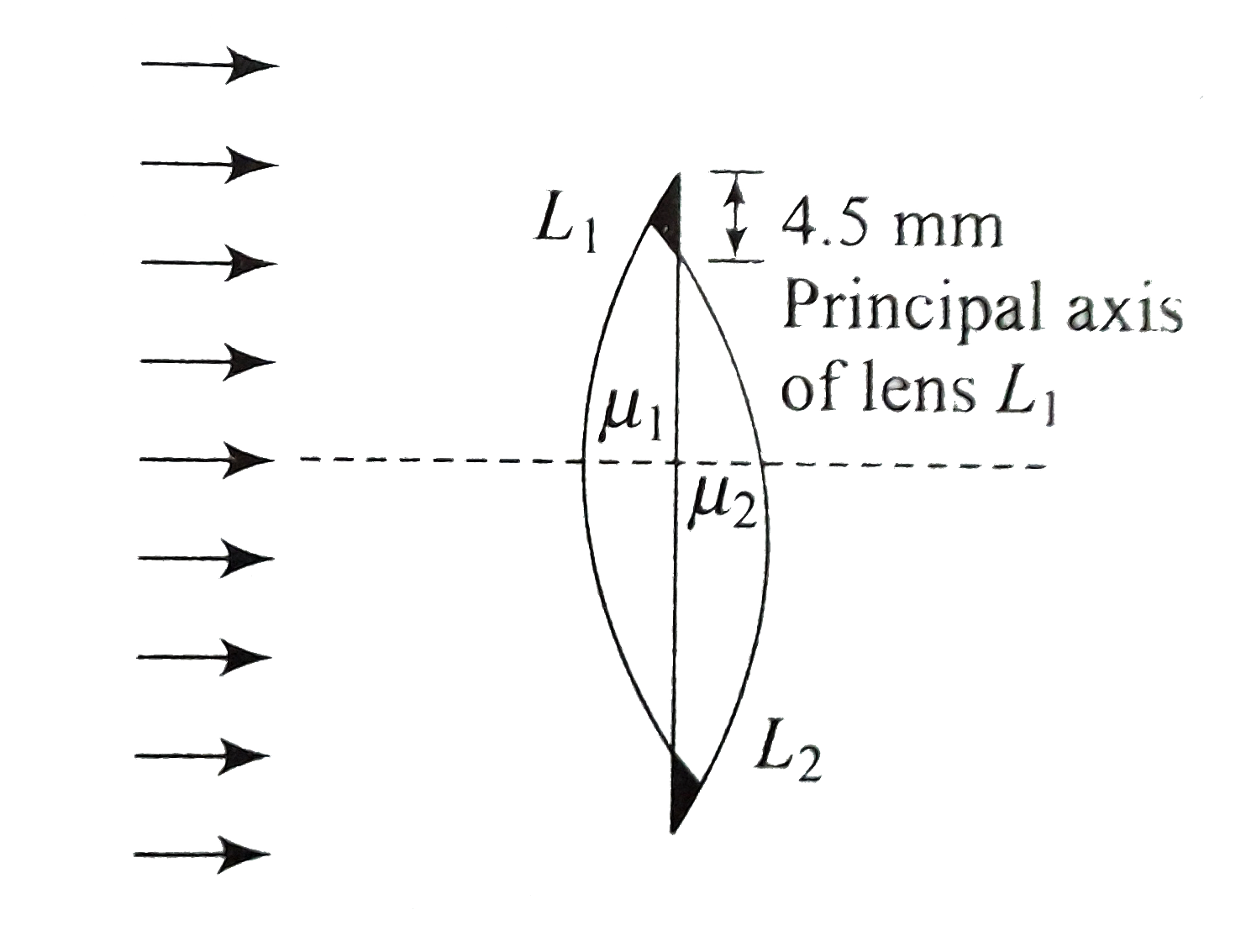
Q. Now, the secocnd lens is shifted vertically downward by a small distance 4.5mm and the extended parts of `L_(1)` and `L_(2)` are blackened as shown in figure. Find the new position of the image of the parallel beam.

A

`200//9` cm behind the lens 2.5 mm below the principal axis of `L_(1)`

B

`100//9cm` in front of th elens 2mm below the prinicipal axis of `L_(1)`

C

`200//9cm` in front of the lens 2.5mm below the principal axis of `L_(1)`

D

`100//9`cm behind the lens 2mm below the princiipal axis of `L_(1)`

Text Solution

Verified by Experts

The correct Answer is:
a.

a. Focal lengths of lenses `L_(1)` and `L_(2)` are, respectively, given by
`(1)/(f_(1))=(mu-1)((1)/(R)-(1)/(oo))rArrf_(1)=50cm`
`(1)/(f_(2))=(mu-1)[(1)/(oo)-(-(1)/(R))]rArrf_(2)=40cm`
The equivalent focal length f of the combination is given by
`(1)/(f)=(1)/(f_(1))+(1)/(f_(2))rArrf=(200)/(9)cm`
Hence, the image of the parallel beam is formed on the common principal axis at a distance of 22.22cm from the combination on the right side.
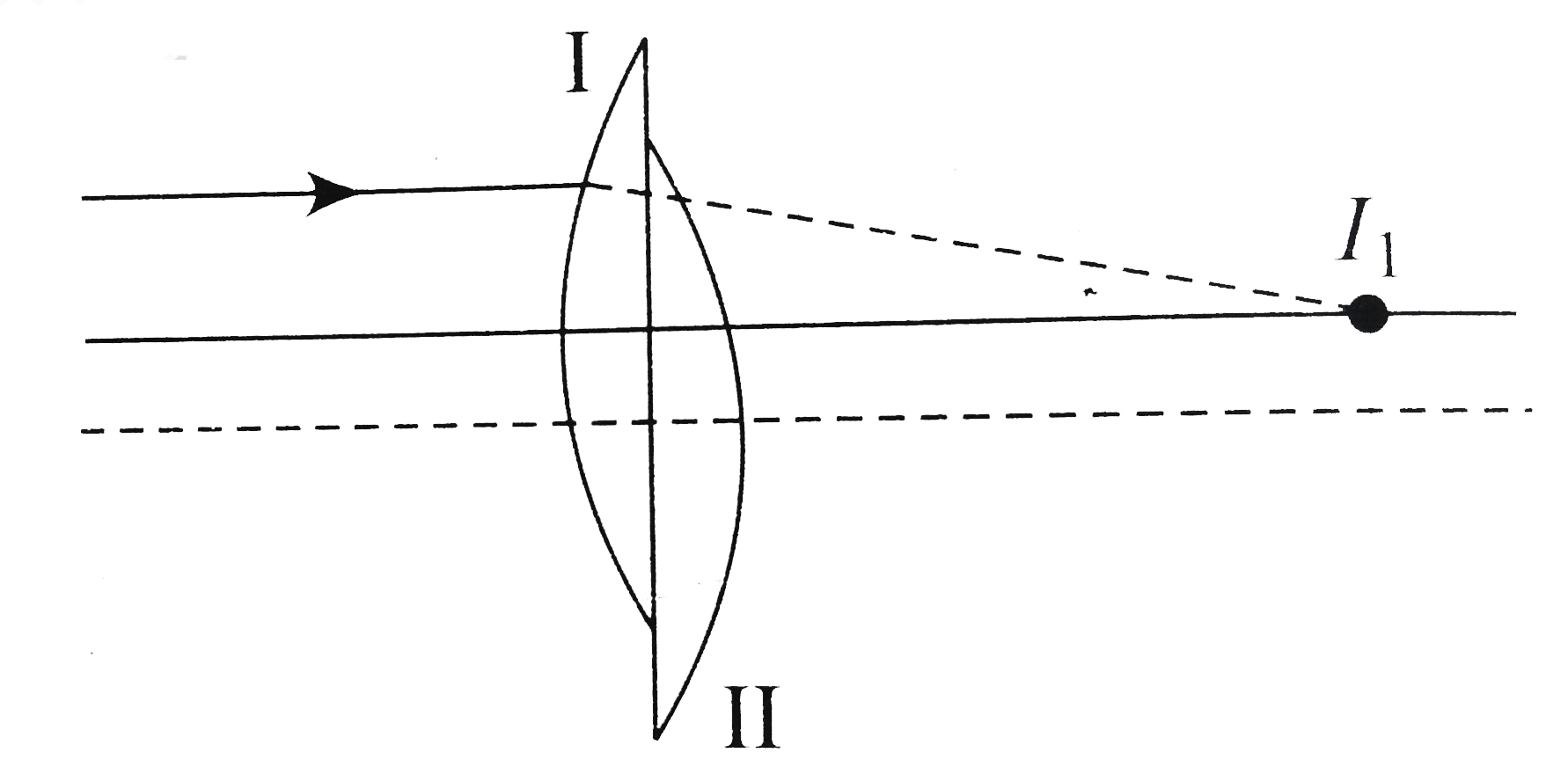
b. Image formed by `L_(1)` is at a distance of 50cm behind the lens. This image lies on the principal axis of `L_(1)` and will act as an object for `L_(2)`
For `L_(2)`, object distance, `u=+50cm`
`f_(2)=+40cm`
`(1)/(upsilon)-(1)/(u)=(1)/(f)rArrmu=(200)/(9) cm`
Magnification caused by `L_(2), m=(upsilon)/(u)=(4)/(9)`
For `L_(2)` object `I_(1)` is at a distance of 4.5mm above its principal axis.
Hence, distance of image `I_(2)` of the object (virtual) `I_(1)` is at a distance `(4//9)xx4.5=2mm` above the principal axis of `L_(2)`
`[:. "height of image" =m xx "height of object" ]`
Hence, final image is at a distance of 22.22cm behind the combination at a distance of 2.5mm below the principal axis of `L_(1)`.
Promotional Banner

Topper's Solved these Questions

  • GEOMETRICAL OPTICS

    CENGAGE PHYSICS ENGLISH|Exercise Integer|15 Videos
  • GEOMETRICAL OPTICS

    CENGAGE PHYSICS ENGLISH|Exercise Archives|7 Videos
  • GEOMETRICAL OPTICS

    CENGAGE PHYSICS ENGLISH|Exercise Assertion-Reasoninig|2 Videos
  • ELECTRON,PHONTS,PHOTOELECTRIC EFFECT & X-RAYS

    CENGAGE PHYSICS ENGLISH|Exercise dpp 3.3|15 Videos
  • HEATING EFFECT OF CURRENT

    CENGAGE PHYSICS ENGLISH|Exercise Thermal Power in Resistance Connected in Circuit|27 Videos

Similar Questions

Explore conceptually related problems

Two identical plano-convex lenses L_(1)(mu_(1)-1.4) and L_(2)(mu_(2)-1.5) of radii of curvature R=20cm are placed as shown in Figure. Q. Find the position of the image of the parallel beam of light relative to the common principal axis.

A plano-convex glass lens (mu_(g)=3//2) of radius of curvature R=10cm is placed at a distance of b from a concave lens of focal length 20cm. What should be the distance a of point object O from the plano-convex lens so that position of final image is independent of b?

A plano-concave lens is made of glass (R.l. = 1.5) and the radius of curvature of the curved face is 50 cm. The power of the lens is

In the figure shown, there are two convex lenses L_(1) and L_(2) having focal. Lengths f_(1) and f_(2) respectively. The distance between L_(1) and L_(2) will be

A double convex thin lens made of glass (refractive index mu = 1.5 ) has both radii of curvature of magnitude 20 cm . Incident light rays parallel to the axis of the lens will converge at a distance L such that

A double convex thin lens made of glass (refractive index mu = 1.5 ) has both radii of curvature of magnitude 20 cm . Incident light rays parallel to the axis of the lens will converge at a distance L such that

Two inductors L_(1) and L_(2) are connected in parallel and a time varying current flows as shown. the ratio of current i_(1)//i_(2)

An object of height 1mm is placed inside a sphere of refractive index mu=2 and radius of curvature 20 cm as shown in the figure. Find the position, size, and nature of image, for the situation shown in Figure. Draw ray diagram.

In a laboratory four convex lenses L_(1), L_(2), L_(3) and L_(4) of focal lengths 2,4,6 and 8 cm respectively are available. Two of these lenses form a telescope of length 10 cm and magnifying power 4 . The objective and eye lenses are

An illuminated point object O is kept 20 cm from a thin convex lens L_(1) of focal length 15 cm as shown below. A thin diverging lens L_(2) of focal length 25 cm is kept co - axial with the first lens and 35 cm from it, as shown in figure below : Find the position of the final image formed by this combination of lenses.

CENGAGE PHYSICS ENGLISH-GEOMETRICAL OPTICS-Linked Comprehension
  1. A parallel beam of light falls successively on a thin convex lens of ...

    Text Solution

    |

  2. Two identical plano-convex lenses L(1)(mu(1)-1.4) and L(2)(mu(2)-1.5) ...

    Text Solution

    |

  3. Two identical plano-convex lenses L(1)(mu(1)-1.4) and L(2)(mu(2)-1.5) ...

    Text Solution

    |

  4. A beam of light converges towards a point O, behind a convex mirror of...

    Text Solution

    |

  5. A beam of light converges towards a point O, behind a convex mirror of...

    Text Solution

    |

  6. A ray of light enters a spherical drop of water of refractive index mu...

    Text Solution

    |

  7. A ray of light enters a spherical drop of water of refractive index mu...

    Text Solution

    |

  8. A ray of light enters a spherical drop of water of refractive index mu...

    Text Solution

    |

  9. The ciliary muscles of eye control the curvature of the lens in the ey...

    Text Solution

    |

  10. The ciliary muscles of eye control the curvature of the lens in the ey...

    Text Solution

    |

  11. The ciliary muscles of eye control the curvature of the lens in the ey...

    Text Solution

    |

  12. The ciliary muscles of eye control the curvature of the lens in the ey...

    Text Solution

    |

  13. The ciliary muscles of eye control the curvature of the lens in the ey...

    Text Solution

    |

  14. A parallel beam of light falls on a solid tranparent sphere. Q. W...

    Text Solution

    |

  15. A parallel beam of light falls on a solid tranparent sphere. Q. I...

    Text Solution

    |

  16. A parallel beam of light falls on a solid tranparent sphere. Q. F...

    Text Solution

    |

  17. Pulfrich refractometer is used to measure the refractive index of soli...

    Text Solution

    |

  18. Pulfrich refractometer is used to measure the refractive index of soli...

    Text Solution

    |

  19. Pulfrich refractometer is used to measure the refractive index of soli...

    Text Solution

    |

  20. An object is present on the principal axis of a concave mirror at a di...

    Text Solution

    |

