Home
Class 12
PHYSICS
An object kept near a convex lens of foc...

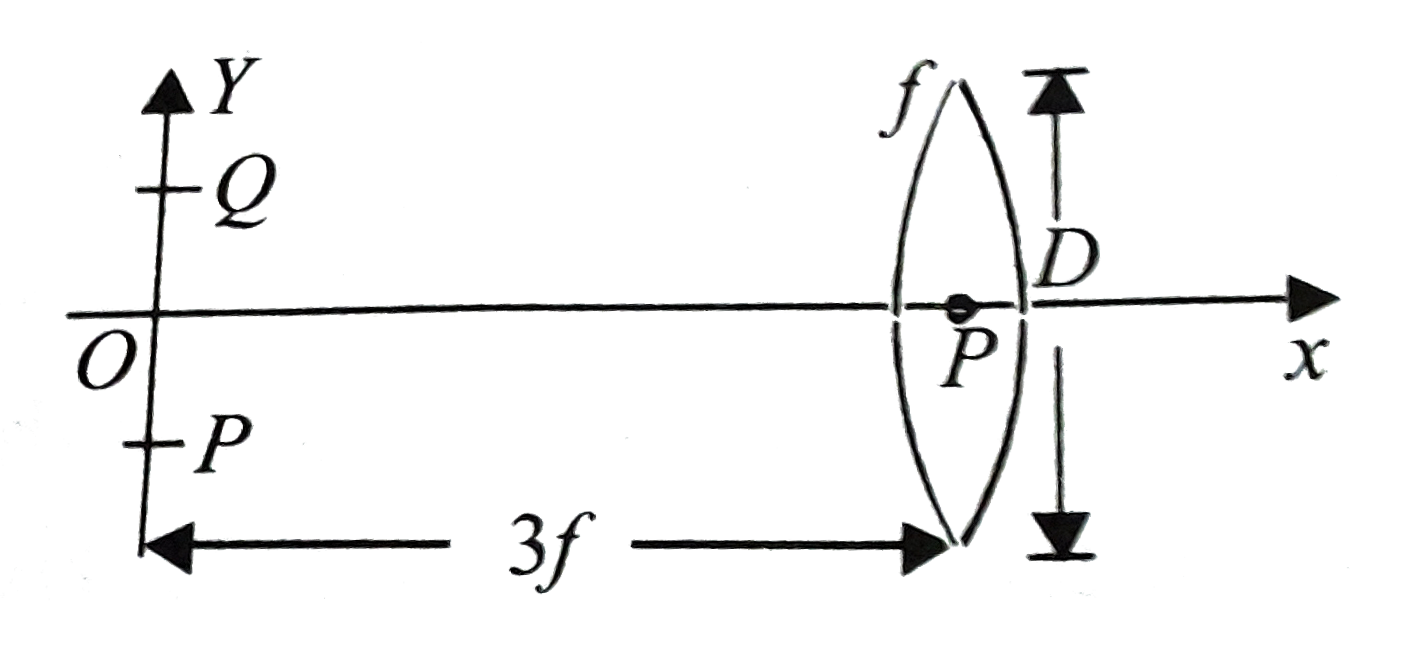
An object kept near a convex lens of focal length f, executes SHM between P and Q according to the equation `y=A sinomegat`, O being the mean position. Take x-axis as the principal axis of the lens and `A lt lt D` to answer the following questions:

Q. The velocity of the image when the object crosses the mean position and goes toward Q is

A

`A omega`

B

`-Aomega`

C

`Aomega//2`

D

None of these

Text Solution

Verified by Experts

The correct Answer is:
c.

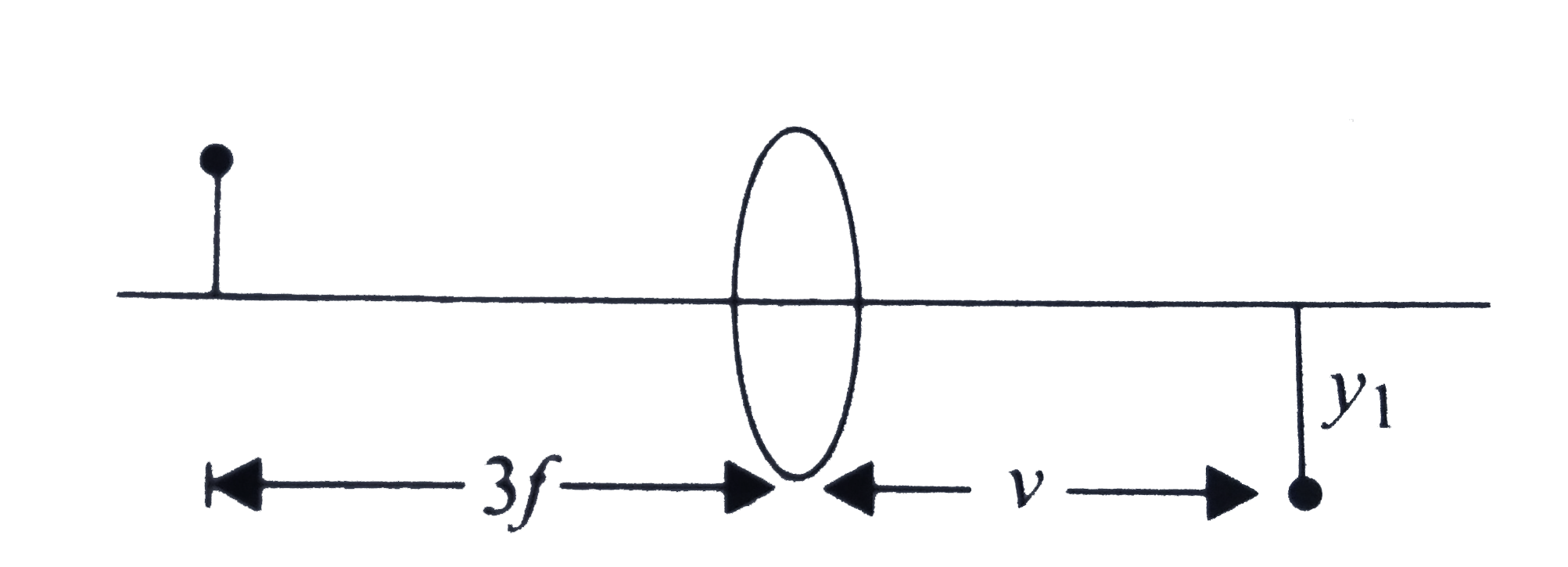
`(1)/(v)-(1)/(-3f)=(1)/(f)rArr(1)/(v)=(1)/(f)-(1)/(3f)rArrv=(3f)/(2)`
`(y_(1))/(y)=(v)/(3f)rArry_(1)=y(v)/(3f)=(y)/(2)`
If `y_(max)=A` then `y_(1 max)=A_(1)=A//2`
Max velocity `=omegaA_(1) =omegaA//2`
Promotional Banner

Topper's Solved these Questions

  • GEOMETRICAL OPTICS

    CENGAGE PHYSICS ENGLISH|Exercise Integer|15 Videos
  • GEOMETRICAL OPTICS

    CENGAGE PHYSICS ENGLISH|Exercise Archives|7 Videos
  • GEOMETRICAL OPTICS

    CENGAGE PHYSICS ENGLISH|Exercise Assertion-Reasoninig|2 Videos
  • ELECTRON,PHONTS,PHOTOELECTRIC EFFECT & X-RAYS

    CENGAGE PHYSICS ENGLISH|Exercise dpp 3.3|15 Videos
  • HEATING EFFECT OF CURRENT

    CENGAGE PHYSICS ENGLISH|Exercise Thermal Power in Resistance Connected in Circuit|27 Videos

Similar Questions

Explore conceptually related problems

An object kept near a convex lens of focal length f, executes SHM between P and Q according to the equation y=A sinomegat , O being the mean position. Take x-axis as the principal axis of the lens and A lt lt D to answer the following questions: Q. The amplitude of oscillation of the image is

An object kept near a convex lens of focal length f, executes SHM between P and Q according to the equation y=A sinomegat , O being the mean position. Take x-axis as the principal axis of the lens and A lt lt D to answer the following questions: Q. The amplitude of oscillation of the image is

An object kept near a convex lens of focal length f, executes SHM between P and Q according to the equation y=A sinomegat , O being the mean position. Take x-axis as the principal axis of the lens and A lt lt D to answer the following questions: Q. The phase difference between the object and the image oscillations is

In YDSE set up (see fig.), the light sources executes SHM between P and Q according to the equation x = A sin omega t , S being the mean position. Assume d rarr 0 and A lt lt L . omega is small enough to neglect Doppler effect. If the sources were stationary at S, intenstiy at O would be I_(0) Read the paragraph carefully and answer the following questions. When the source comes toward the point Q,

In YDSE set up (see fig.), the light sources executes SHM between P and Q according to the equation x = A sin omega t , S being the mean position. Assume d rarr 0 and A lt lt L . omega is small enough to neglect Doppler effect. If the sources were stationary at S, intenstiy at O would be I_(0) Read the paragraph carefully and answer the following questions. The fractional change in intensity of the central maximum as function of time is

In YDSE set up (see fig.), the light sources executes SHM between P and Q according to the equation x = A sin omega t , S being the mean position. Assume d rarr 0 and A lt lt L . omega is small enough to neglect Doppler effect. If the sources were stationary at S, intenstiy at O would be I_(0) Read the paragraph carefully and answer the following questions. The fringe width beta can be expressed as

A convex lens of focal length f and a plane mirror are y distance apart. An object O is kept on the principal axis of the lens at a distance x from the lens. The values of x and y for the final image of O to fall exactly (position and size) on the object O are :

A beaker containing an ideal fluid executes plane SHM in a horizontal plane according to the equation x=(sqrt(3)g)/(omega^(2))sinomegat , O being the mean position. A bob is suspended at S through a string of length L as shown in the figure. The line SO is vertical. Assuming L gt gt (sqrt(3)g)/(omega^(2)) . The tension in the string is maximum at time t=

A point object moves along the principal axis of a convex lens of focal length f such that its real image, also formed on the principal axis at a distance (4f)/3 (at t=0) moves away from the lens with uniform velocity alpha . Find the velocity of the point object as a function of time t.

A point object O is placed on the principal axis of a convex lens of focal length f=20cm at a distance of 40 cm to the left of it. The diameter of the lens is 10. An eye is placed 60 cm to right of the lens and a distance h below the principal axis. The maximum value of h to see the image is

CENGAGE PHYSICS ENGLISH-GEOMETRICAL OPTICS-Linked Comprehension
  1. A parallel beam of light falls on a solid tranparent sphere. Q. W...

    Text Solution

    |

  2. A parallel beam of light falls on a solid tranparent sphere. Q. I...

    Text Solution

    |

  3. A parallel beam of light falls on a solid tranparent sphere. Q. F...

    Text Solution

    |

  4. Pulfrich refractometer is used to measure the refractive index of soli...

    Text Solution

    |

  5. Pulfrich refractometer is used to measure the refractive index of soli...

    Text Solution

    |

  6. Pulfrich refractometer is used to measure the refractive index of soli...

    Text Solution

    |

  7. An object is present on the principal axis of a concave mirror at a di...

    Text Solution

    |

  8. An object is placed between a plane mirror and a concave mirror of foc...

    Text Solution

    |

  9. An object is present on the principal axis of a concave mirror at a di...

    Text Solution

    |

  10. An object kept near a convex lens of focal length f, executes SHM betw...

    Text Solution

    |

  11. An object kept near a convex lens of focal length f, executes SHM betw...

    Text Solution

    |

  12. An object kept near a convex lens of focal length f, executes SHM betw...

    Text Solution

    |

  13. A convex lens of focal length 40cm is held at a distance 12cm coaxiall...

    Text Solution

    |

  14. A convex lens of focal length 40cm is held at a distance 12cm coaxiall...

    Text Solution

    |

  15. A convex lens of focal length 40cm is held at a distance 12cm coaxiall...

    Text Solution

    |

  16. A concave mirror forms real image of a point source lying on the optic...

    Text Solution

    |

  17. A concave mirror forms real image of a point source lying on the optic...

    Text Solution

    |

  18. A concave mirror forms real image of a point source lying on the optic...

    Text Solution

    |

  19. An object AB of height 1cm lying on the axis of convex mirror of focal...

    Text Solution

    |

  20. An object AB of height 1cm lying on the axis of convex mirror of focal...

    Text Solution

    |

