Home
Class 12
PHYSICS
A concave mirror forms real image of a p...

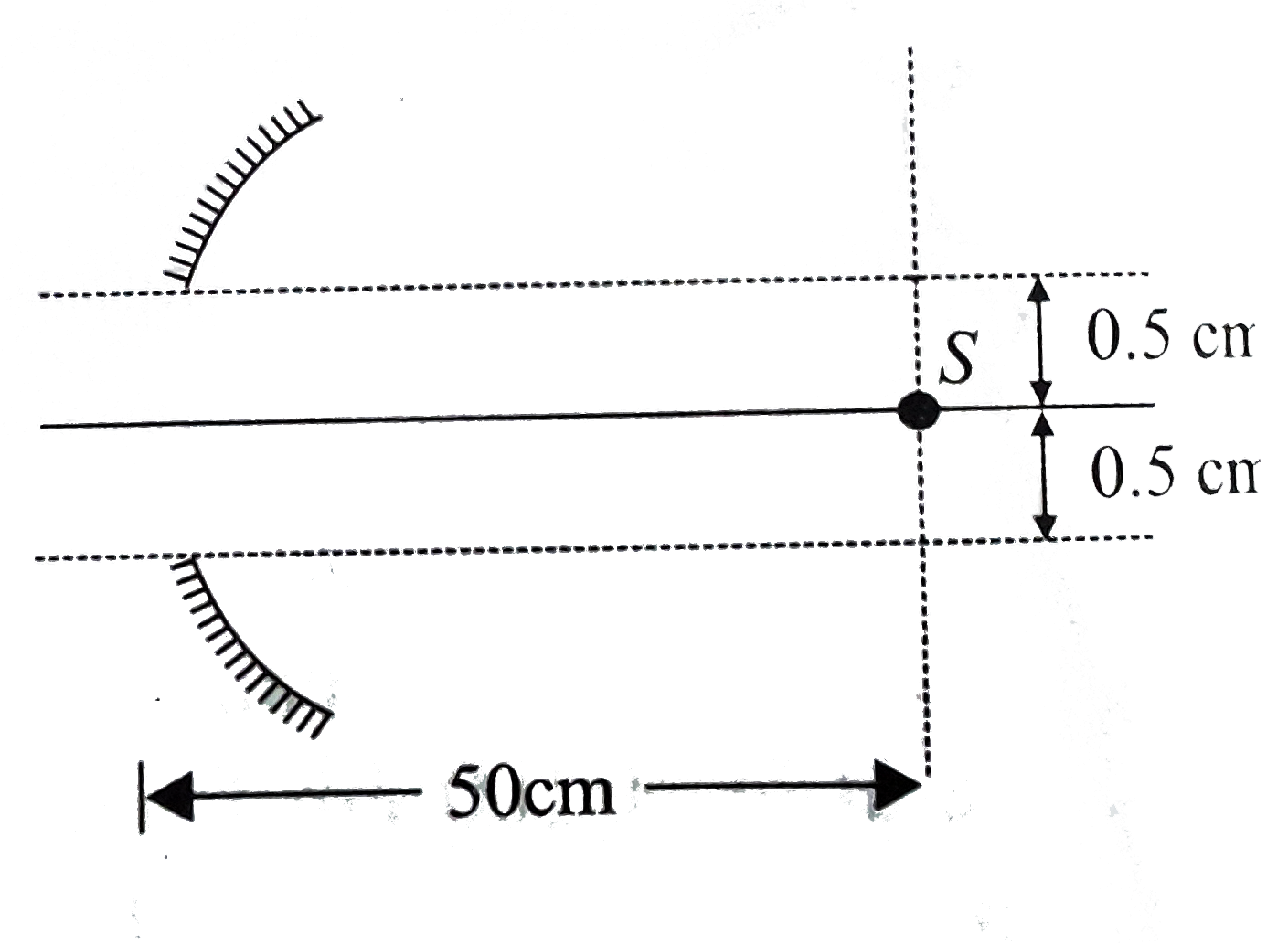
A concave mirror forms real image of a point source lying on the optical axis at a distance of 50cm from the mirror. The focal length of the mirror is 25cm. The mirror is cut in two, and its halves are drawn at a distance of 1 cm apart in a direction perpendicular to the optical axis.

Q. In the given situation, if the two halves are each rotated (before being separated) about S by `90^(@)`, with reference to original position, then the distance between the two images will be

A

0.5cm

B

2cm

C

1cm

D

zero

Text Solution

Verified by Experts

The correct Answer is:

d.

Both the mirrors will be having the common object at their center of curvature. Hence the image position also coincides.
Promotional Banner

Topper's Solved these Questions

  • GEOMETRICAL OPTICS

    CENGAGE PHYSICS ENGLISH|Exercise Integer|15 Videos
  • GEOMETRICAL OPTICS

    CENGAGE PHYSICS ENGLISH|Exercise Archives|7 Videos
  • GEOMETRICAL OPTICS

    CENGAGE PHYSICS ENGLISH|Exercise Assertion-Reasoninig|2 Videos
  • ELECTRON,PHONTS,PHOTOELECTRIC EFFECT & X-RAYS

    CENGAGE PHYSICS ENGLISH|Exercise dpp 3.3|15 Videos
  • HEATING EFFECT OF CURRENT

    CENGAGE PHYSICS ENGLISH|Exercise Thermal Power in Resistance Connected in Circuit|27 Videos

Similar Questions

Explore conceptually related problems

A concave mirror forms real image of a point source lying on the optical axis at a distance of 50cm from the mirror. The focal length of the mirror is 25cm. The mirror is cut in two, and its halves are drawn at a distance of 1 cm apart in a direction perpendicular to the optical axis. Q. The distance between the two images formed by the two halves of the mirror is

Concave mirror forms the real image of a point source lying on the optical axis at a distance of 50 cm from the mirror. The focal length of the mirror is 25 cm. The mirror is cut into and its halves are drawn a distance of 1 cm apart in a direction perpendicular to the optical axis. How will the image formed by the halves of the mirror be arranged?

A concave mirror forms real image of a point source lying on the optical axis at a distance of 50cm from the mirror. The focal length of the mirror is 25cm. The mirror is cut in two, and its halves are drawn at a distance of 1 cm apart in a direction perpendicular to the optical axis. Q. Two statements are provided. Choose which is true and which is false. Statement I: Image formed by half cut mirror has just half the intensity as that of the intensity of image formed by complete mirror. Statement II: More the lateral separation between the two halves of the mirror, less will be the separation between the two images, as show in the given situation.

A concave mirror forms a virtual image of size twice that of the object placed at a distance 5 cm from it . Find the focal length of the mirror.

A concave mirror forms a real image of an object placed in front of it at a distance 30 cm, of size three times the size of object. Find the focal length of mirror.

A concave mirror forms a virtual imageof size twice that of the object placed at a distance 5 cm from it. Find: a. the focal length of the mirror b. position of image.

A point light source is kept in front of a convex mirror at a distance of 40 cm. The focal length of the mirror is 40 cm. Find the position of image.

An object is placed at a distance of 30 cm from a concave mirror and its real image is formed at a distance of 30 cm from the mirror. The focal length of the mirror is

A convex mirror forms the image of an object placed at a distance 40 cm in front of mirror, at distance 10 cm Find the focal length of mirror.

A concave mirror forms a real image of an object placed in front of it at a distance 30 cm, of size three times the size of object. Find a. the focal length of mirror b. position of image.

CENGAGE PHYSICS ENGLISH-GEOMETRICAL OPTICS-Linked Comprehension
  1. A parallel beam of light falls on a solid tranparent sphere. Q. W...

    Text Solution

    |

  2. A parallel beam of light falls on a solid tranparent sphere. Q. I...

    Text Solution

    |

  3. A parallel beam of light falls on a solid tranparent sphere. Q. F...

    Text Solution

    |

  4. Pulfrich refractometer is used to measure the refractive index of soli...

    Text Solution

    |

  5. Pulfrich refractometer is used to measure the refractive index of soli...

    Text Solution

    |

  6. Pulfrich refractometer is used to measure the refractive index of soli...

    Text Solution

    |

  7. An object is present on the principal axis of a concave mirror at a di...

    Text Solution

    |

  8. An object is placed between a plane mirror and a concave mirror of foc...

    Text Solution

    |

  9. An object is present on the principal axis of a concave mirror at a di...

    Text Solution

    |

  10. An object kept near a convex lens of focal length f, executes SHM betw...

    Text Solution

    |

  11. An object kept near a convex lens of focal length f, executes SHM betw...

    Text Solution

    |

  12. An object kept near a convex lens of focal length f, executes SHM betw...

    Text Solution

    |

  13. A convex lens of focal length 40cm is held at a distance 12cm coaxiall...

    Text Solution

    |

  14. A convex lens of focal length 40cm is held at a distance 12cm coaxiall...

    Text Solution

    |

  15. A convex lens of focal length 40cm is held at a distance 12cm coaxiall...

    Text Solution

    |

  16. A concave mirror forms real image of a point source lying on the optic...

    Text Solution

    |

  17. A concave mirror forms real image of a point source lying on the optic...

    Text Solution

    |

  18. A concave mirror forms real image of a point source lying on the optic...

    Text Solution

    |

  19. An object AB of height 1cm lying on the axis of convex mirror of focal...

    Text Solution

    |

  20. An object AB of height 1cm lying on the axis of convex mirror of focal...

    Text Solution

    |
