Home
Class 12
PHYSICS
A glass prism of refractive index 1.5 i...

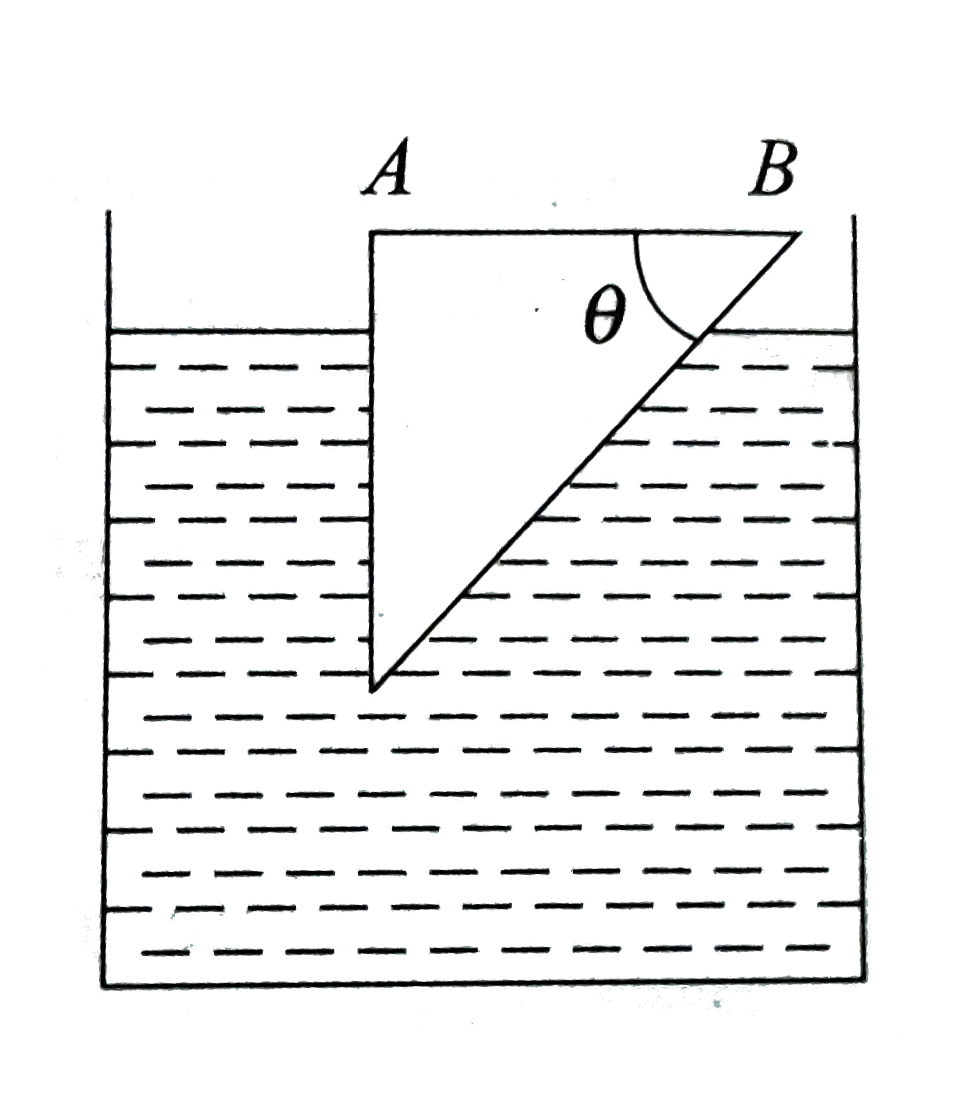
A glass prism of refractive index 1.5 is immersed in water (refractive index `4//3`) . A light beam normally on the face AB is totally reflected to reach on the face BC if

A

`sinthetage(8)/(9)`

B

`(2)/(3) lt sintheta ge lt (8)/(9)`

C

`sintheta le (2)/(3)`

D

`sintheta le (8)/(9)`

Text Solution

Verified by Experts

The correct Answer is:
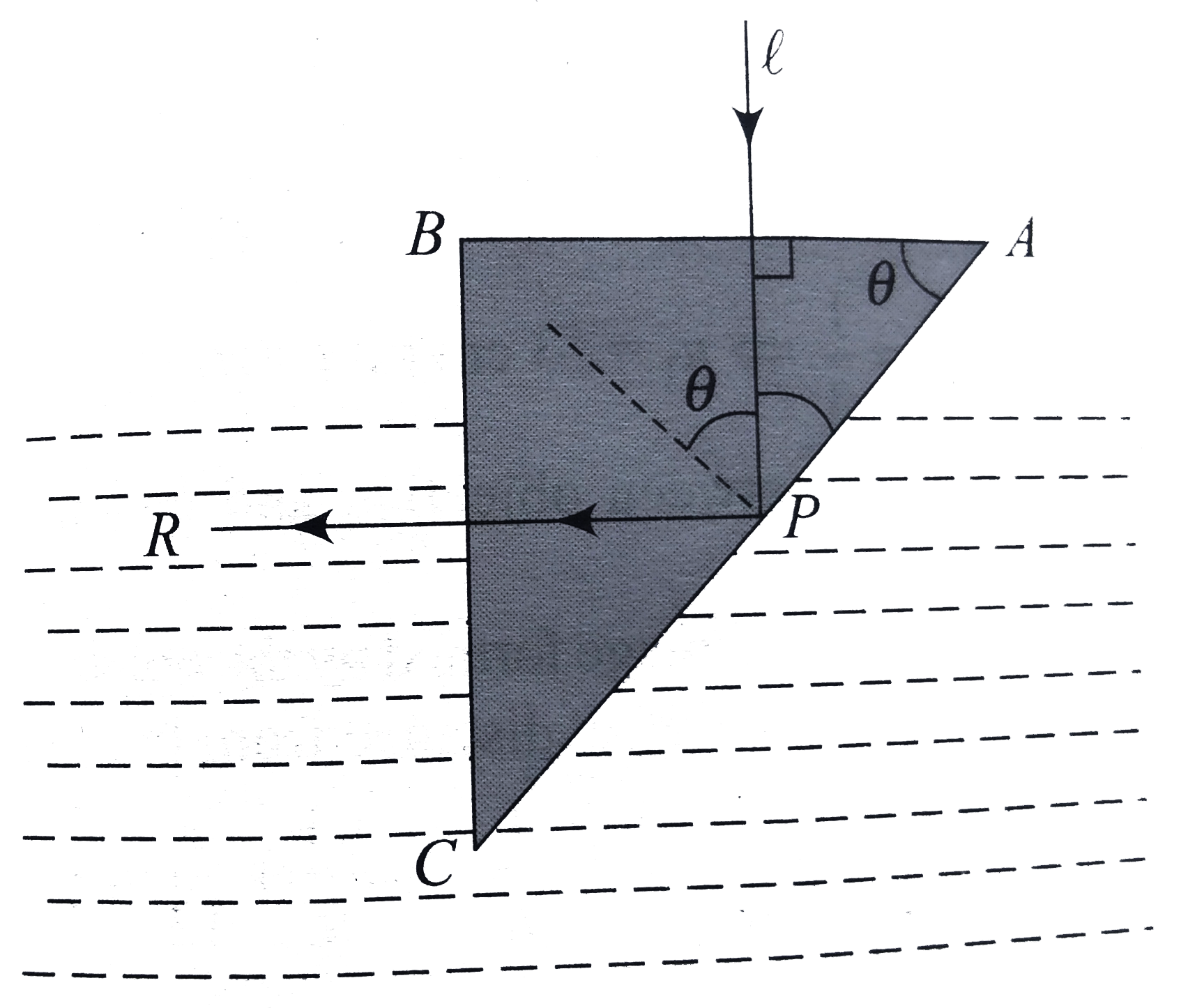
a.

The phenomenon of total internal reflection takes place during reflection at P.
`sintheta=(1)/(._(g)^(w)mu)` (i)
where `theta` is the angle of incidence at P.
Now, `._(g)^(w)mu=(._(g)^(a)h)/(._(g)^(a)mu)=(1.5)/(4//3)=1.125`
Putting in (i),
` sintheta=(1)/(1.125)=(8)/(9)`
Therefore, `sintheta` should be greater than `(8)/(9)`
Promotional Banner

Topper's Solved these Questions

  • GEOMETRICAL OPTICS

    CENGAGE PHYSICS ENGLISH|Exercise Multiple Correct Answers Type|8 Videos
  • GEOMETRICAL OPTICS

    CENGAGE PHYSICS ENGLISH|Exercise Assertion-Reasoninig Type|2 Videos
  • GEOMETRICAL OPTICS

    CENGAGE PHYSICS ENGLISH|Exercise True/False|5 Videos
  • ELECTRON,PHONTS,PHOTOELECTRIC EFFECT & X-RAYS

    CENGAGE PHYSICS ENGLISH|Exercise dpp 3.3|15 Videos
  • HEATING EFFECT OF CURRENT

    CENGAGE PHYSICS ENGLISH|Exercise Thermal Power in Resistance Connected in Circuit|27 Videos

Similar Questions

Explore conceptually related problems

A glass prism of refractive index 1.5 is immersed in water of refractive index 4/3. A light ray incident normally on face AB is totally reflected at face AC if

(a) Show using a proper diagram how unpolarised light can be linearly polarised by reflection from a transparent glass surface. (b) The figure shows a ray of light falling normally on. the face AB of an equilateral glass prism having refractive index 3/2, placed A in water ofrefractive index 4/3. Will this ray suffer total internal reflection on striking the face AC? Justify your answer.

A glass prism is immeresed in water as shown in the figure. When a beam of light incident is incident normally on the face ab, it is internally reflected at the face ad. If the refractive index of glass is 1.5 and that of water is 4//3 , then

A prism of refractive index 1.53 is placed in water of refractive index 1.33 . If the angle of prism is 60^@ , calculate the angle of minimum deviation in water.

A narrow beam of monochromatic light, PQ, is incident normally on one face of an equiangular glass prism of refractive index 1.45 . When the prism is immersed in a certain liquid, the ray makes a grazing emergence along the other face (figure). Find the refractive index of this liquid .

A transparent cube of side d, made of a material of refractive index mu_(2) , is immersed in a liquid of refractive index mu_(1)(mu_(1)ltmu_(2)) . . A ray is incident on the face AV at an angle theta (shown in the figure). Total internal refraction takes place at point E on the face BC. Then must satisfy:

A transparent cube of side d, made of a material of refractive index mu_(2) , is immersed in a liquid of refractive index mu_(1)(mu_(1)ltmu_(2)) . . A ray is incident on the face AV at an angle theta (shown in the figure). Total internal refraction takes place at point E on the face BC. Then must satisfy:

The focal length of lens of refractive index 1.5 in air is 30 cm When it is immersed in water of refractive index (4)/(3) ,then its focal length will be

A lens is made of flint glass (refractive index =1.5 ). When the lens is immersed in a liquid of refractive index 1.25 , the focal length:

A narrow beam of monochromatic light, pe, is incident normally on one face of an equiangular glass prism of refractive inder 1-45. When the prism is immersed in a certain liquid, the ray makes a grazing emergence along the other face (See below figure). Find the refractive index of this liquid.

CENGAGE PHYSICS ENGLISH-GEOMETRICAL OPTICS-Single Correct Answer Type
  1. When a ray of light enters a glass slab from air.

    Text Solution

    |

  2. In Young's double slit experiment, the sepcaration between the slits i...

    Text Solution

    |

  3. A glass prism of refractive index 1.5 is immersed in water (refractiv...

    Text Solution

    |

  4. A convex lens of focal length 40 cm in contact with a concave lens wit...

    Text Solution

    |

  5. A ray of light from a denser medium strike a rarer medium at an angle ...

    Text Solution

    |

  6. Two coherent monochromatic light beams of intensities I and 4I are sup...

    Text Solution

    |

  7. A short linear object of length b lies along the axis of a concave mir...

    Text Solution

    |

  8. A beam of light consisting of red, green and blue colurs is incident o...

    Text Solution

    |

  9. A thin prism P(1) with angle 4^(@) and made from glass of refractive i...

    Text Solution

    |

  10. Two thin convex lenses of focal lengths f(1) and f(2) are separated by...

    Text Solution

    |

  11. Spherical aberration in a thin lens can be reduced by

    Text Solution

    |

  12. A beam of light of wavelength 600nm from a distance source falls on a ...

    Text Solution

    |

  13. An isosceles prism of angle 120degree has a refractive index 1.44. Two...

    Text Solution

    |

  14. A diminished image of an object is to be obtained on a screen 1.0 m fr...

    Text Solution

    |

  15. The focal lengths of the objective and the eyepiece of a compound mic...

    Text Solution

    |

  16. An eye specialist prescribes spectacles having a combination of a conv...

    Text Solution

    |

  17. A real image of a distant object is formed by a plano-convex lens on i...

    Text Solution

    |

  18. A concave mirror is placed on a horizontal table with its axis directe...

    Text Solution

    |

  19. A spherical surface of radius of curvature R separates air (refractive...

    Text Solution

    |

  20. A concave lens of glass, refractive index 1.5, has both surfaces of sa...

    Text Solution

    |

