Home
Class 12
PHYSICS
Two thin convex lenses of focal lengths ...

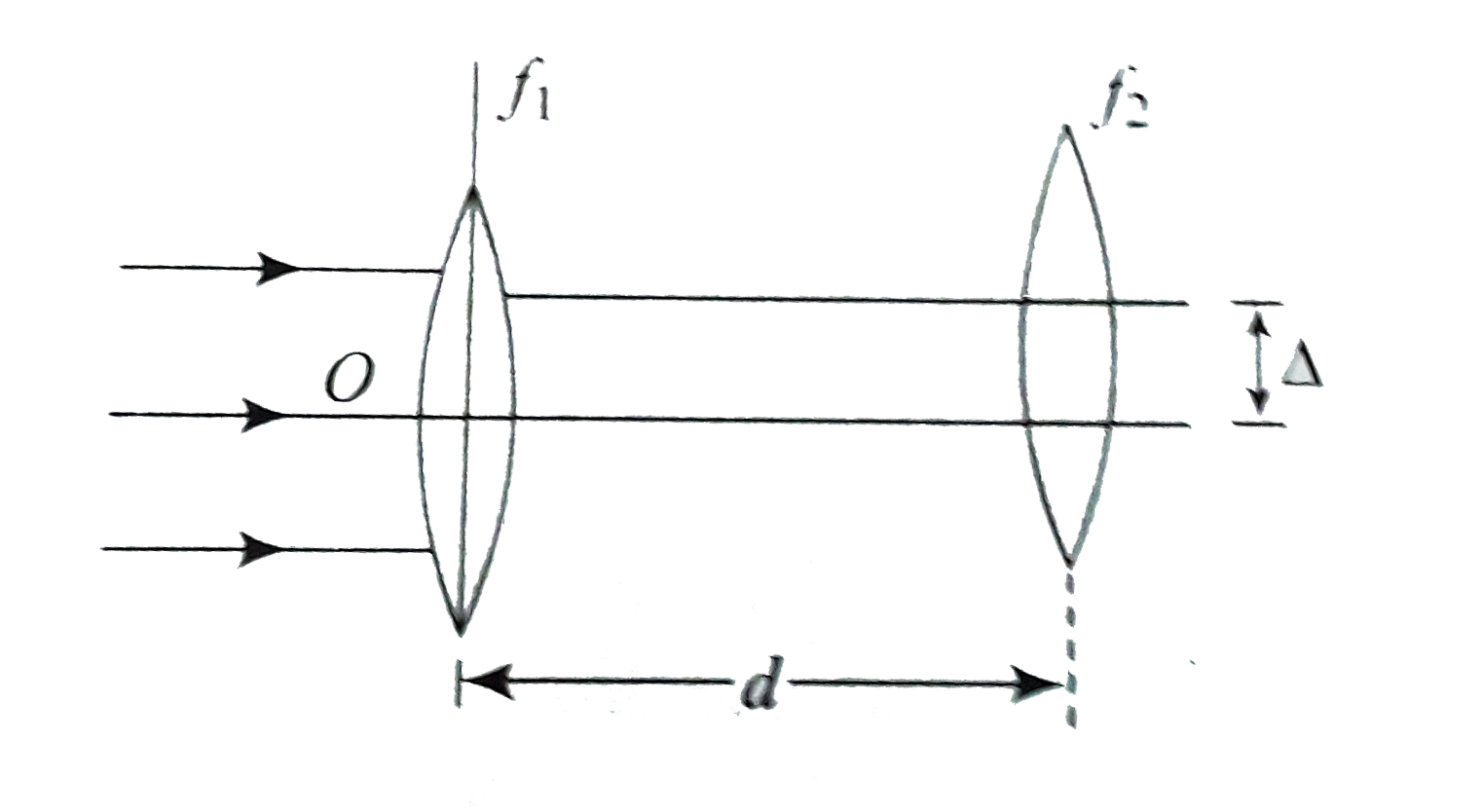
Two thin convex lenses of focal lengths `f_(1)` and `f_(2)` are separated by a horizontal distance `d(d lt f_(1)` and `d lt f_(2))` and their centers are displaced by a vertical separation as shown in the figure. A parallel beam of rays coming from left. Take the origin of coordinates O at the center of first lens.

Q. Find the y-coordinate of the focal point of this lens system.

A

`x=(f_(1)f_(2))/(f_(1)+f_(2)),y=Delta`

B

`x=(f_(1)(f_(2)+d))/(f_(1)+f_(2)-d),y=(Delta)/(f_(1)+f_(2))`

C

`x=(f_(1)f_(2)+d(f_(1)-d))/(f_(1)+f_(2)-d),y=(Delta(f_(1)-d))/(f_(1)+f_(2)-d)`

D

`x=(f_(1)f_(2)+d(f_(1)-d))/(f_(1)+f_(2)-d),y=(Delta(f_(1)-d))/(f_(1)+f_(2)-d)`

Text Solution

Verified by Experts

The correct Answer is:
c.

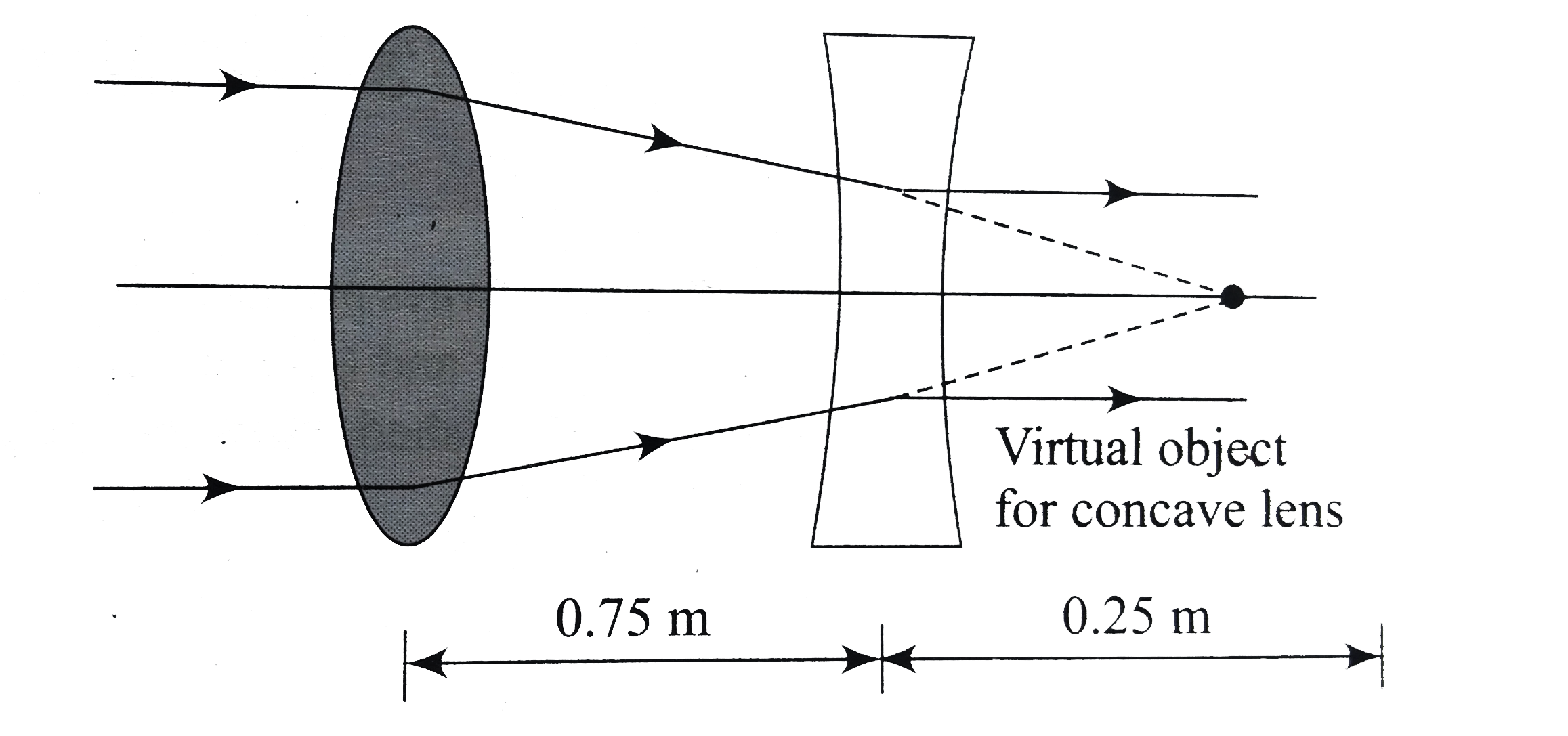
The image `I^(')` of parallel rays formed by lens 1 will act as a virtual object.
Applying lens formula for lens 2,
`(1)/(v)-(1)/(u)=(1)/(f)`
`rArr(1)/(v)-(1)/(f_(1)-d)=(1)/(f_(2))`
`rArr v=(f_(2)(f_(1)-d))/(f_(2)+f_(1)-d)`
The horizontal distance of the image O is
`x=d+(f_(2)(f_(1)-d))/(f_(2)+f_(1)-d)`
`=(df_(2)+df_(1)-d^(2)+f_(2)f_(1)-df_(2))/(f_(2)+f_(1)-d)`
`=(f_(1)f_(2)+d(f_(1)-d))/(f_(2)+f_(1)-d)`
To find teh y-coordinate, we use magnification formula for lens 2,
`m=(v)/(u)=(f_(2)(f_(1)-d)/(f_(1)+f_(2)-d))/(f_(1)-d)=(f_(2))/(f_(1)+f_(2)-d)`. Also
`m=(h^(2))/(Delta)rArr h_(2)=(Deltaxx f_(2))/(f_(1)+f_(2)-d)`
Therefore, the y-coordinate,
`y=Delta-h_(2)`
`=Delta-(Deltaf_(2))/(f_(1)+f_(2)-d)`
`=(Deltaf_(1)+Deltaf_(2)-Deltad-Deltaf_(2))/(f_(1)+f_(2)-d)=(Delta(f_(1)-d))/(f_(1)-f_(2)-d)`
Promotional Banner

Topper's Solved these Questions

  • GEOMETRICAL OPTICS

    CENGAGE PHYSICS ENGLISH|Exercise Multiple Correct Answers Type|8 Videos
  • GEOMETRICAL OPTICS

    CENGAGE PHYSICS ENGLISH|Exercise Assertion-Reasoninig Type|2 Videos
  • GEOMETRICAL OPTICS

    CENGAGE PHYSICS ENGLISH|Exercise True/False|5 Videos
  • ELECTRON,PHONTS,PHOTOELECTRIC EFFECT & X-RAYS

    CENGAGE PHYSICS ENGLISH|Exercise dpp 3.3|15 Videos
  • HEATING EFFECT OF CURRENT

    CENGAGE PHYSICS ENGLISH|Exercise Thermal Power in Resistance Connected in Circuit|27 Videos

Similar Questions

Explore conceptually related problems

Two thin convex lenses of focal lengths f_(1) and f_(2) are separated by a horizontal distance d (where dltf_(1) , dltf_(2) ) and their centres are displaced by a vertical separation triangle as shown in the fig. Taking the origin of coordinates O, at the centre of the first lens the x and y coordinates of the focal point of this lens system, for a parallel beam of rays coming form the left, are given by:

Two thin convex lenses of focal lengths f_(1) and f_(2) are separated by a horizontal distance d (where dltf_(1) , dltf_(2) ) and their centres are displaced by a vertical separation triangle as shown in the fig. Taking the origin of coordinates O, at the centre of the first lens the x and y coordinates of the focal point of this lens system, for a parallel beam of rays coming form the left, are given by:

Two thin lenses of focal lengths f_(1) and f_(2) are in contact. The focal length of this combination is

Two thin lenses of focal length f_(1) and f_(2) are in contact and coaxial. The power of the combination is

Two converging lenses of focal lengths f_(1)=10cm and f_(2)=20cm are placed at some separation. A parallel beam of light is incident on first lens. Then,

Two converging lenses of the same focal length f are separated by a distance 2f. The axis of the second lens is inclined at angle theta=60^@ with respect to the axis of the first lens. A parallel paraxial beam of light is incident from left side of the lens. Find the coordinates of the final image with respect to the origin of the first lens.

A convex lens of focal length f_(1) is kept in contact with a concave lens of focal length f_(2) . Find the focal length of the combination.

In the figure shown, there are two convex lenses L_(1) and L_(2) having focal. Lengths f_(1) and f_(2) respectively. The distance between L_(1) and L_(2) will be

A convex lens of focal length f cut into parts first horizontally and then vertically. Find the focal length of part A of the lens, as shown:

A convex lens of focal length 10 cm and a concave lens of same focal length in value are placed co-axially at a separation of 20 cm as shown in figure. A point object is at infinity on the principal axis. Take the optic center of convex lens as origin of co ordinate system and the principal axis as x-axis as shown in figure. The co-ordinates of the image formed after refraction through both the lenses is

CENGAGE PHYSICS ENGLISH-GEOMETRICAL OPTICS-Single Correct Answer Type
  1. A beam of light consisting of red, green and blue colurs is incident o...

    Text Solution

    |

  2. A thin prism P(1) with angle 4^(@) and made from glass of refractive i...

    Text Solution

    |

  3. Two thin convex lenses of focal lengths f(1) and f(2) are separated by...

    Text Solution

    |

  4. Spherical aberration in a thin lens can be reduced by

    Text Solution

    |

  5. A beam of light of wavelength 600nm from a distance source falls on a ...

    Text Solution

    |

  6. An isosceles prism of angle 120degree has a refractive index 1.44. Two...

    Text Solution

    |

  7. A diminished image of an object is to be obtained on a screen 1.0 m fr...

    Text Solution

    |

  8. The focal lengths of the objective and the eyepiece of a compound mic...

    Text Solution

    |

  9. An eye specialist prescribes spectacles having a combination of a conv...

    Text Solution

    |

  10. A real image of a distant object is formed by a plano-convex lens on i...

    Text Solution

    |

  11. A concave mirror is placed on a horizontal table with its axis directe...

    Text Solution

    |

  12. A spherical surface of radius of curvature R separates air (refractive...

    Text Solution

    |

  13. A concave lens of glass, refractive index 1.5, has both surfaces of sa...

    Text Solution

    |

  14. A hollow double concave lens is made of very thin transparent materia...

    Text Solution

    |

  15. A point source of light S, placed at a distance L in front of the cen...

    Text Solution

    |

  16. A diverging beam of light from a point source S having divergence angl...

    Text Solution

    |

  17. A rectangular slab ABCD, of refractive index n1 , is immersed in water...

    Text Solution

    |

  18. In a compound microscope, the intermediate image is

    Text Solution

    |

  19. A ray of light passes through four transparent media with refractive i...

    Text Solution

    |

  20. A given ray of light suffers minimum deviation in an equilateral prism...

    Text Solution

    |

