Home
Class 12
PHYSICS
Two plane mirrors A and B are aligned pa...

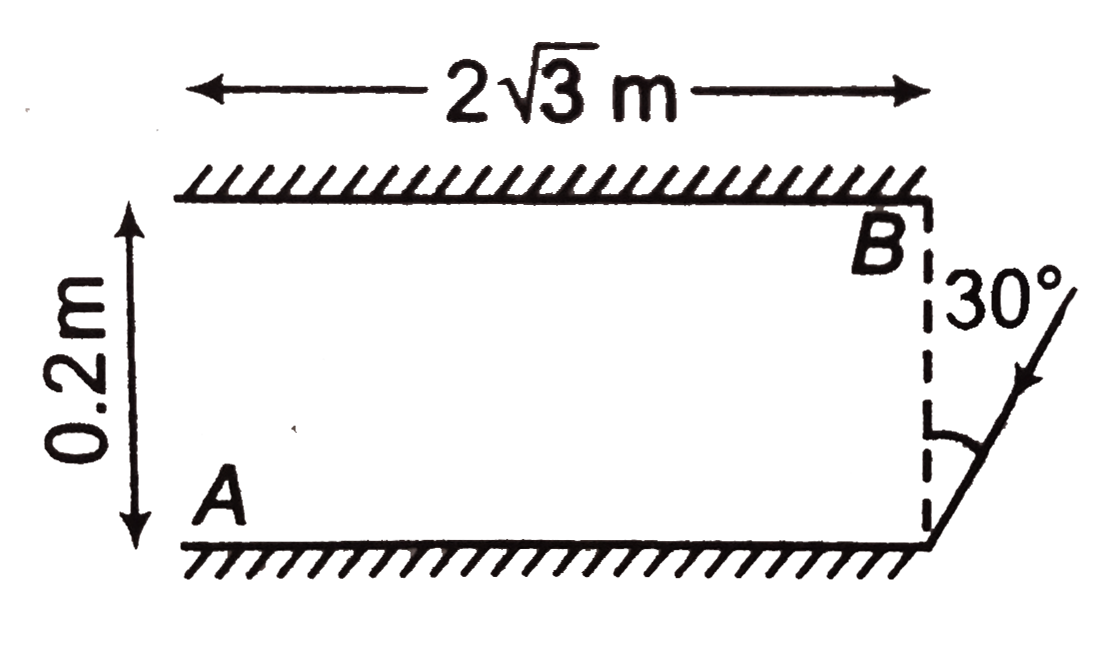
Two plane mirrors A and B are aligned parallel to each other as shown in the figure. A light ray is incident at an angle of `30^(@)` at a point just inside one end of A. The number of times the ray undergoes reflections (including the first one) before it emerges out is

A

28

B

30

C

32

D

34

Text Solution

Verified by Experts

The correct Answer is:
B

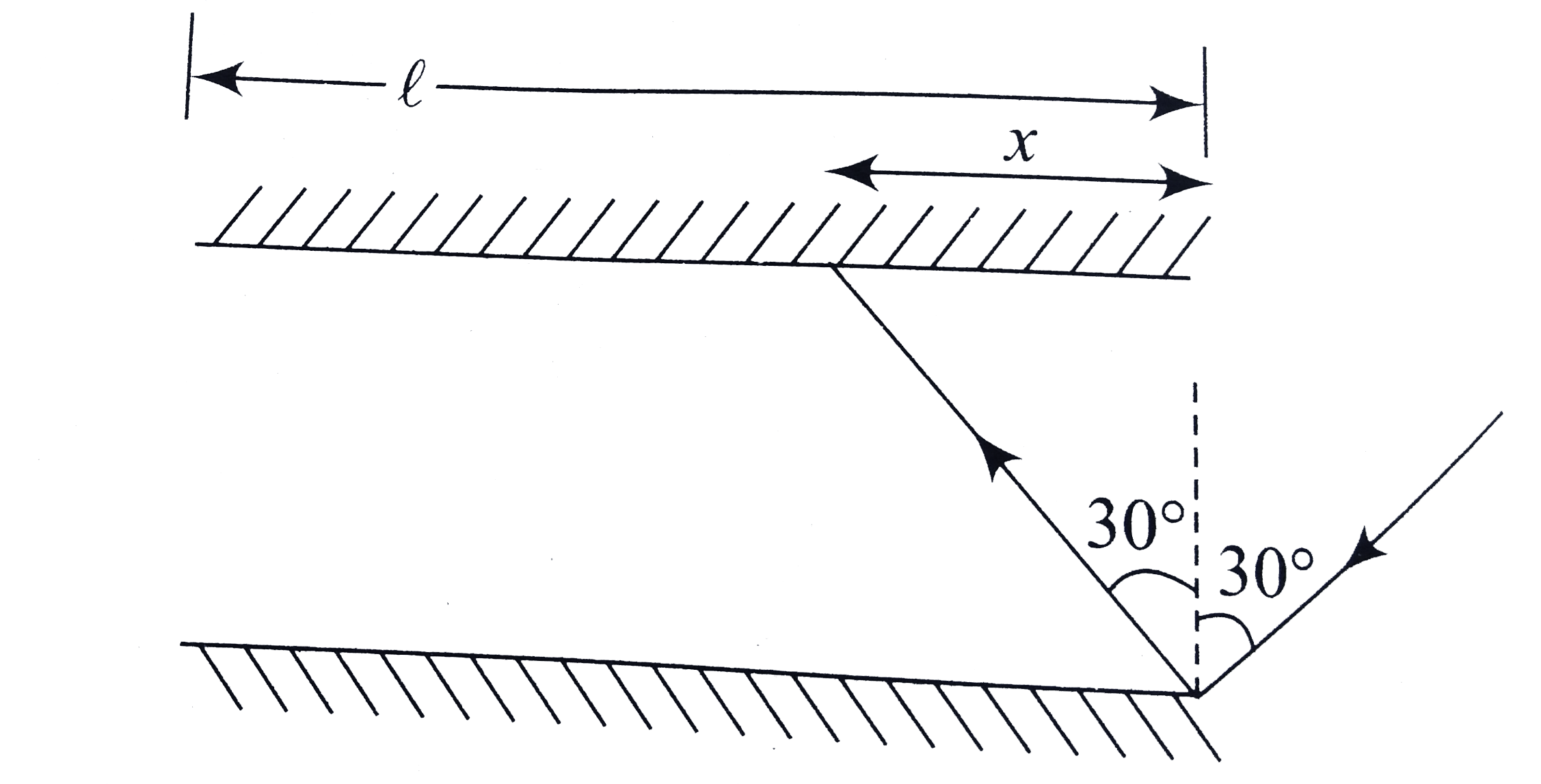
Maximum number or relfections `=[(l)/(x)]` , where `x=0.2tan30^(@)`
Promotional Banner

Topper's Solved these Questions

  • GEOMETRICAL OPTICS

    CENGAGE PHYSICS ENGLISH|Exercise Multiple Correct Answers Type|8 Videos
  • GEOMETRICAL OPTICS

    CENGAGE PHYSICS ENGLISH|Exercise Assertion-Reasoninig Type|2 Videos
  • GEOMETRICAL OPTICS

    CENGAGE PHYSICS ENGLISH|Exercise True/False|5 Videos
  • ELECTRON,PHONTS,PHOTOELECTRIC EFFECT & X-RAYS

    CENGAGE PHYSICS ENGLISH|Exercise dpp 3.3|15 Videos
  • HEATING EFFECT OF CURRENT

    CENGAGE PHYSICS ENGLISH|Exercise Thermal Power in Resistance Connected in Circuit|27 Videos

Similar Questions

Explore conceptually related problems

Two plane mirrors are arranged at right angles to each other as shown in figure.A ray of light is incident on the horizontal mirror at an angle theta . For what value of theta the ray emerges parallel to the incoming ray after reflection from the vertical mirror ?

A ray of light is incident at an angle of 30^(@) with the plane of a plane mirror. Find the angle of reflection.

Two plane mirrors are making an angle of 60^(@) to each other. A light ray falls on one of the mirrors. The light ray is incident parallel to angular bisector of mirrors. How many reflection does the light ray undergo?

Two plane mirror are inclined to each other at 90^(@) . A ray of light is incident on one mirror. The ray will undergo a total deviation of

Two plane mirrror are inclined to each other at 70^(@) . A ray of light is incident on one mirror. They ray after two reflections will undergo a total deviation of :

Two plane mirrors are inclined to each other at an angle theta . A ray of light is reflected at one mirror and then at the other. Find the total deviation of the ray.

Two mirrors are inclined at angle theta as shown in figure. Light rays are incident parallel to one of mirrors. Light will start retracing its path after the reflection if

Two plane mirrors are inclined at an angle of 60^(@) with each other. An incident ray hits one of the mirror at an angle of 80^(@) with the normal. Its angle of deviation after two reflections is

A ray of light is incident at an angle of 60^(@) on one face of a prism of angle 30^(@) . The ray emerging out of the prism makes an angle of 30^(@) with the incident ray. The emergent ray is

Two plans mirrors are inclined to each other at some angle .A ray of light incident at 30^(@) on one,after reflection form the other retraces its path .The angles between the mirrors is:

CENGAGE PHYSICS ENGLISH-GEOMETRICAL OPTICS-Single Correct Answer Type
  1. An observer can see through a pin-hole the top end of a thin rod of...

    Text Solution

    |

  2. Which one of the following sperical lenses does not exhibit dispersion...

    Text Solution

    |

  3. Two plane mirrors A and B are aligned parallel to each other as shown ...

    Text Solution

    |

  4. The size of the image of an object, which is at infinity, as formed by...

    Text Solution

    |

  5. A ray of light is incident at the glass-water interface at an angle i....

    Text Solution

    |

  6. A beam of white light is incident on the glass-air interface from glas...

    Text Solution

    |

  7. An equilateral prism is placed on a horizontal surface. A ray PQ is in...

    Text Solution

    |

  8. A point object is placed at the center of a glass sphere of radius 6cm...

    Text Solution

    |

  9. A convex lens is in contact with a concave lens. The magnitude of the...

    Text Solution

    |

  10. A container is filled with water (mu=1.33) upto a height of 33.25cm. A...

    Text Solution

    |

  11. Focal length of the plano-convex lens is 15cm. A small object is place...

    Text Solution

    |

  12. The graph shown relationship between object distance and image distanc...

    Text Solution

    |

  13. A biconvex lens of focal length f forms a circular image of radius r o...

    Text Solution

    |

  14. A ray of light travelling in water is incident on its surface open to ...

    Text Solution

    |

  15. In an experiment to determine the focal length (f) of a concave mirror...

    Text Solution

    |

  16. Rays of light from Sunn falls on a biconvex lens of focal length f an...

    Text Solution

    |

  17. A light beam is traveling from Region I to region IV (refer figure). T...

    Text Solution

    |

  18. Two beam of red and violet color are made to pass separately through a...

    Text Solution

    |

  19. A ball is dropped from a height of 20m above the surface of water in a...

    Text Solution

    |

  20. A biconvex lens of focal length 15cm is in front of a plane mirror. Th...

    Text Solution

    |

