Home
Class 12
PHYSICS
A light beam is traveling from Region I ...

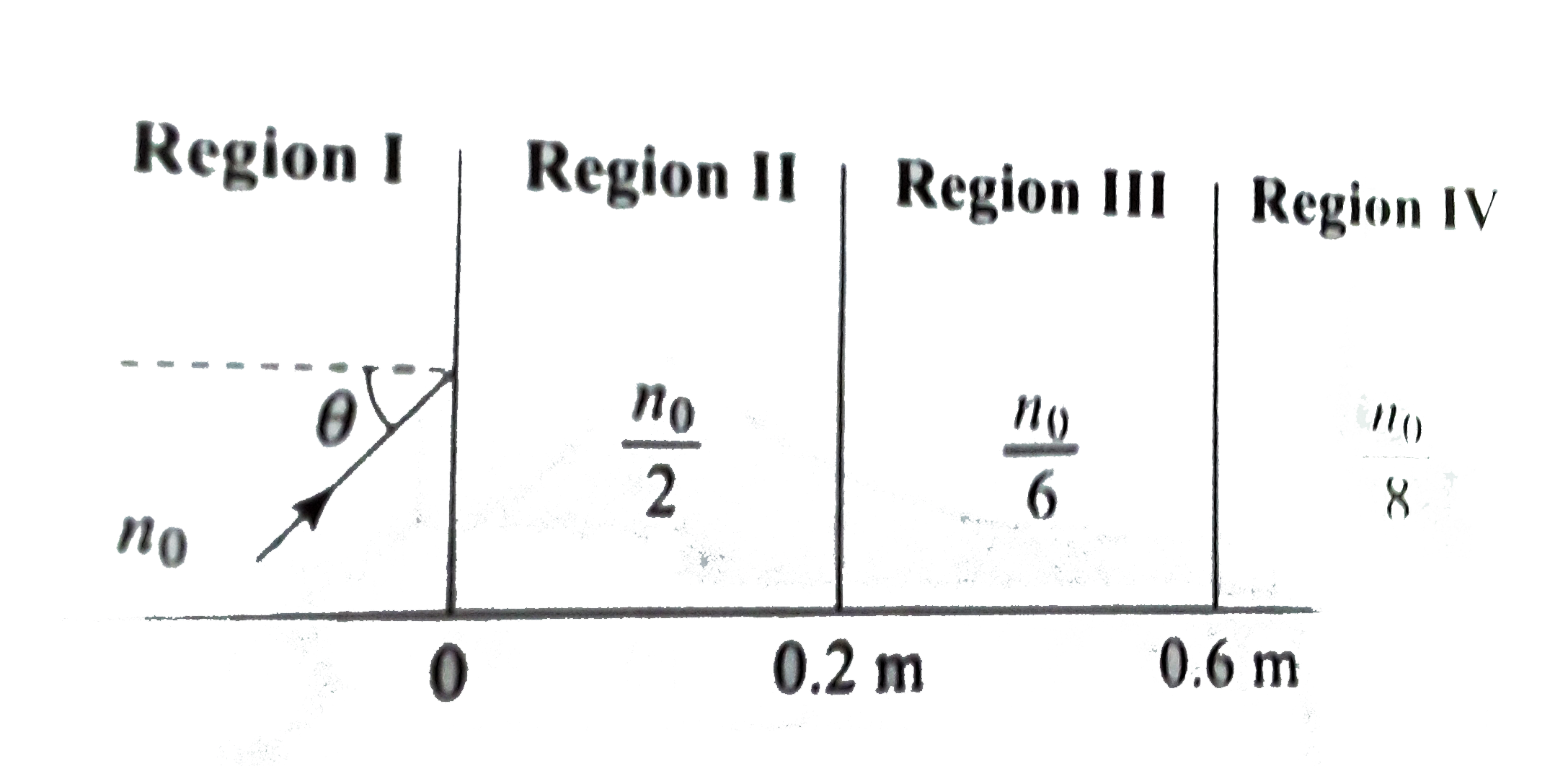
A light beam is traveling from Region I to region IV (refer figure). The refractive indices in Region I, II, III, and IV are `n_(0), n_(0)//2,n_(0)//6 and n_(0)//8` , respectively. The angle of incidence `theta` for which the beam just misses entering Region IV is

A

`sin^(-1)(3//4)`

B

`sin^(-1)(1//8)`

C

`sin^(-1)(1//4)`

D

`sin^(-1)(1//3)`

Text Solution

Verified by Experts

The correct Answer is:

b.

Critical angle from region III to region IV
`sintheta_(c)=(n_(0)//8)/(n_(0)//6)=(3)/(4)`
Now, applying Snell's law in region I and region III
`n_(0)sintheta =(n_(0))/(6)sintheta_(c)`
`sintheta =(1)/(6)sintheta_(c)=(1)/(6)((3)/(4))=(1)/(8)rArr theta=sin^(-1)((1)/(8))`
`:.` Correct option is (b).`
Promotional Banner

Topper's Solved these Questions

  • GEOMETRICAL OPTICS

    CENGAGE PHYSICS ENGLISH|Exercise Multiple Correct Answers Type|8 Videos
  • GEOMETRICAL OPTICS

    CENGAGE PHYSICS ENGLISH|Exercise Assertion-Reasoninig Type|2 Videos
  • GEOMETRICAL OPTICS

    CENGAGE PHYSICS ENGLISH|Exercise True/False|5 Videos
  • ELECTRON,PHONTS,PHOTOELECTRIC EFFECT & X-RAYS

    CENGAGE PHYSICS ENGLISH|Exercise dpp 3.3|15 Videos
  • HEATING EFFECT OF CURRENT

    CENGAGE PHYSICS ENGLISH|Exercise Thermal Power in Resistance Connected in Circuit|27 Videos

Similar Questions

Explore conceptually related problems

A beam of light passes from medium 1 to medium 2 to medium 3 as shown figure. What may be concluded about the three indices of refraction, n_(1),n_(2),and n_(3) ?

A beam of electrons is moving with uniform velocity in a region having transverse uniform electric and magnetic field of strength. 100 V/m and 0.1 T respectively at right angles to the direction of beam. The velocity of the electrons is

An intially parallel cyclindrical beam travels in a medium of refractive index mu (I) = mu_(0) + mu_(2) I , where mu_(0) and mu_(2) are positive constants and I is intensity of light beam. The intensity of the beam is decreasing with increasing radius. Answer the following questions : As the beam enters the medium, it will

An intially parallel cyclindrical beam travels in a medium of refractive index mu (I) = mu_(0) + mu_(2) I , where mu_(0) and mu_(2) are positive constants and I is intensity of light beam. The intensity of the beam is decreasing with increasing radius. Answer the following questions : The initial shape of the wavefront of the beam is

An intially parallel cyclindrical beam travels in a medium of refractive index mu (I) = mu_(0) + mu_(2) I , where mu_(0) and mu_(2) are positive constants and I is intensity of light beam. The intensity of the beam is decreasing with increasing radius. Answer the following questions : The speed of light in the medium is

The value of I(n) =int_0^pi(sin ^2n theta)/(sin^2theta) d theta is (AA n in N)

A hollow double concave lens is made of very thin transparent material. It can be filled with air or either of two liquids L_(1) or L_(2) having refractive indices n_(1) and n_(2) , respectively (n_(2) gt n_(1) gt 1) . The lens will diverge parallel beam of light if it is filles with

A light ray enters into a medium whose refractive index varies along the x-axis as n(x) = n_(0) sqrt(1+(x)/(4)) where n_(0)=1 . The medium is bounded by the plates x =0,x =1 & y =0 . It the ray enters at the origin at an angle 30^(@) with x-axis

Let P(n): 2^(n) lt n! , then the smallest positive integer for which P(n) is true is: (i) 1 (ii) 2 (iii) 3 (iv) 4

In the figure, the point A(m, n) lies in Quadrant II as shown. In which region is the point B(n, m) ?

CENGAGE PHYSICS ENGLISH-GEOMETRICAL OPTICS-Single Correct Answer Type
  1. The size of the image of an object, which is at infinity, as formed by...

    Text Solution

    |

  2. A ray of light is incident at the glass-water interface at an angle i....

    Text Solution

    |

  3. A beam of white light is incident on the glass-air interface from glas...

    Text Solution

    |

  4. An equilateral prism is placed on a horizontal surface. A ray PQ is in...

    Text Solution

    |

  5. A point object is placed at the center of a glass sphere of radius 6cm...

    Text Solution

    |

  6. A convex lens is in contact with a concave lens. The magnitude of the...

    Text Solution

    |

  7. A container is filled with water (mu=1.33) upto a height of 33.25cm. A...

    Text Solution

    |

  8. Focal length of the plano-convex lens is 15cm. A small object is place...

    Text Solution

    |

  9. The graph shown relationship between object distance and image distanc...

    Text Solution

    |

  10. A biconvex lens of focal length f forms a circular image of radius r o...

    Text Solution

    |

  11. A ray of light travelling in water is incident on its surface open to ...

    Text Solution

    |

  12. In an experiment to determine the focal length (f) of a concave mirror...

    Text Solution

    |

  13. Rays of light from Sunn falls on a biconvex lens of focal length f an...

    Text Solution

    |

  14. A light beam is traveling from Region I to region IV (refer figure). T...

    Text Solution

    |

  15. Two beam of red and violet color are made to pass separately through a...

    Text Solution

    |

  16. A ball is dropped from a height of 20m above the surface of water in a...

    Text Solution

    |

  17. A biconvex lens of focal length 15cm is in front of a plane mirror. Th...

    Text Solution

    |

  18. A bi-convex lens is formed with two thin plano-convex lenses as shown ...

    Text Solution

    |

  19. A ray of light travelling in the direction (1)/(2)(hati,+sqrt3hatj) is...

    Text Solution

    |

  20. The image of an object, formed by a plano-convex lens at a distance of...

    Text Solution

    |
