Home
Class 12
PHYSICS
Two sources S(1) and S(2) emiting light ...

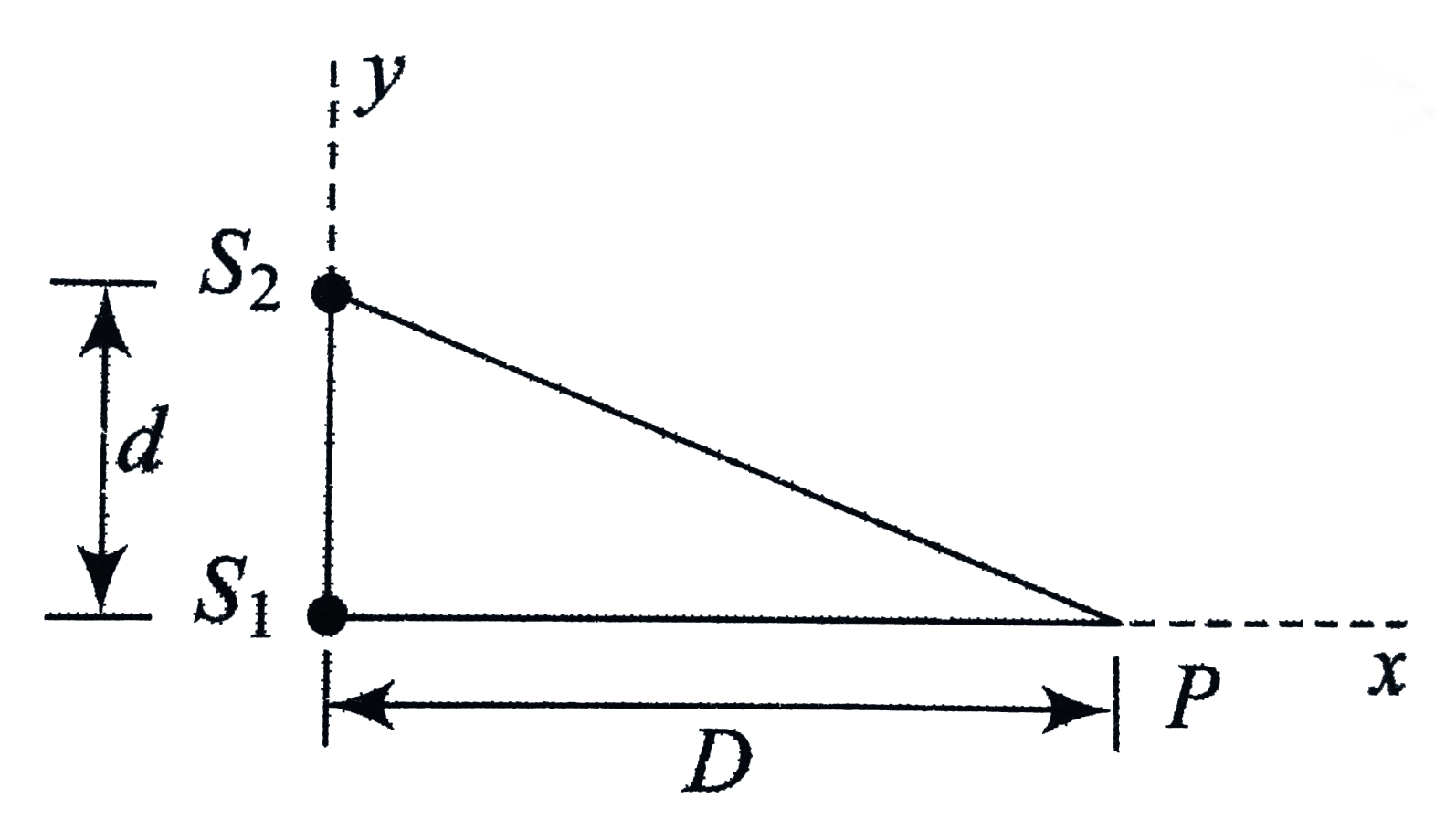
Two sources `S_(1)` and `S_(2)` emiting light of wavelenght 600 nm placed a distance `1.0 xx 10^(-2)` cm apart.
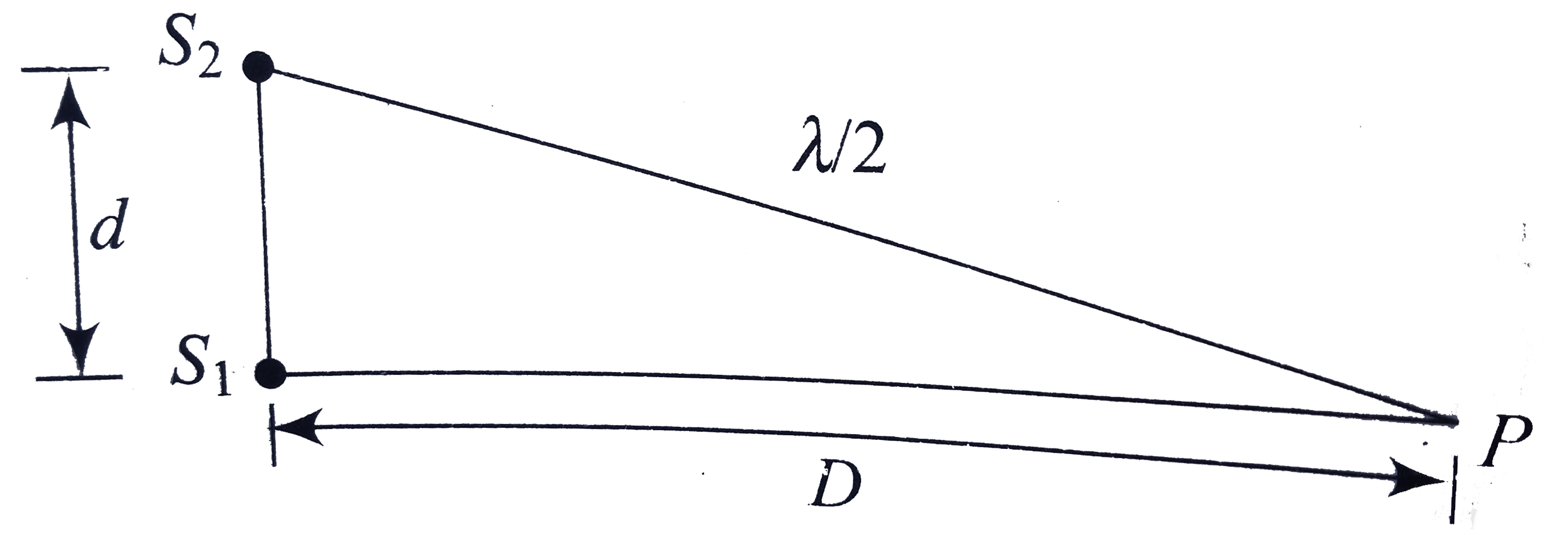
A detector can be moved on line `S_(1) P` which is perpendicular to `S_(1) S_(2)`
(a) What would be the minimum and maximum path difference at the detector as it moves along line `S_(1) P` ?
(b) Locate the psoition of the farthest minima detected
.

Text Solution

Verified by Experts

a. Path difference at P,`Delta x = S_(2) P - S_(1) P`
Minimum path difference will occur when the observer will be at a large distance from the sources. The Path difference will be maximum when the observer is near source `S_(1)`. As observer moves from `S_(1)` toward `+ x-` direction, the path difference decreases from d to zero.
`(Delta x)_(max)` : when `S_(1) P`, i.e., detector is at position`S_(1)`.
`:. (Delta x)_(max) = S_(1) S_(2) = d = 1.0 xx 10^(-2) m`
`(Delta x)_(min)` : when detector is at large distance and
`(Delta x)_(min)` will be apprximately zero.
b. Let the farthest minimum occur at P. As we move away increases as we move toward `S_(2)`. At the position of the farthest minimum path difference is
`S_(2) P - S_(1) P = lambda//2`
`(D^(2) + d^(2))^(1//2) - D = lambda//2`
`[D(1 + (d^(2))/(D^(2)))^(1//2)] - D = lambda//2`
`(d^(2))/(2D) = (lambda)/(2) implies D = (d^(2))/(lambda) D = (d^(2))/(lambda) = (lambda)/(4) = 1.7 cm`
.
Promotional Banner

Topper's Solved these Questions

  • WAVE OPTICS

    CENGAGE PHYSICS ENGLISH|Exercise Solved Examples|10 Videos
  • WAVE OPTICS

    CENGAGE PHYSICS ENGLISH|Exercise Exercise 2.1|12 Videos
  • SOURCES OF MAGNETIC FIELD

    CENGAGE PHYSICS ENGLISH|Exercise single correct Ansewer type|12 Videos

Similar Questions

Explore conceptually related problems

Two sources S_1 and S_2 emitting light of wave length 600 nm are placed a distance 1.0x10^-2 cm apart. A detector can be moved on the litre line S_1P which is perpendicular to S_1S_2 . a.What would be the minimum and maximum path differrence at the detector as it is moved alog the line S_1P ? b. Locate the position of the farthest minimum detect.

Two source of sound, S_(1) and S_(2) , emitting waves of equal wavelength 2 cm , are placed with a separation of 3 cm between them. A detector can be moved on a line parallel to S_(1) S_(2) and at a distance 24 cm from it. Initially, the detecor is equidistant from the two sources. Assuming that the waves emitted by the sources are in phase, find the minimum distance through which the detector should be shifted to detect a minimum of sound.

Two sources of sound, S_1 and S_2 , emitting waves of equal wavelength 20.0 cm, are placed with a separation of 20.0 cm between them. A detector can be moved on a line parallel to S_1S_2 and at a distance of 20.0 cm from P it. Initially, the detector is equidistant from the two sources. Assuming that the waves emitted by the sources are in phase, find the minimum distance through wffich the detector should be shifted to detect a minimum of sound.

Two coherent point sources S_(1) and S_(2) vibrating in phase emit light of wavelength lambda . The separation between the sources is 2lambda . Consider a line passing through S_(2) and perpendicular to line S_(1) S_(2) . Find the position of farthest and nearest minima. .

Two coherent point sources S_1 and S_2 emit light of wavelength lambda . The separation between sources is 2lambda . Consider a line passing through S_2 and perpendicular to the line S_(1)S_(2) . What is the smallest distance on this line from S_2 where a minimum of intensity occurs?

Two coherent sources S_(f) and S_(2) (in phase with ech other) are placed at a distance of 2lambda as shown where lambda is wavelength of sound. A detector moves on line A B parrallel to S_(1)S_(2) . If detector detects maximum intensity at finite distance from O at theta = +- ((pi)/(n)) . Find n

Two coherent point sources S_1 " and "S_2 vibrating in phase light of wavelength lambda . The separation between the sources is 2lambda . The smallest distance from S_(2) on a line passing through S_2 and perpendicular to s_(1)s_(2) where a minimum of intensity occurs is

While conduction the Young's double slit experiment, a student replaced the two slits with a large opaque plate in the x-y plane containing two small holes that act as two coherent point sources (S_(1),S_(2)) emitting light of wavelength 600nm. The student mistakenly placed the screen parallel to the x-z plane (for zgt0) at a distance D=3 m from the mid-point of S_(1) , S_(2) , as shown schematically in the figure. The distance between the sources d=0.6003 mm . The origin O is at the intersection of the screen and the line joining S_(1)S_(2) . Which of the following is (are) true of the intensity pattern of the screen?

The coherent point sources S_(1) and S_(2) vibrating in same phase emit light of wavelength lambda . The separation between the sources is 2lambda . Consider a line passing through S_(2) and perpendicular to the line S_(1)S_(2) . What is the smallest distance from S_(2) where a minimum of intensity occurs due to interference of waves from the two sources?

The coherent point sources S_(1) and S_(2) vibrating in same phase emit light of wavelength lambda . The separation between the sources is 2lambda . Consider a line passingh through S_(2) and perpendicular to the line S_(1)S_(2) . What is the smallest distance from S_(2) where a minimum of intensity occurs due to interference of waves from the two sources?