Home
Class 12
PHYSICS
Two coherent point sources S(1) and S(2)...

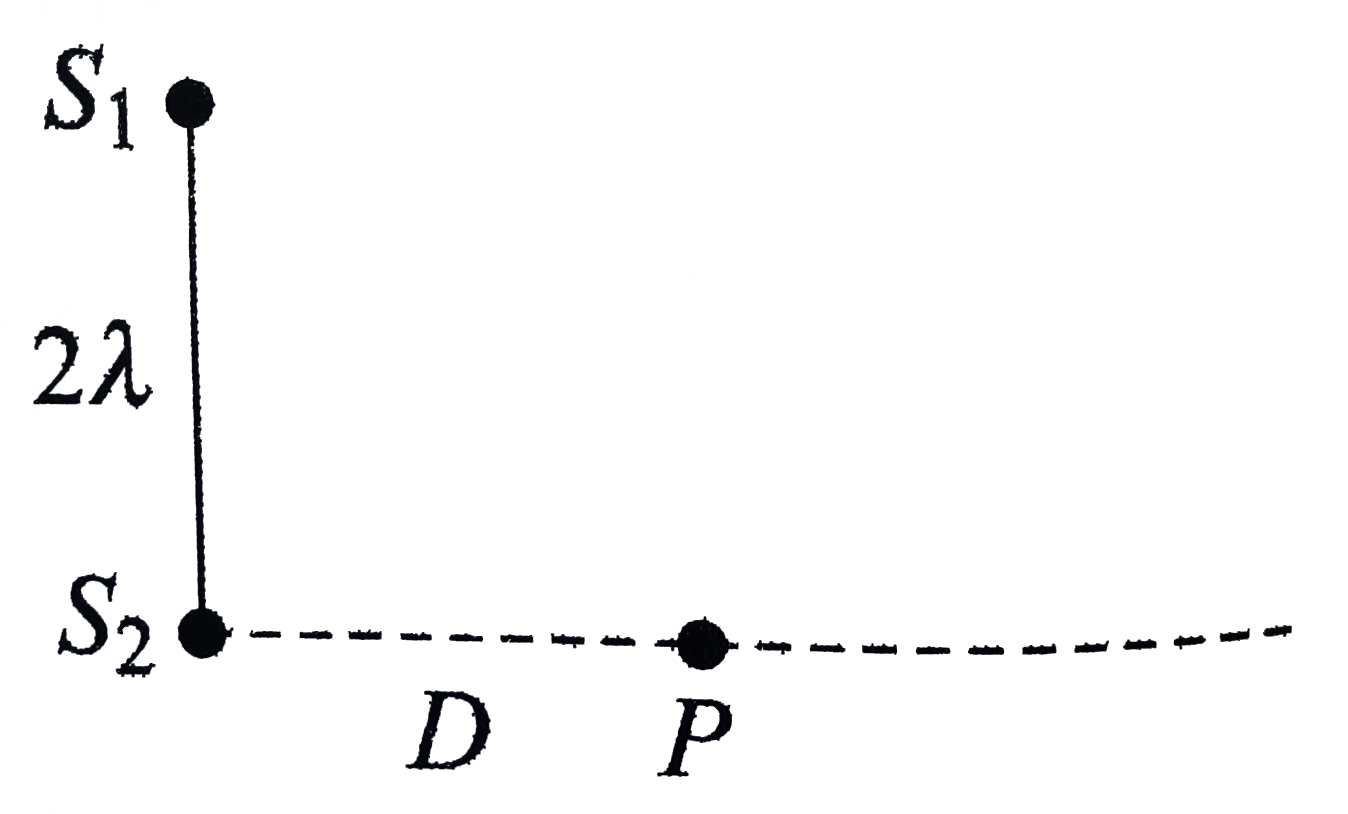
Two coherent point sources `S_(1)` and `S_(2)` vibrating in phase emit light of wavelength `lambda`. The separation between the sources is `2lambda`. Consider a line passing through `S_(2)` and perpendicular to line `S_(1) S_(2)`. Find the position of farthest and nearest minima.
.

Text Solution

Verified by Experts

`Delta x_(min) = (2n - 1) (lambda)/(2)`
The farthest mimima has path difference `lambda//2` while the nearest minima has path difference `(3//2)lambda`. For the nearest minima,
`S_(1) P - S_(2) P = (3)/(2) lambda` [as maximum path difference is `2lambda`]
`implies sqrt((2lambda)^(2) + D^(2)) - D = (3)/(2) lambda`
`implies (2lambda)^(2) + D^(2) = ((3)/(2) lambda + D)^(2)`
`implies 4lambda^(2) + D^(2) = (9)/(4) lambda^(2) + D^(2) xx 2 xx (3)/(2) lambda xx D`
`implies 3D = 4lambda - (9lambda)/(4) = (7lambda)/(4) implies D = (7)/(12) lambda`
For the farthest minima,
`S_(1)P - S_(2)P = (lambda)/(2)`
`impliessqrt (4 lambda^(2) + D^(2)) - D = (lambda)/(2)`
`4lambda^(2) + D^(2) = (lambda^2)/(4) + D^(2) + D lambda implies D = 4 lambda - lambda//4 = (15 lambda)/(4)`.
Promotional Banner

Topper's Solved these Questions

  • WAVE OPTICS

    CENGAGE PHYSICS ENGLISH|Exercise Solved Examples|10 Videos
  • WAVE OPTICS

    CENGAGE PHYSICS ENGLISH|Exercise Exercise 2.1|12 Videos
  • SOURCES OF MAGNETIC FIELD

    CENGAGE PHYSICS ENGLISH|Exercise single correct Ansewer type|12 Videos

Similar Questions

Explore conceptually related problems

The coherent point sources S_(1) and S_(2) vibrating in same phase emit light of wavelength lambda . The separation between the sources is 2lambda . Consider a line passing through S_(2) and perpendicular to the line S_(1)S_(2) . What is the smallest distance from S_(2) where a minimum of intensity occurs due to interference of waves from the two sources?

The coherent point sources S_(1) and S_(2) vibrating in same phase emit light of wavelength lambda . The separation between the sources is 2lambda . Consider a line passingh through S_(2) and perpendicular to the line S_(1)S_(2) . What is the smallest distance from S_(2) where a minimum of intensity occurs due to interference of waves from the two sources?

Two coherent point sources S_1 and S_2 emit light of wavelength lambda . The separation between sources is 2lambda . Consider a line passing through S_2 and perpendicular to the line S_(1)S_(2) . What is the smallest distance on this line from S_2 where a minimum of intensity occurs?

Two coherent point sources S_1 " and "S_2 vibrating in phase light of wavelength lambda . The separation between the sources is 2lambda . The smallest distance from S_(2) on a line passing through S_2 and perpendicular to s_(1)s_(2) where a minimum of intensity occurs is

Two identical light sources S_1 and S_2 emit light of same wavelength lambda . These light rays will exhibit interference if

Two coherent point sources S_1 " and "S_2 vibrating in phase light of wavelength lambda . The separation between them is 2lambda as shown in figure. The first bright fringe is formed at .P. due to interference on a screen placed at a distance .D. from S_(1)" "(D gt gt lambda) , then OP is

Figure shows two coherent sources S_1 and S_2 which emit sound of wavelength lamda in phase. The separation between the sources is 3lamda . A circular wire at large radius is placed in such a way that S_1 S_2 lies in its plane and the middle point of S_1 S_2 , is at the centre of the wire. Find the angular positions 0 on the wire for which constructive interference takes place.

Two monochromatic coherent point sources S_(1) and S_(2) are separated by a distance L. Each sources emits light of wavelength lambda , where L gt gt lambda . The line S_(1) S_(2) when extended meets a screen perpendicular to it at point A. Then

Two coherent sources emit light of wavelength lambda . Separation between them, d = 4 lambda . If a detector moves along the y-axis, what is the maximum number of minima observed?

Two coherent point sources S_1 and S_2 are separated by a small distance d as shown. The fringes obtained on the screen will be

