Home
Class 12
PHYSICS
A convex lens of focal length 20 cm is c...

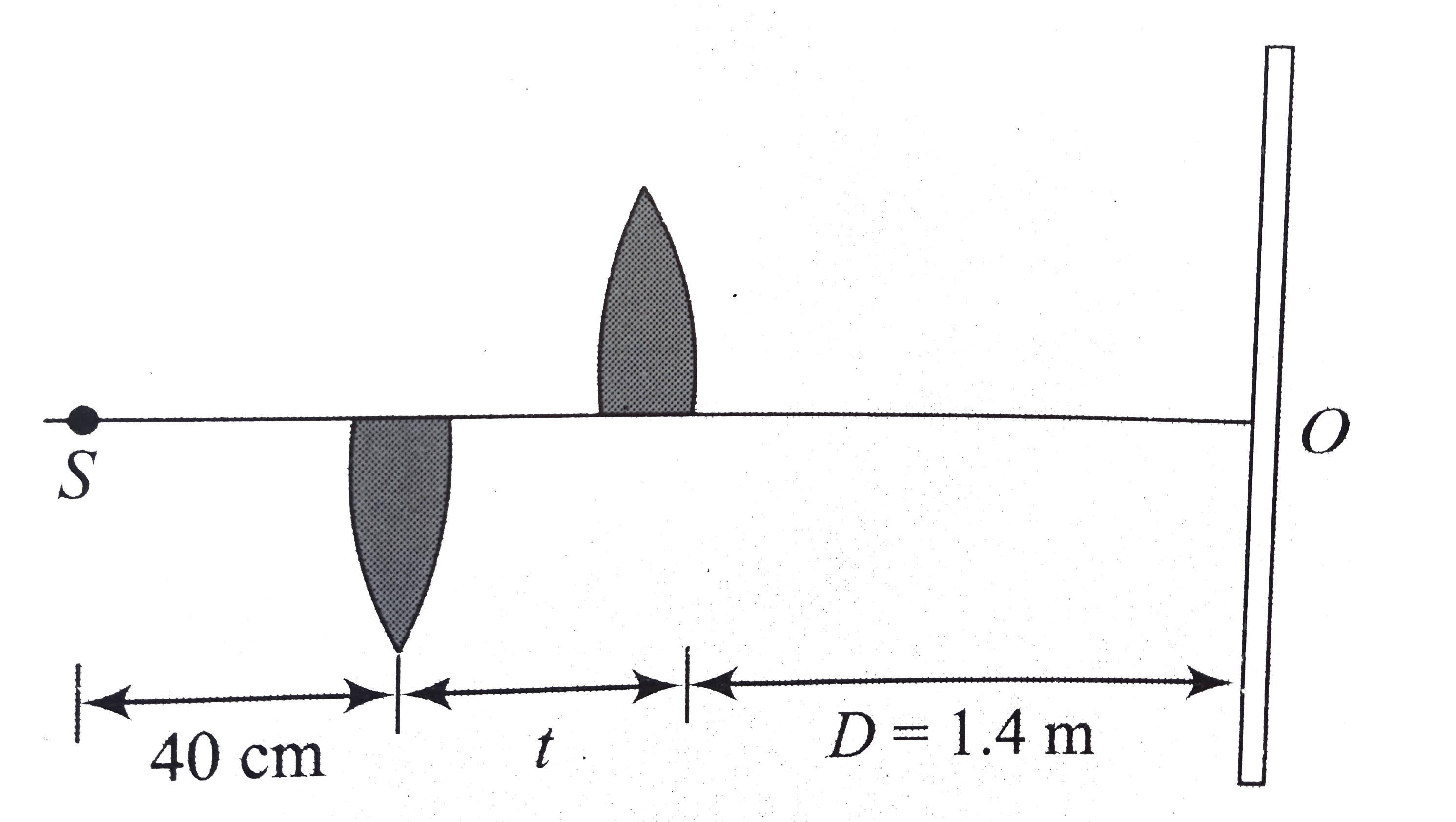
A convex lens of focal length 20 cm is cut long its diameter and the two halves are displaced by `t = 1` cm along the principal axix. A monochromatic point source of wavelength 476 nm is placed at a distance 40 cm from the first half, as shown in Fig. 2.21. Find the position of the first maximum.

Text Solution

Verified by Experts
Using the formula
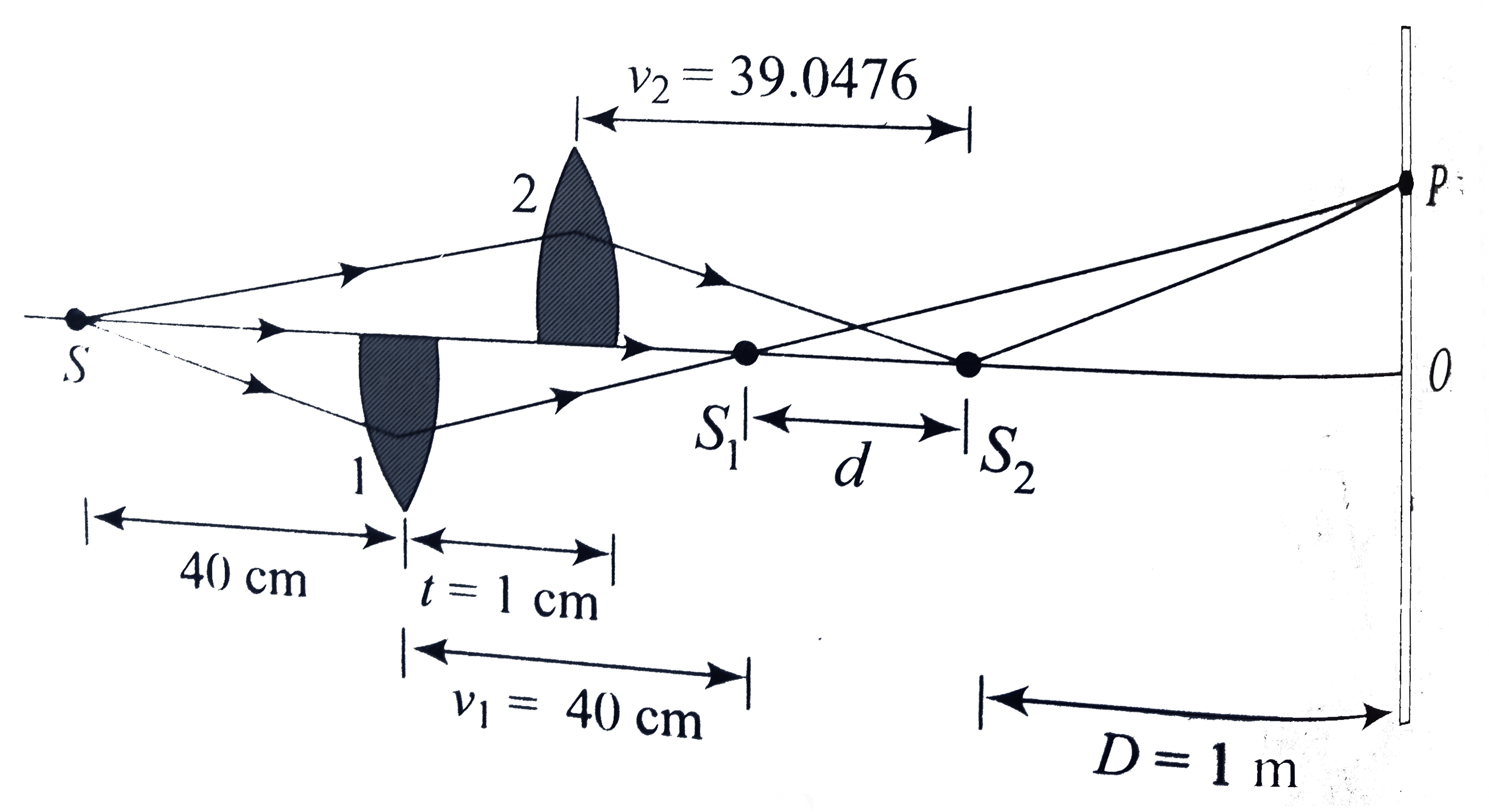
`nu = (fu_(1))/(u_(1) - f) = ((20)(40))/((40 - 20)) = 40 cm`
and `nu = (u_(2) f)/(u_(2) - f) = ((41)(20))/(41 - 20) = 39.0476 cm`
`d = nu_(2) - nu_(1) = 0.0476 cm = 0.476 mm`
The optical path difference at P is
`Delta x_(p) = (SS_(2) + S_(1) P) = S_(1) S_(2) + S_(2) P - S_(1) P`
`= (SS_(2) + S_(2) P) - (SS_(1) +S_(1) P)`
`= (SS_(2) - SS_(1)) - (S_(1) P - S_(2) P)`
` = d - (S_(1) P - S_(2) P)`
We know that
`S_(1) P - S_(2) P = d [1 - (y^(2))/(2D^(2))]`
`Delta x_p = d - d [1 - (y^(2))/(2D^(2))] = (y^(2) d)/(2D^(2))`
The position of hte n th maximumis given by
`(Y^(2) d)/(2D^(2)) = n lambda or y = D sqrt((2n lambda)/(d)`
The Position of the first maximum is given by
`y = 10^(3) sqrt((2(1)(0.476 xx 10^(-3)))/(0.476)) = 44.72 mm`
Promotional Banner

Topper's Solved these Questions

  • WAVE OPTICS

    CENGAGE PHYSICS ENGLISH|Exercise Solved Examples|10 Videos
  • WAVE OPTICS

    CENGAGE PHYSICS ENGLISH|Exercise Exercise 2.1|12 Videos
  • SOURCES OF MAGNETIC FIELD

    CENGAGE PHYSICS ENGLISH|Exercise single correct Ansewer type|12 Videos

Similar Questions

Explore conceptually related problems

An object is placed at a distance of 12 cm from a convex lens of focal length 8 cm. Find : the position of the image

A convex lens of focal length 15 cm is split into two halves and the two halves are placed at a separation of 120 cm. Between, the two halves of convex lens a plane mirror is placed horizontal and at a distance of 4 mm below the principal axis of the lens halves. An object of length 2 mm is placed at a distance of 20 cm from one half lens as shown in figure. Find the position and size of the final image. Trace the path of rays forming the image.

A converging lens of focal length 15 cm and a converging mirror of focal length 10 cm are placed 50 cm apart with common principal axis. A point source is placed in between the lens and the mirror at a distance of 40 cm from the lens. Find the locations of the two images formed.

A converging lens of focal length 20 cm and a converging mirror of focal length 10 cm are placed 60 cm apart with common principal axis. A point source is placed in between the lens and the mirror at a distance of 50 cm from the lens. Find the locations of the images formed.

A point light source is kept in front of a convex mirror at a distance of 40 cm. The focal length of the mirror is 40 cm. Find the position of image.

A convex lens of focal length 20 cm is placed in front of a convex mirror of focal length 15 cm at a distance of 5 cm. An object of length 2 cm is placed perpendicular to the common axis at a distance of 20 cm from the lens

A converging lens of focal length 15 cm and a converging mirror of focal length 20 cm are placed with their principal axes coinciding. A point source S is placed on the principal axis at a distance of 12 cm from the lens as shown in figure. It is found that the final beam comes out parallel to the principal axis. Find the separation between the mirror and the lens.

An equi-convex lens of mu=1.5 and R=20 cm is cut into two equal parts along its axis. Two parts are then separated by a distance of 120 cm (as shown in figure). An object of height 3 mm is placed at a distance of 30 cm to the left of first half lens. The final image will form at

The focal length of a convex mirror is 40 cm. A point source of light is kept at distance 40 cm from the mirror. Find the distance of image from the mirror.

A pin of length 2.0 cm lies along the principal axis of a converging lens, the centre being at a distance of 11 cm from the lens. The focal length of the lens is 6 cm. Find the size of the image.

