Home
Class 12
PHYSICS
Figure 2.39 shows a photograph that illu...

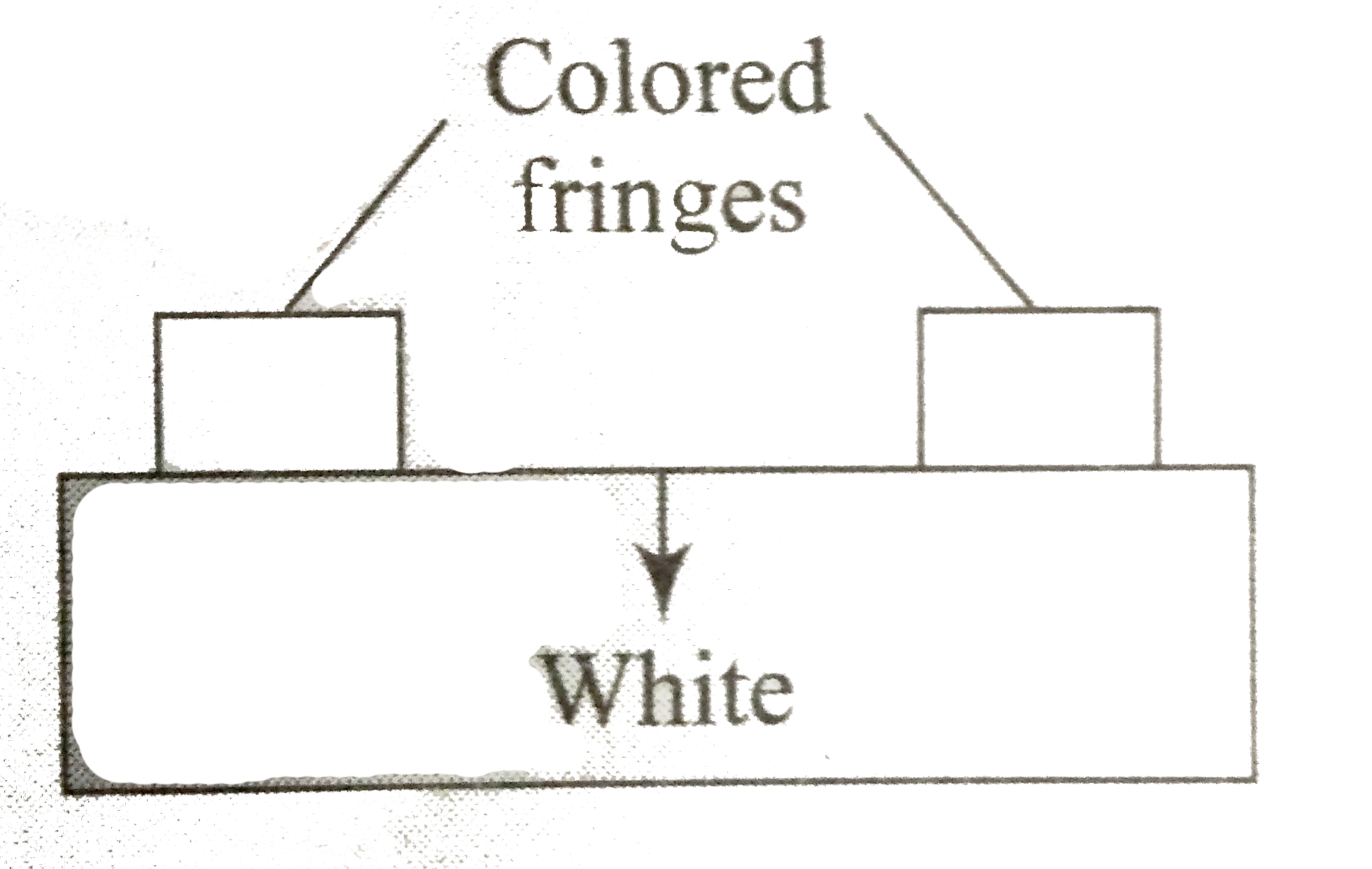
Figure 2.39 shows a photograph that illustrates the kind of interference fringes that can result when white light, which is a mixture of all colors, is used in Young's experiment, Except for the central fringe, which is white, the bright frings are a rainbow of colors. Why does Young's experiment separate white light into the constituent colors? In any group of colored fringes, such as the two singled out in the figure, why is red farther out from the central fringe than green is? And finally, why is the central fringe white rather than colored?

Text Solution

Verified by Experts

To understand how the color separation arises, we nee to remember that each color corresponds to a different wavelength `lambda` and the constructive and destructive interference depend on the wavelength. According to equation `sin theta = m lambda//d,` there is a different angle that locates a bright fringe lead to the separation of colors on the observation screen. In fact, on either side of the central fringe, there is one group of colored fringes for `m = 1` and another for each value of m.
Now, consider what it means that, within any single group of colored fringes, red is farther out from the central fringe then green is. It means that, in the equation `sin theta = m lambda//d,` red light has angle `theta` greater than green light does. Does this make sense ? Yes, because red has the larger wavelength `lambda_("red") = 600 nm` and `lambda_(green) = 550 nm`.
In Fig. 2.39, the central fringe is distinguished from all the other colored fringes by being white. In Eq. (i), the central fringe is different from the other fringes because it is the only one for which `m = 0.` Eq.(i), a value of `m = 0` means that `sin theta = m lambda//d = 0,` which reveals that `theta = 0^(@),` no matter what the wavelength `lambda` is. In other words. all wavelengths have a zeroth order bright fringe located at the same place on the screen, so that all colors strike the screen there and mix together to produce the white central fringe.
Promotional Banner

Topper's Solved these Questions

  • WAVE OPTICS

    CENGAGE PHYSICS ENGLISH|Exercise Solved Examples|10 Videos
  • WAVE OPTICS

    CENGAGE PHYSICS ENGLISH|Exercise Exercise 2.1|12 Videos
  • SOURCES OF MAGNETIC FIELD

    CENGAGE PHYSICS ENGLISH|Exercise single correct Ansewer type|12 Videos

Similar Questions

Explore conceptually related problems

A Young's double slit experiment is performed with white light, then

Young's experiment is performed in air and then performed in water, the fringe width:

The distance of nth bright fringe to the nth dark fringe in Young's experiment is equal to

In the Young’s double slit experiment, for which colour the fringe width is least

How does the fringe width of interference fringes change, when the whole apparatus of Young's experiment is kept in a liquid of refractive index 1.3 ?

A Young's double slit experiment is performed with white light.

In Young's interference experiment, the central bright fringe can be indentified due to the fact that it

The distance of n^(th) bright fringe to the (n+1)^(th) dark fringe in Young's experiment is equal to:

In a Young's double slit experiment performed with a source of white light, only black and white fringes are observed.

In single slit experiment, if green light is instead of orange light then width of fringe will
