Home
Class 12
PHYSICS
A Lloyd's mirror or length 5 cm is illum...

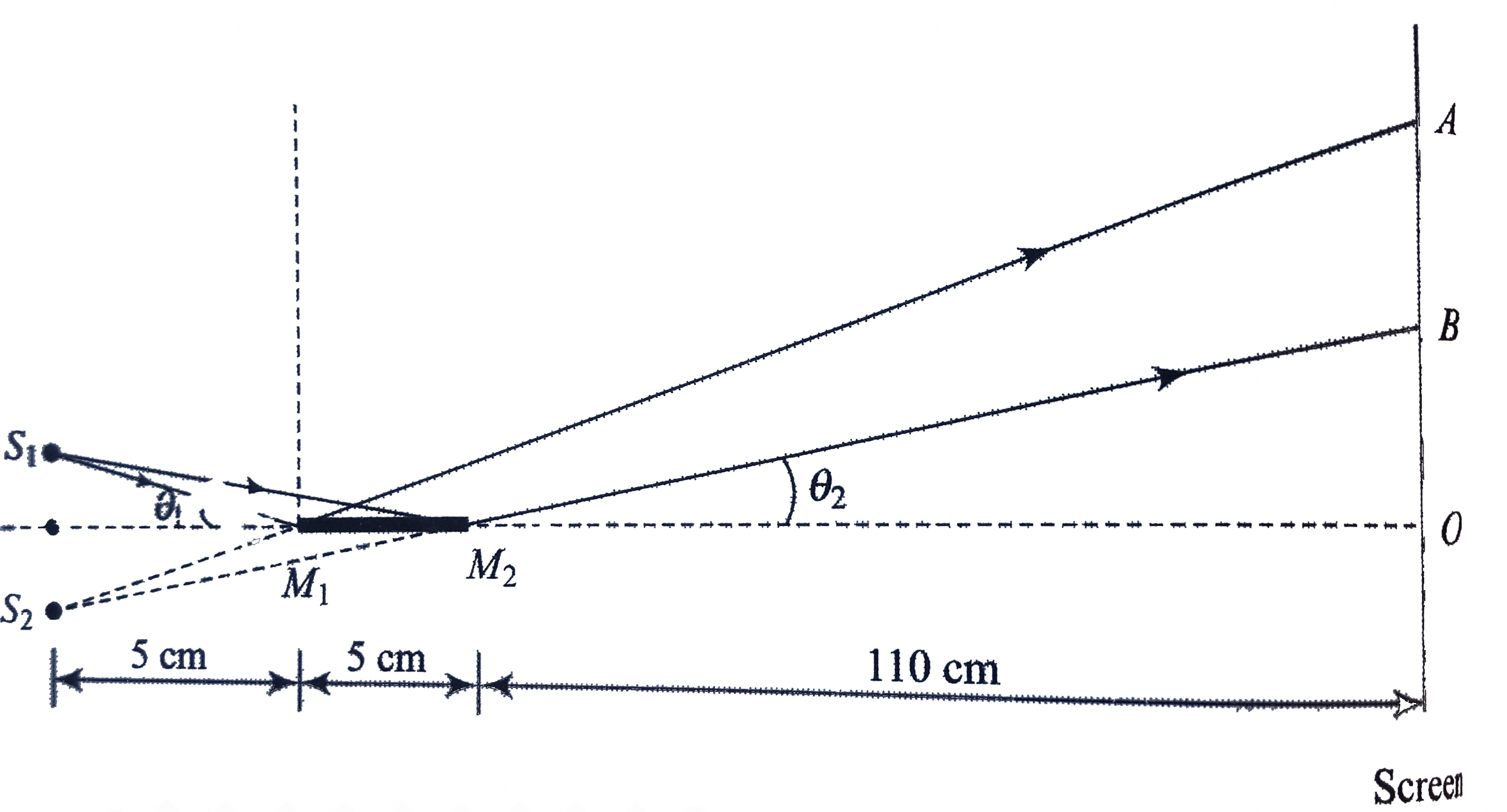
A Lloyd's mirror or length 5 cm is illuminated with monochromatic light of wavelength `lambda (= 6000 Å)` from a narrow 1 mm slit in its plane and 5 cm plane from its near edge. Find the fringe width on a screen 120 cm from the slit and width of interference pattern on the screen.

Text Solution

Verified by Experts

In plane mirror, imgae is formed behind it as the object is in front of it. So,
`d = 2 mm = 0.2 cm`
`lambda = 6000 Å = 6000 xx 10^(-8) cm`
`D = 120 cm`
Therefore, fringe width,
` beta = (lambda D)/( d) = (6 xx 10^(-5) xx 120)/(0.2) = 0.036 cm`
The width of fringe is AB. From figure
`tan theta_(1) = (0.1)/(5)` and `tan theta_(2) = (0.1)/(10)`
In right-angled triangles `AM_(1) O` and `BM_(2) O`,
`tan theta_(1) = (0.1)/(5) = (OA)/(M_(1) O) implies OA = 115 xx (0.1)/(5) cm`,
`tan theta_(2) = (0.1)/(10) = (OB)/(OM_(2)) impliesOB = 110 xx (0.1)/(10) cm`
Hence, width of fringe pattern is
`OA - OB = (115 xx 0.1)/(5) - (110 xx 0.1)/(10) = 1.2 cm`
Promotional Banner

Topper's Solved these Questions

  • WAVE OPTICS

    CENGAGE PHYSICS ENGLISH|Exercise Solved Examples|10 Videos
  • WAVE OPTICS

    CENGAGE PHYSICS ENGLISH|Exercise Exercise 2.1|12 Videos
  • SOURCES OF MAGNETIC FIELD

    CENGAGE PHYSICS ENGLISH|Exercise single correct Ansewer type|12 Videos

Similar Questions

Explore conceptually related problems

In Yonung's double-slit experiment, two slits which are separated by 1.2 mm are illuminated with a monochromatic light of wavelength 6000 Å The interference pattern is observed on a screen placed at a distance of 1 m from the slits. Find the number of bright fringes formed over 1 cm width on the screen.

A narrow slit of width 1 mm is illuminated by monochromatic light of wavelength 600 nm. The distance between the first minima on either side of a screen at a distance of 2 m is

A narrow slit of width 2 mm is illuminated by monochromatic light fo wavelength 500nm. The distance between the first minima on either side on a screen at a distance of 1 m is

Monochromatic light of a wavelength 650 nm falls normally on a slit of width 1:3 xx 10^(-4) cm and the resulting Fraunhofer diffraction is obtained on a screen. Find the angular width of the central maxima.

Two slits, 4 mm apart, are illuminated by light of wavelength 6000 Å . What will be the fringe width on a screen placed 2 m from the slits

In a Lloyds's mirror experiment as narrow slit S transmitting a light of wavelength lambda is placed 3 mm above a small plane mirror ( as shown). The light coming directly from the the slit and that coming after the reflection interfere on a screen placed at a distance of 90 cm from the slit. Length of mirror is 2 mm and the middle point of mirror is 2 mm from point P. If the mirror is shifted towards left then how does the fringe pattern on screen changes ?

If two slits is Young's experiment are 0.4 mm apart and fringe width on a screen 200 cm away is 2 mm the wavelength of light illuminating the slits is

Monochromatic light of wavelength 580 nm is incident on a slit of width 0.30 mm. The screen is 2m from the slit . The width of the central maximum is

For a parallel beam of monochromatic light of wavelength 'lambda' diffraction is produced by a single slit whose width 'a' is of the order of the wavelength of the light. If 'D' is the distance of the screen from the slit, the width of the central maxima will be

A double slit S_1-S_2 is illuminated by a coherent light of wavelength lamda . The slits are separated by a distance d. A plane mirror is placed in front of the double slit at a distance D_1 , from it and a screen sum is placed behind the double slit at a distance D_2 , from it . The screen sum receives only the light reflected by the mirror. Find the fringe-width of the interference pattern on the screen.
