Home
Class 12
PHYSICS
In Young's experiment the upper slit is ...

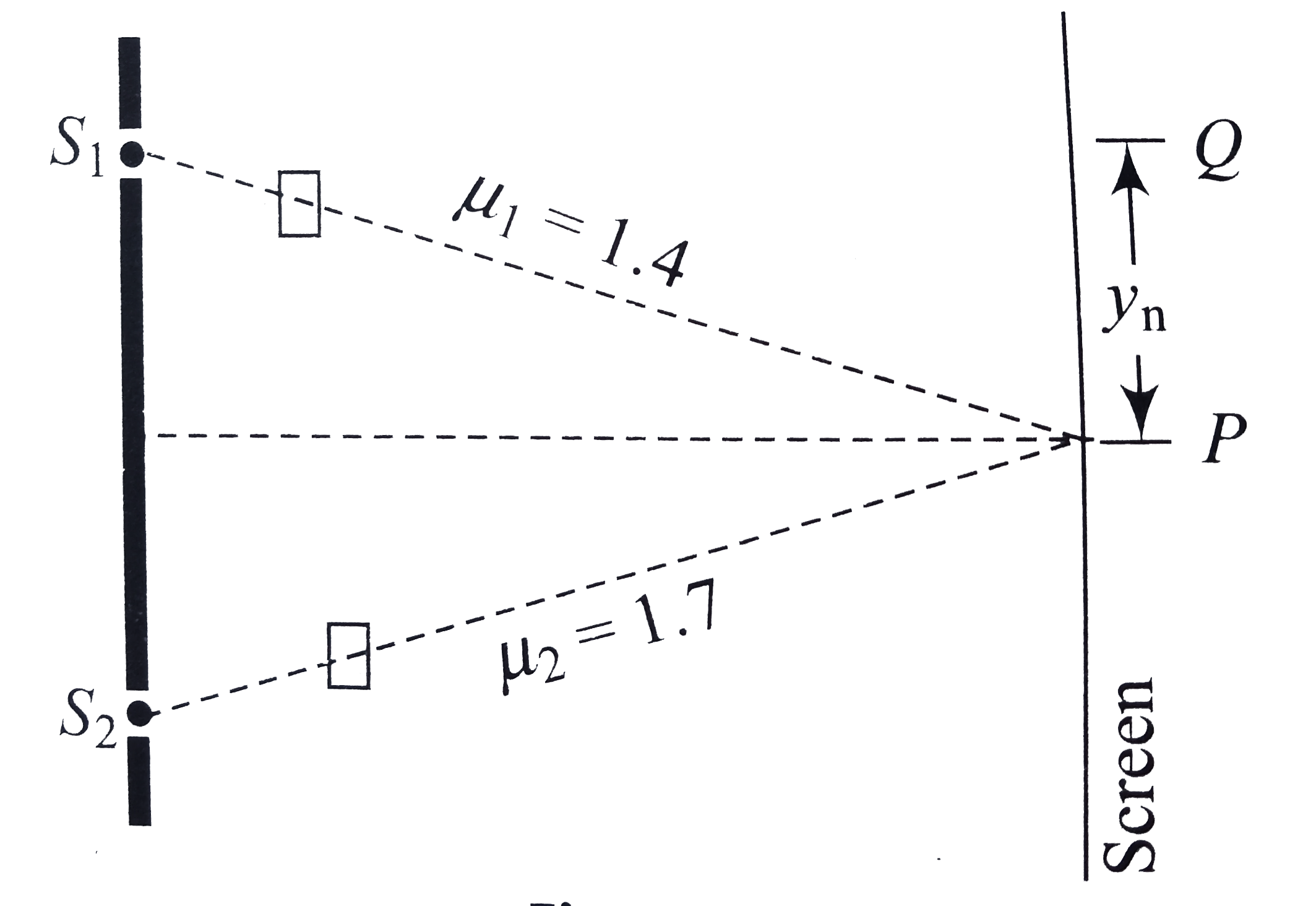
In Young's experiment the upper slit is covered by a thin glass plate of refractive index `1.4` while the lower slit is covered by another glass plate, having the same thickness as the first one but having refractive index `1.7` interference pattern is observed using light of wavelength `5400 Å`
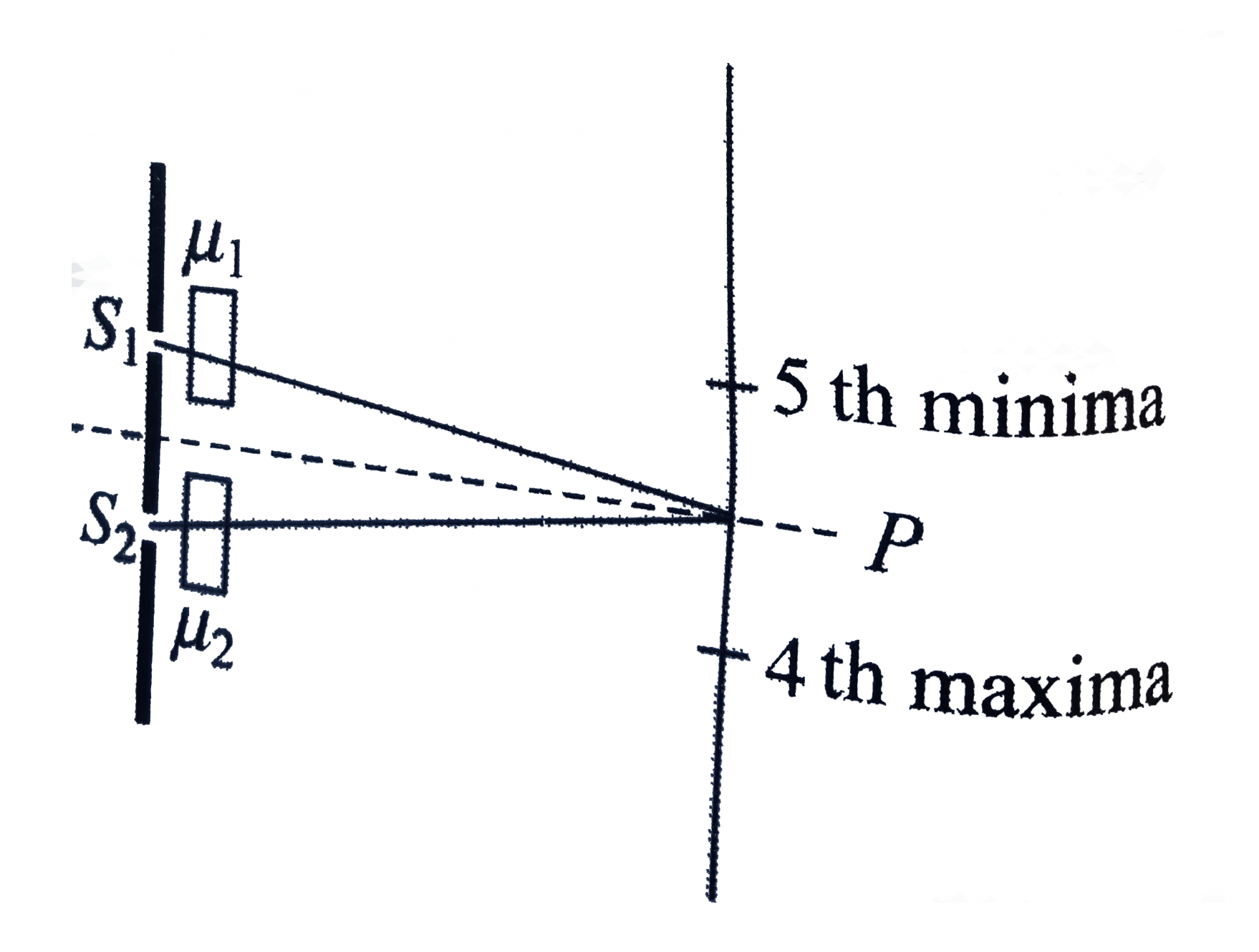
It is found that point P on the screen where the central maximum `(n = 0)` fell before the glass plates were inserted now has `3//4` the original intensity. It is further observed that what used to be the fourth maximum earlier, lies below point P while the fifth minimum lies above P.
Calculate the thickness of glass plate. (Absorption of light by glass plate may be neglected.
.

Text Solution

Verified by Experts

Path difference between two waves starting from `S_(1)` and `S_(2)` and reaching at P,
` Delta = (mu_(2) - mu_(1)) t ` In the absence of plate, phase difference between two waves reaching at P equals zero. When the plates are introduced, let the phase difference between waves at P be `delta`.
As the waves are of point of equal amplitude (or intensity), so initial intensity at P,
`I_(0) = (a_(1) + a_(2))^(2) = 4a^(2)`
New intensity at P is
`I_(0) = (a_(1) + a_(2))^(2) = (2a)^(2) = 4a^(2)`
New Intensity at P is
`I = (3)/(4) I_(0) = (3)/(4) xx 4a^(2) = 3a^(2)`
We have,
`I = a_(1)^(2) + a_(2)^(2) + 2a_(1) a_(2) cos delta`
`implies 3a^(2) = a^(2) + a^(2) + 2a^(2) cos delta`
This gives
`delta = (pi)/(3), (5 pi)/(3), (7pi)/(3),... =(2 m pi +- (pi)/(3)), m = 1, 2, 3,...`
shift of interference pattern upward due to glass plate,
` 1 = (D)/(d) (mu_(1) - 1) t = (D)/(d) (1.7 - 1) t`
Net shift downward is
`(D)/(d) (mu_(2) - mu_(1) t) = (D)/(d) (1.7 - 1.4) t = (D)/(d) (0.3t)`
From given conditions,
`(D)/(d) (0.3 t) gt (5 lambda D)/(d)` and `(D)/(d) (0.3t) lt (6 - (1)/(2)) (lambda)/(d)`
`implies (5 lambda)/(0.3) lt t lt (11 lambda)/(2 xx 0.3)`
`lambda 5400 Å = 5.4 xx 10^(-7)m`
Path difference created at P due to both the plates is `(mu_(2) - (mu_(1))t`.
Also, path difference,
`Delta = (lambda)/(2 pi) xx` phase difference
`implies(mu_(2) - mu_(1)) t = (lambda)/(2 pi) delta`
or ` 0.3 t = (lambda)/(2 pi) xx (2m pi +- (pi)/(3))`
=`(m +- (1)/(6)) lambda`
`=(m +- (1)/(6)) xx 5.4 xx 10^(-7) m`
From Eqs. (ii) and (iii), we have (putting m = 5),
`t = ((5 + (1)/(6)) xx 5.4 xx 10^(-7))/(0.3)`
` = 93 xx 10^(-7)` m taking `(+)` sign
`= 87 xx 10^(-7)` m taking `(-)` sign
In view of Eq. (ii),
`t = 93 xx 10^(-7) m = 9.3 xx 10^(-6) m = 9.3 mu m`
Promotional Banner

Topper's Solved these Questions

  • WAVE OPTICS

    CENGAGE PHYSICS ENGLISH|Exercise Exercise 2.1|12 Videos
  • WAVE OPTICS

    CENGAGE PHYSICS ENGLISH|Exercise Exercise 2.2|22 Videos
  • WAVE OPTICS

    CENGAGE PHYSICS ENGLISH|Exercise Comprehension Type|14 Videos
  • SOURCES OF MAGNETIC FIELD

    CENGAGE PHYSICS ENGLISH|Exercise single correct Ansewer type|12 Videos