Home
Class 12
PHYSICS
The Young's double-slit experiment is do...

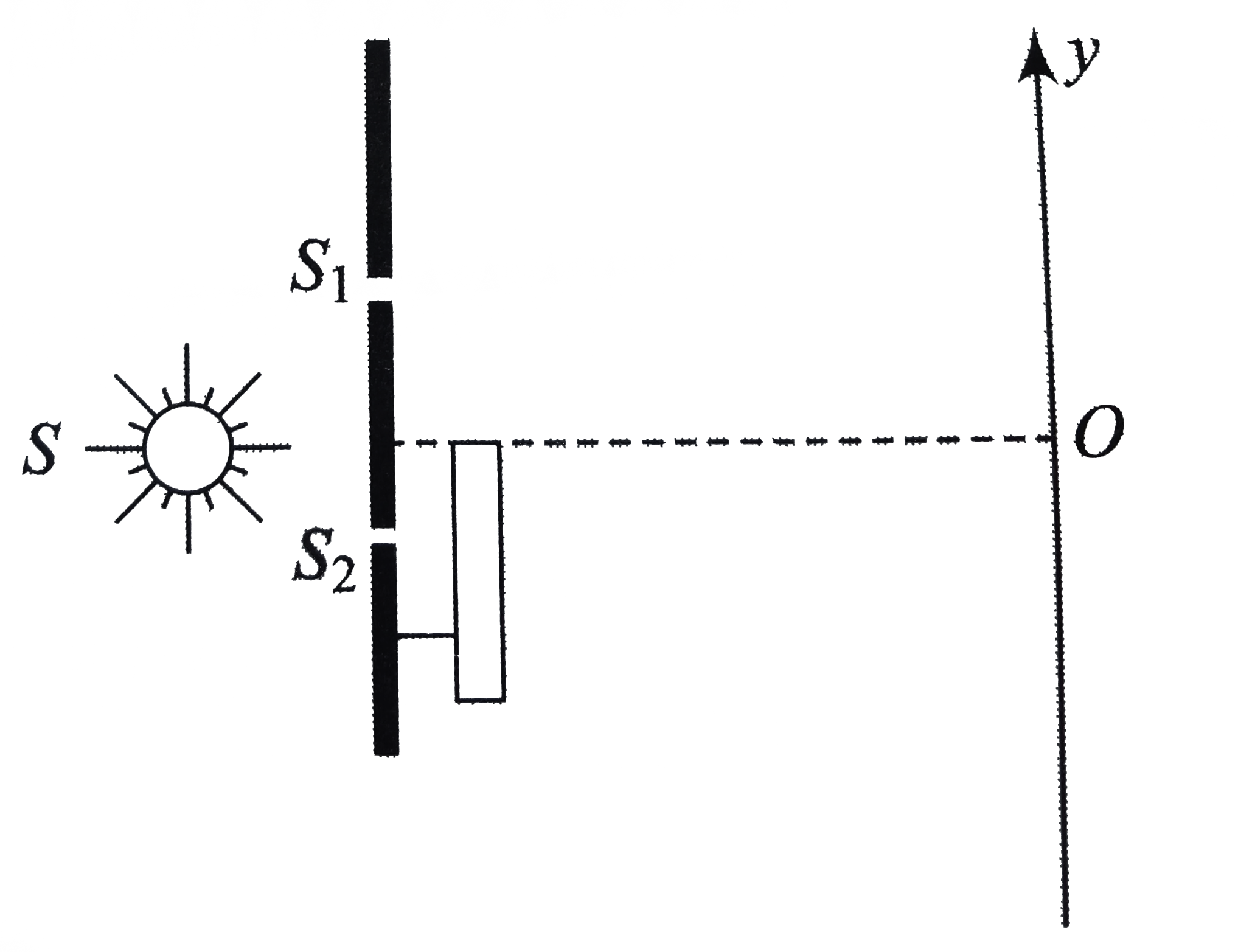
The Young's double-slit experiment is done in a medium of refractive index `4//3`. A light of 600 nm wavelength isfalling on the slits having 0.45 mm separation. The lower shift `S_(2)` is covered by a thin glass sheet of refractive index. 1.5. The interference pattern is observed on a screen placed 1.5 m from the slits as shown in Figure
a. Find the location of central maximum (bright fringe with zero path difference) on the y-axis.
b. Find the light intensity of point O relative to the maximum fringe intensity.
c. Now , if 600 nm light is replaced by white light of range 400 - 700 nm, find the wavelengths of the light that from maxima exaclty at point O.
(All wavelength in the problem are for the given medium of refractive index `4//3` Ignoe dispersion.)

Text Solution

Verified by Experts
Given `lambda nm = 6 xx 10^(-7) m, d = 0.45 mm = 0.45 xx 10^(-3) m, D = 1.5`. Thickness of glass sheet,
`t = 10.4 mu m = 10.4 xx 10^(-6)m`.
Refractive index of glass sheet, `mu_(g) = 1.5`.
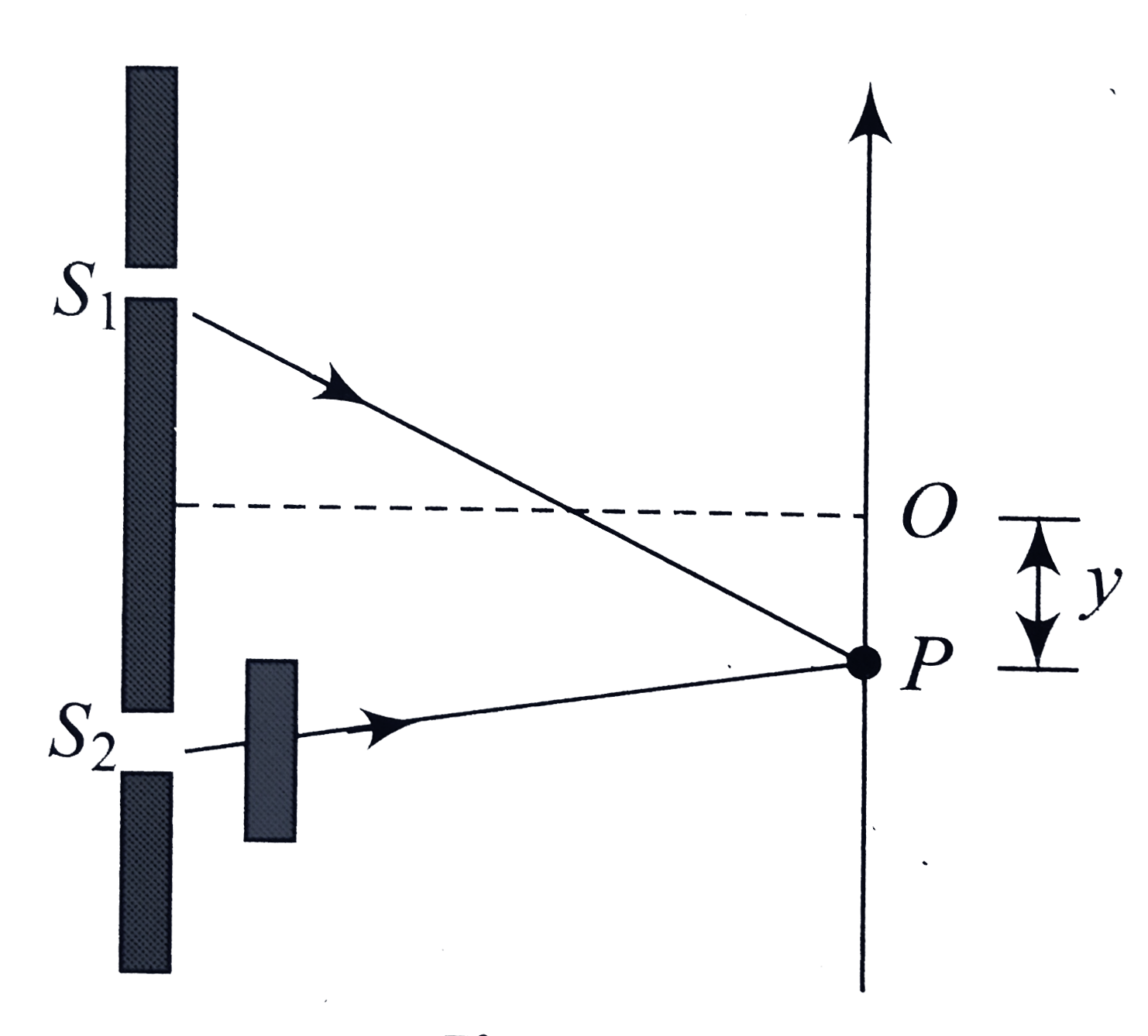
a. Let central maximum is obtained at a distance y below point O.Then,
`Delta x_(1) = S_(1) P - S_(2) P = (yd)/(D)`
Path difference due to glass sheet,
`Delta x_(2) = (mu_(g)/(mu_(m) - 1 )) t`
New path diffenence will be zero when
`Deltax_(1) = Delta x_(2)`
`implies (yd)/(d) = ((mu_(g))/(mu_(m)) - 1) t`
`implies y = ((mu_(g))/(mu_(m)) - 1) t (D)/(d)`
Subsituting the value, we have
`y = ((mu_(g))/(mu_(m))-1)t (D)/(d)`
or we can say `y = 4.33 mm.`
a. At O, `Delta x_(1) = 0` and `Delta x (2) = ((mu_(g))/(mu_(m)) - 1)t`
`:.` Net path difference `Delta x = Delta x_(2)`
Corresponding phase difference, `Detla phi` or simply
` phi = (2 pi)/(lambda) Delta x`.
Substituting the values, we have
`phi = (2 pi)/(6 xx 10^(-7)) ((1.5)/(4//3) -1) (10.4 xx 10^(-6)) = ((13)/(3)) pi`
Now,
`I (phi) = I_(max) cos^(2) ((phi)/(2))`
`I = I_(max) cos^(2) ((13 pi)/(6))`
`= (3)/(4) I_(max)`
At O, path difference is `Delta x = Delta x_(2) = ((mu_(g)) /(mu_(m) - 1)) t`
For maximum intensity at O,
` Delta x = n lambda` (here `n = 1, 2, 3,...)`
`lambda = (Delta x)/(1), (Delta x)/(2), (Delta x)/(3),....` and so on
`Delta x = ((1.5)/(4//3) - 1) (10.4 xx 10^(-6) m)`
`= ((1.5)/(4//3) - 1) (10.4 xx 10^(-3) nm`
`= 1300 nm`
Maximum intensity will be corresponding to
`lambda 1300 nm, (1300)/(2) nm, (1300)/(3) nm, (1300)/(4) nm,...`
`= 1300 nm, 650 nm, 433.33 nm, 325 nm,...`
The wavelength in the range 400 to 700 nm are 650 nm and 433.33 nm.
Promotional Banner

Topper's Solved these Questions

  • WAVE OPTICS

    CENGAGE PHYSICS ENGLISH|Exercise Exercise 2.1|12 Videos
  • WAVE OPTICS

    CENGAGE PHYSICS ENGLISH|Exercise Exercise 2.2|22 Videos
  • WAVE OPTICS

    CENGAGE PHYSICS ENGLISH|Exercise Comprehension Type|14 Videos
  • SOURCES OF MAGNETIC FIELD

    CENGAGE PHYSICS ENGLISH|Exercise single correct Ansewer type|12 Videos

Similar Questions

Explore conceptually related problems

A YDSE is performed in a medium of refractive index 4 // 3 , A light of 600 nm wavelength is falling on the slits having 0.45 nm separation . The lower slit S_(2) is covered b a thin glass plate of thickness 10.4 mm and refractive index 1.5. The interference pattern is observed on a screen placed 1.5 m from the slits as shown in figure. (All the wavelengths in this problem are for the given medium of refractive index 4 // 3 , ignore absorption.) Find the light intensity at point O relative t maximum fringe intensity.

A YDSE is performed in a medium of refractive index 4 // 3 , A light of 600 nm wavelength is falling on the slits having 0.45 nm separation . The lower slit S_(2) is covered b a thin glass plate of thickness 10.4 mm and refractive index 1.5. The interference pattern is observed on a screen placed 1.5 m from the slits as shown in figure. (All the wavelengths in this problem are for the given medium of refractive index 4 // 3 , ignore absorption.) The location of the central maximum (bright fringe with zero path difference) on the y-axis will be

In YDSE's experiment performed in a medium of refractive index (4/3), a light of 60 nm wavelength is falling ono the slits having 0.45 mm separation.t he lower slit S_(2) is covered by a thin glass sheet of thickness 10.4 mum and refractive index 1.5 the interference pattern is observed on a screen palced 1.5m from the slits as shown int hef ignore dispersion. Q. If white light of range 400-700 nm has replaced 600 nm light, one of the wavelengths of light that forms maxima exactly at point O wll be:

A YDSE is performed in a medium of refractive index 4 // 3 , A light of 600 nm wavelength is falling on the slits having 0.45 nm separation . The lower slit S_(2) is covered b a thin glass plate of thickness 10.4 mm and refractive index 1.5. The interference pattern is observed on a screen placed 1.5 m from the slits as shown in figure. (All the wavelengths in this problem are for the given medium of refractive index 4 // 3 , ignore absorption.) Now, if 600 nm, find the wavelength of the ligth that forms maximum exactly at point O.

Two slits in YDSE are placed 1 mm from each other. Interference pattern is observed on a screen placed 1m from the plane of slits. What is the angular fringe width for a light of wavelength 400 nm

A young's double slit apporatus is immersed in a liquid of refractive index 1.33.It has slit separation of 1 mm and interference pattern is observed on the screen at a distance 1.33 m from plane of slits.The wavelength in air is 6300 Å Find the distance of seventh bright fringe from third bright fringe lying on the same side of central bright fringe.

A young's double slit apporatus is immersed in a liquid of refractive index 1.33.It has slit separation of 1 mm and interference pattern is observed on the screen at a distance 1.33 m from plane of slits.The wavelength in air is 6300 Å Calculate the fringe width.

In Young's experiment, light of wavelength 600 nm falls on the double slits separated by 0.1 mm. What is the highest order of maximum intensity in the interference pattern obtained on a screen kept 3 m from the slits? How does the highest order change if the distance of screen from the slits is changed?

In Yonung's double-slit experiment, two slits which are separated by 1.2 mm are illuminated with a monochromatic light of wavelength 6000 Å The interference pattern is observed on a screen placed at a distance of 1 m from the slits. Find the number of bright fringes formed over 1 cm width on the screen.

A source emitting light of wavelengths 480 nm and 600 nm is used in a double slit interference experiment. The separation between the slits is 0.25 mm and the interference is observed on a screen placed at 150 cm from the slits. Find the linear separation between the first maximum (next to the central maximum) corresponding to the two wavelengths.

