Home
Class 12
PHYSICS
Consider an interference arrangement sim...

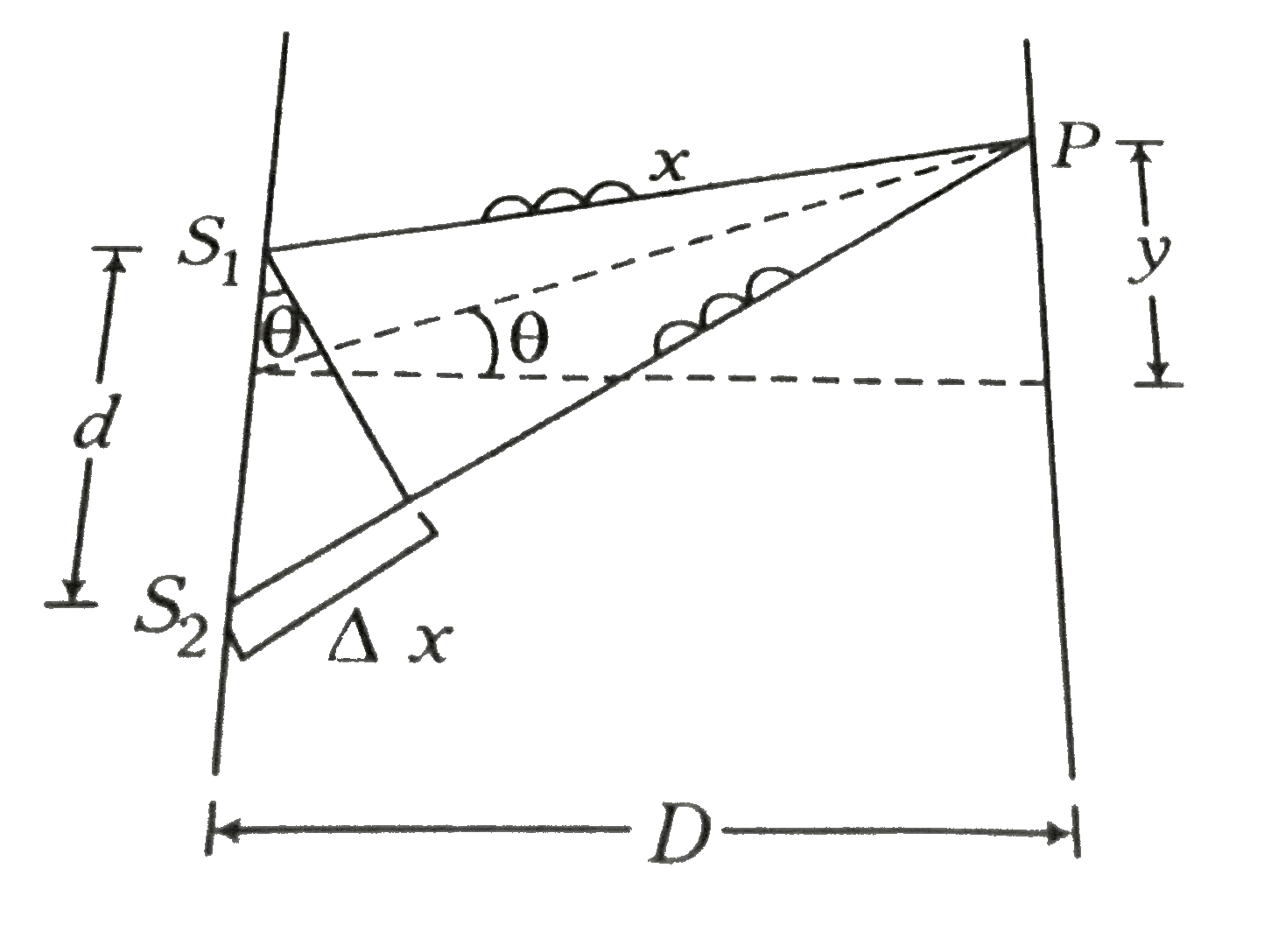
Consider an interference arrangement similar to YDSE. Slits `S_(1)` and `S_(2)` are illuminated with coherent microwave sources each of frequency 2 MHz The sources are synchronized to have zero phase difference. The slits are separated by distance d= 75m. The intensity `I_((theta))` is measured as a function of `theta` where `theta` is defined as shown in figure. if `I_(0)` is maximum intensity then calculated `I_((theta))` for `(i) theta= 0^(@), (ii) theta=pi//6 and (iii) theta = pi//2`

Text Solution

Verified by Experts

In an interference arrangement similar to double-slit experiment, `S_(1)` and `S_(2)` are illuminated with coherent source microwave source each of frequeny 1 MHz
` lambda = ( c )/(f) = (3 xx 10^(8))/(10^(6)) = 300m`
`Delta x = d sin theta , phi = (2 pi)/(lambda) d sin theta = pi sin theta`
`I_(R) = 4 I cos^(2) phi // 2 = 4 I cos^(2) ((pi sin phit)/(2))`
For `I theta` to be maximum, `I_(0) = 4 I implies I = (I_0)/(4) implies I_(0) = 4 I`
`I_(R) = I_(0) cos^(2) ((pi sin theta)/(2))`
a. `theta = 0^(@) implies I_(R) I_(0)`
b. `theta = 30^(@) implies I_(R) =I_(0)/(2)`
c. `theta = 90^(@) implies I_(R) = 0`
Promotional Banner

Topper's Solved these Questions

  • WAVE OPTICS

    CENGAGE PHYSICS ENGLISH|Exercise Subjective|11 Videos
  • WAVE OPTICS

    CENGAGE PHYSICS ENGLISH|Exercise Single Correct|128 Videos
  • WAVE OPTICS

    CENGAGE PHYSICS ENGLISH|Exercise Exercise 2.1|12 Videos
  • SOURCES OF MAGNETIC FIELD

    CENGAGE PHYSICS ENGLISH|Exercise single correct Ansewer type|12 Videos

Similar Questions

Explore conceptually related problems

In an interference arrangement similar to Young's double-slit experiment, the slits S_1 and S_2 are illuminated with coherent microwave sources, each of frequency 10^6 Hz. The sources are synchronized to have zero phase difference. The slits are separated by a distance d=150.0 m. The intensity I (theta) is measured as a function of theta, where theta is defined as shown. If I_0 is the maximum intensity, then I (theta) for 0lethetale90degree is given by

S_(1) and S_(2) are two coherent sources of sound of frequency 110Hz each they have no initial phase difference. The intensity at a point P due to S_(1) is I_0 and due to S_2 is 4I_0 . If the velocity of sound is 330m//s then the resultant intensity at P is

S_(1) and S_(2) are two coherent sources of frequency f each. (theta _(1)=theta_(2)=0^(@)) V_(sound)=330m//s. (i) so that constructive interfence at 'p' (ii) so that destructive interfrece at 'p'

Two coherent sources each emitting light of intensity I_(0) Interfere, in a medium at a point, where phase different between them is (2pi)/3 . Then, the resultant intensity at that point would be.

In Young's double slit experiment, the slits are horizontal. The intensity at a point P as shown in figure is (3)/(4) I_(0) ,where I_(0) is the maximum intensity. Then the value of theta is, (Given the distance between the two slits S_(1) and S_(2) is 2 lambda )

Derive formulas for the following in terms of functions of 2 theta and and then of theta. (i) sin 4 theta (ii) cos 4 theta, (iii) tan 4 theta

Find the value of theta in each of the following: (i) 2sin2theta=sqrt(3) (ii) 2cos3theta=1 (iii) sqrt(3)tan2theta-3=0

Find the value of theta in each of the following: (i) 2sin2theta=sqrt(3) (ii) 2cos3theta=1

Consider interference between waves form two sources of intensities I_(0)&4I_(0) .Find intensities at point where the phase difference is pi

Two identical sources each of intensity I_(0) have a separation d = lambda // 8 , where lambda is the wavelength of the waves emitted by either source. The phase difference of the sources is pi // 4 The intensity distribution I(theta) in the radiation field as a function of theta Which specifies the direction from the sources to the distant observation point P is given by

CENGAGE PHYSICS ENGLISH-WAVE OPTICS-Exercise 2.2
  1. In YDSE for wavelength lambda = 589nm, the interference fringe have an...

    Text Solution

    |

  2. A beam of light consisting of wavelengths 6000 Å and 4500 Å is used i...

    Text Solution

    |

  3. White light is used in a YDSE with D = 1 m and d = 0.9 mm. Light reach...

    Text Solution

    |

  4. Monichromatic lightof wavelenght 600 nm is used ina Young's double sli...

    Text Solution

    |

  5. Interference fringes are produced by a double slit arrangement and a...

    Text Solution

    |

  6. In YDSE with d = 1 mm and D = 1 m, Slabs of (t = 1 mu m, mu = 3) and (...

    Text Solution

    |

  7. In YDSE with D = 1 m, d = 1 mm, light of wavelength 500 nm is incident...

    Text Solution

    |

  8. In Young's experiment, find the distance between two slits that result...

    Text Solution

    |

  9. Consider an interference arrangement similar to YDSE. Slits S(1) and S...

    Text Solution

    |

  10. If Young's double-slit experiment is performed under water, how would ...

    Text Solution

    |

  11. In Young's double -slit experiment, why do we use mono chromatic light...

    Text Solution

    |

  12. Young's interference experiment is performed with monochromatic light....

    Text Solution

    |

  13. Two radio antennas separated by 300 m as shown in figure simultaneousl...

    Text Solution

    |

  14. Young's double-slit experiment is performed with a 600 nm light and a ...

    Text Solution

    |

  15. Two slits are separated by 0.320 mm. A beam of 500 nm light strikes th...

    Text Solution

    |

  16. The intensity on the screen at a certain point in a double-slit interf...

    Text Solution

    |

  17. Distance between the slits, in YDSE, shown in figure is d=20lamda wher...

    Text Solution

    |

  18. In Young's double slit experiment, first slit has width four times the...

    Text Solution

    |

  19. The width of one of the two slits in a Young's double slit experiment ...

    Text Solution

    |

  20. In Young's double slit experiment, one of the slit is wider than other...

    Text Solution

    |
