Home
Class 12
PHYSICS
In a photoelectric emission, electrons a...

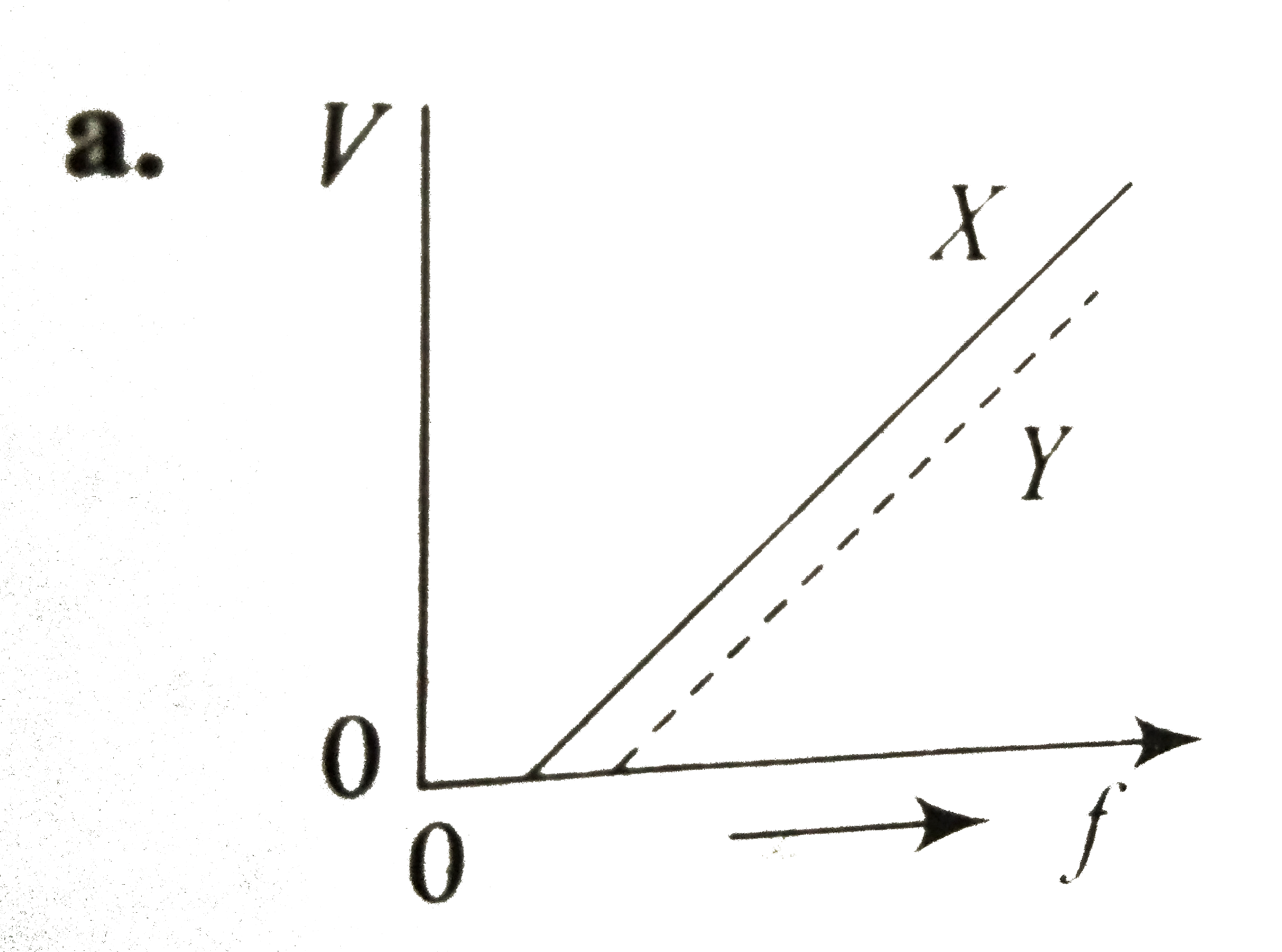
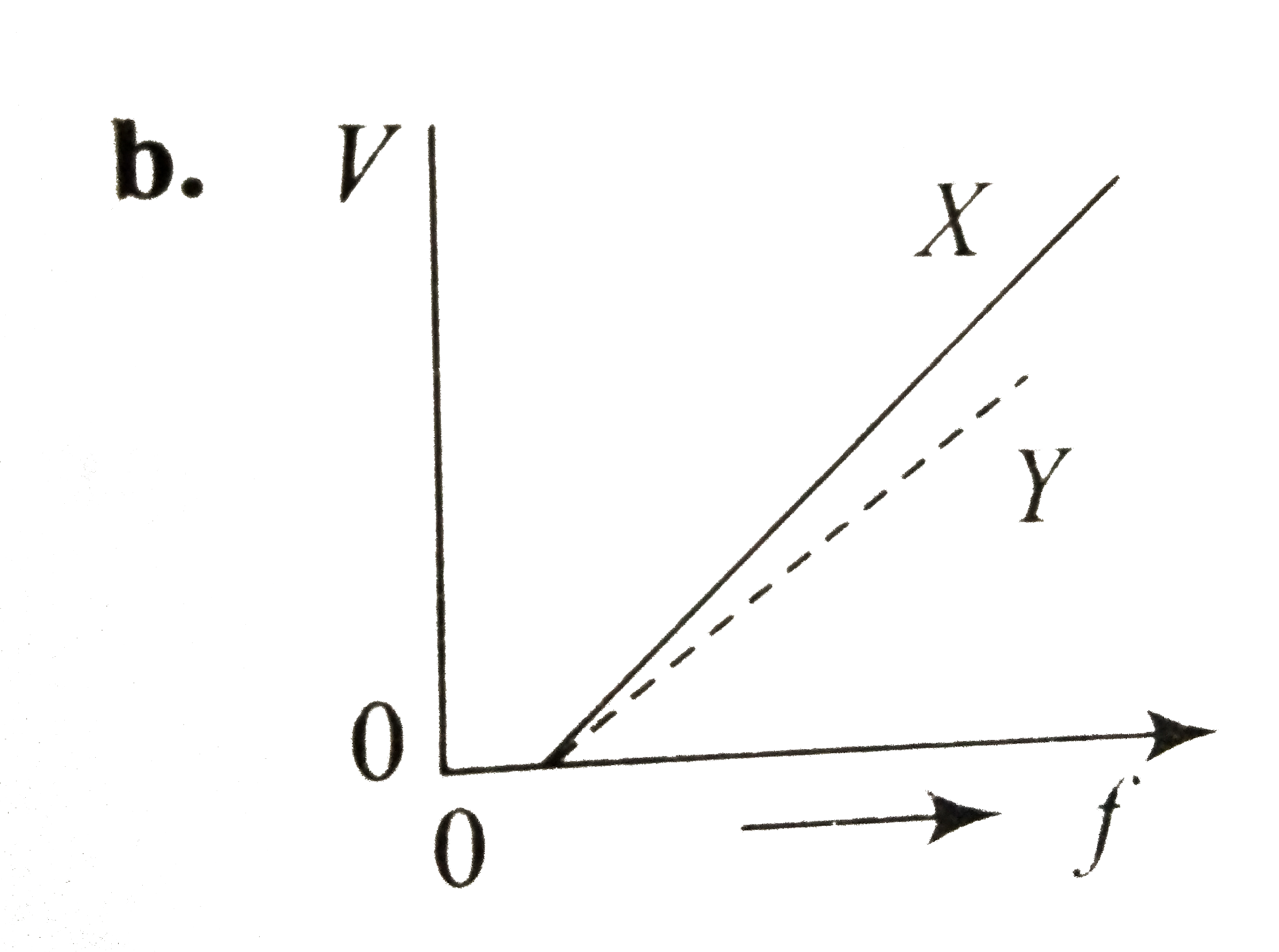
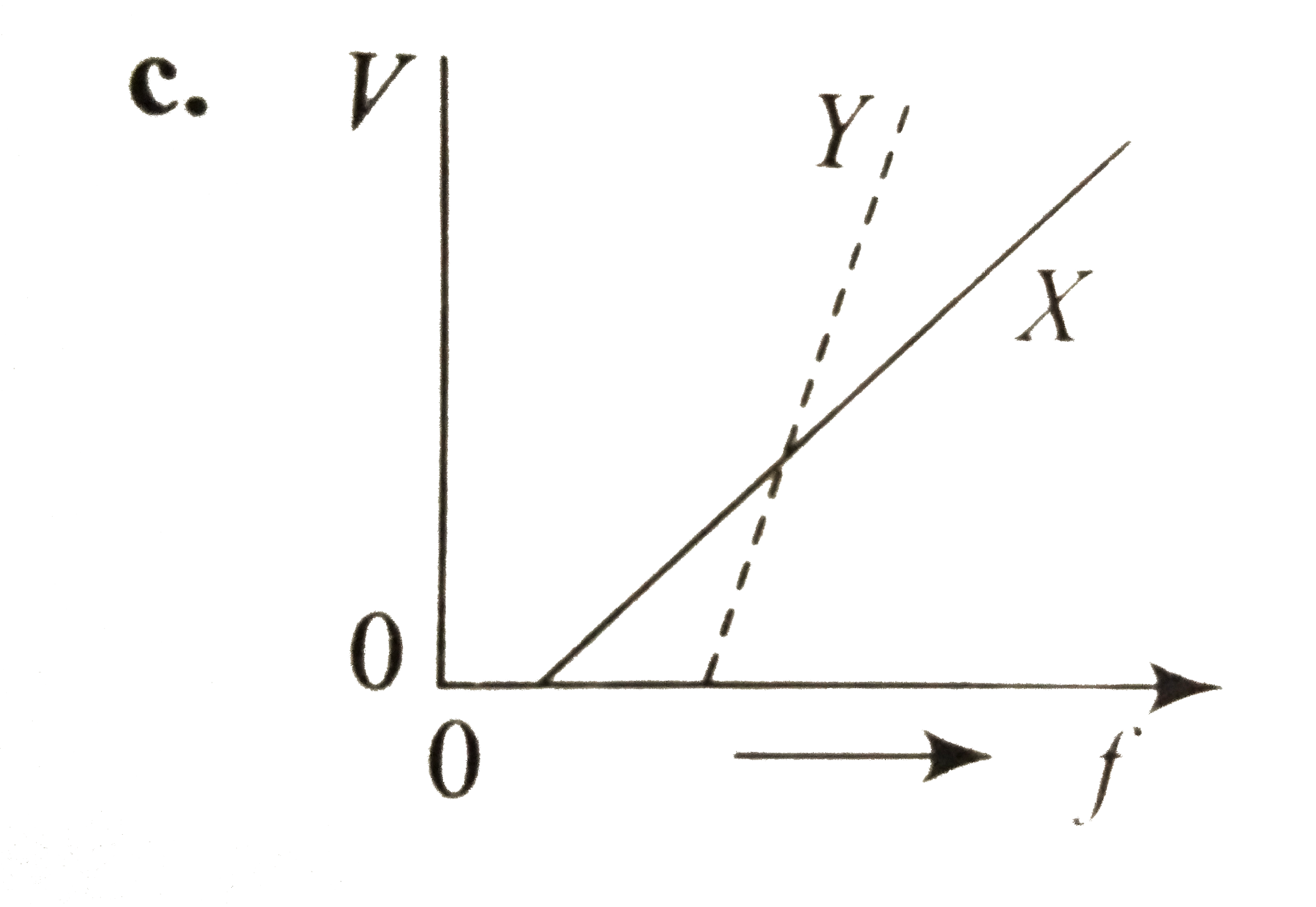
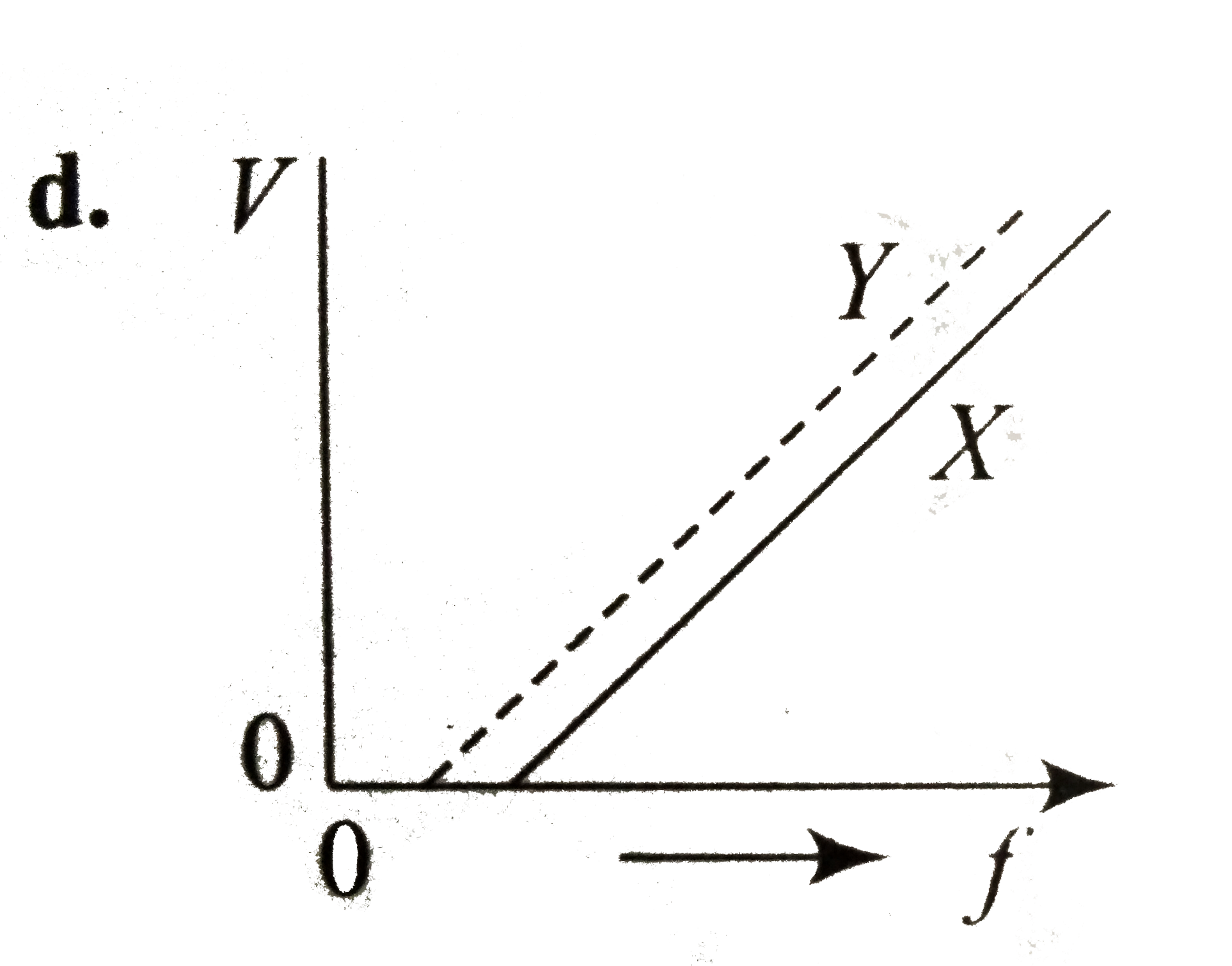
In a photoelectric emission, electrons are ejected from metals X and Y by light of frequency f. The potential difference V required to stop the electrons is measured for various frequencies.. If Y has a greater work function than X, which graph illustrates the expected results?

A

B

C

D

Text Solution

AI Generated Solution

The correct Answer is:

To solve the problem regarding the photoelectric emission from metals X and Y, we need to analyze the relationship between the stopping potential (V) and the frequency (f) of the incident light. Here are the steps to arrive at the solution: ### Step 1: Understand the Work Function The work function (φ) of a metal is the minimum energy required to eject an electron from the surface of that metal. It is related to the threshold frequency (ν₀) by the equation: \[ \phi = h \nu_0 \] where \( h \) is Planck's constant. Given that metal Y has a greater work function than metal X, we can express this as: \[ \phi_Y > \phi_X \] This implies: \[ h \nu_{0Y} > h \nu_{0X} \] Thus, the threshold frequency for metal Y is greater than that for metal X: \[ \nu_{0Y} > \nu_{0X} \] ### Step 2: Einstein's Photoelectric Equation The stopping potential (V) is related to the frequency of the incident light (f) by Einstein's photoelectric equation: \[ eV = hf - \phi \] where \( e \) is the charge of the electron. For metals X and Y, we can write: 1. For metal X: \[ eV_X = hf - h\nu_{0X} \] Rearranging gives: \[ V_X = \frac{hf}{e} - \frac{h\nu_{0X}}{e} \] 2. For metal Y: \[ eV_Y = hf - h\nu_{0Y} \] Rearranging gives: \[ V_Y = \frac{hf}{e} - \frac{h\nu_{0Y}}{e} \] ### Step 3: Analyze the Graphs From the equations derived, we can see that both \( V_X \) and \( V_Y \) are linear functions of frequency \( f \) with the same slope of \( \frac{h}{e} \). However, the y-intercepts will differ due to the different work functions (or threshold frequencies). - The y-intercept for metal X will be at \( -\frac{h\nu_{0X}}{e} \). - The y-intercept for metal Y will be at \( -\frac{h\nu_{0Y}}{e} \). Since \( \nu_{0Y} > \nu_{0X} \), the y-intercept for metal Y will be lower than that for metal X. ### Step 4: Conclusion The graph that illustrates the expected results will show: - Both lines having the same slope (indicating the same value of \( \frac{h}{e} \)). - The line for metal Y starting at a lower value on the V-axis (indicating a higher threshold frequency). ### Final Answer The correct graph will depict two straight lines with the same slope, where the line for metal Y is positioned lower than that for metal X on the V-axis. ---

To solve the problem regarding the photoelectric emission from metals X and Y, we need to analyze the relationship between the stopping potential (V) and the frequency (f) of the incident light. Here are the steps to arrive at the solution: ### Step 1: Understand the Work Function The work function (φ) of a metal is the minimum energy required to eject an electron from the surface of that metal. It is related to the threshold frequency (ν₀) by the equation: \[ \phi = h \nu_0 \] where \( h \) is Planck's constant. Given that metal Y has a greater work function than metal X, we can express this as: ...
Promotional Banner

Topper's Solved these Questions

  • PHOTOELECTRIC EFFECT

    CENGAGE PHYSICS ENGLISH|Exercise Multiple Correct|10 Videos
  • PHOTOELECTRIC EFFECT

    CENGAGE PHYSICS ENGLISH|Exercise Linked Comprehension|44 Videos
  • PHOTOELECTRIC EFFECT

    CENGAGE PHYSICS ENGLISH|Exercise Subjective|16 Videos
  • NUCLEAR PHYSICS

    CENGAGE PHYSICS ENGLISH|Exercise ddp.5.5|14 Videos
  • RAY OPTICS

    CENGAGE PHYSICS ENGLISH|Exercise DPP 1.6|12 Videos

Similar Questions

Explore conceptually related problems

In photoelectric emission process from a metal of work function 1.8 eV , the kinetic energy of most energetic electrons is 0.5 eV . The corresponding stopping potential is

Find the retarding potential requred to stop the escape of photo electrons from the metal surface of work function 1.07 eV , which is irradiated with light of wavelength 332 mn

The threshold wavelength for ejection of electrons from a metal is 430 nm. The work function for the photoelectric emission from the metal is

The threshold wavelength for ejection of electrons from a metal is 250 nm. The work function for the photoelectric emission from the metal is

The threshold wavelength for ejection of electrons from a metal is 330 nm. The work function for the photoelectric emission from the metal is

The threshold wavelength for ejection of electrons from a metal is 230 nm. The work function for the photoelectric emission from the metal is

The threshold wavelength for ejection of electrons from a metal is 350 nm. The work function for the photoelectric emission from the metal is

The threshold wavelength for ejection of electrons from a metal is 450 nm. The work function for the photoelectric emission from the metal is

The threshold wavelength for ejection of electrons from a metal is 280 nm. The work function for the photoelectric emission from the metal is

The threshold wavelength for ejection of electrons from a metal is 650 nm. The work function for the photoelectric emission from the metal is

CENGAGE PHYSICS ENGLISH-PHOTOELECTRIC EFFECT-Single Correct
  1. If lamda0 stands for mid-wavelength in the visible region, the de Brog...

    Text Solution

    |

  2. The threshold frequency for certain metal is v0. When light of frequen...

    Text Solution

    |

  3. In a photoelectric emission, electrons are ejected from metals X and Y...

    Text Solution

    |

  4. In a photoelectric cell, the wavelength of incident light is chaged fr...

    Text Solution

    |

  5. When a metallic surface is illuminated by a light of frequency 8xx10^(...

    Text Solution

    |

  6. The de Broglie wavelength of neutrons in thermal equilibrium is (given...

    Text Solution

    |

  7. A partical of mass M at rest decays into two Particles of masses m1 ...

    Text Solution

    |

  8. What is the energy of a proton possessing wavelength 0.4A?

    Text Solution

    |

  9. An electron and a photon possess the same de Broglie wavelength. If Ee...

    Text Solution

    |

  10. In Q.72,An electron and a photon possess the same de Broglie wavelengt...

    Text Solution

    |

  11. An electron and a photon, each has a wavelength of 1.2A. What is the r...

    Text Solution

    |

  12. What is the wavelength of a photon of energy 1 eV?

    Text Solution

    |

  13. If lamda1 and lamda2 denote the wavelength of de Broglie waves for ele...

    Text Solution

    |

  14. Which curve shows the relation ship between the energy R and the wavel...

    Text Solution

    |

  15. Work function of nickel is 5.01 eV. When ultraviolet radiation of wave...

    Text Solution

    |

  16. An electron is accelerated through a potential difference of V volt. I...

    Text Solution

    |

  17. The kinetic energy of most energetic electrons emitted from a metallic...

    Text Solution

    |

  18. How many photons are emitted per second by a 5 m W laser source operat...

    Text Solution

    |

  19. Figure is the plot of the stopping potential versus the frequency of t...

    Text Solution

    |

  20. Figure is the plot of the stopping potential versus the frequency of t...

    Text Solution

    |
