Home
Class 12
PHYSICS
A nozzle throws a stream of gas against ...


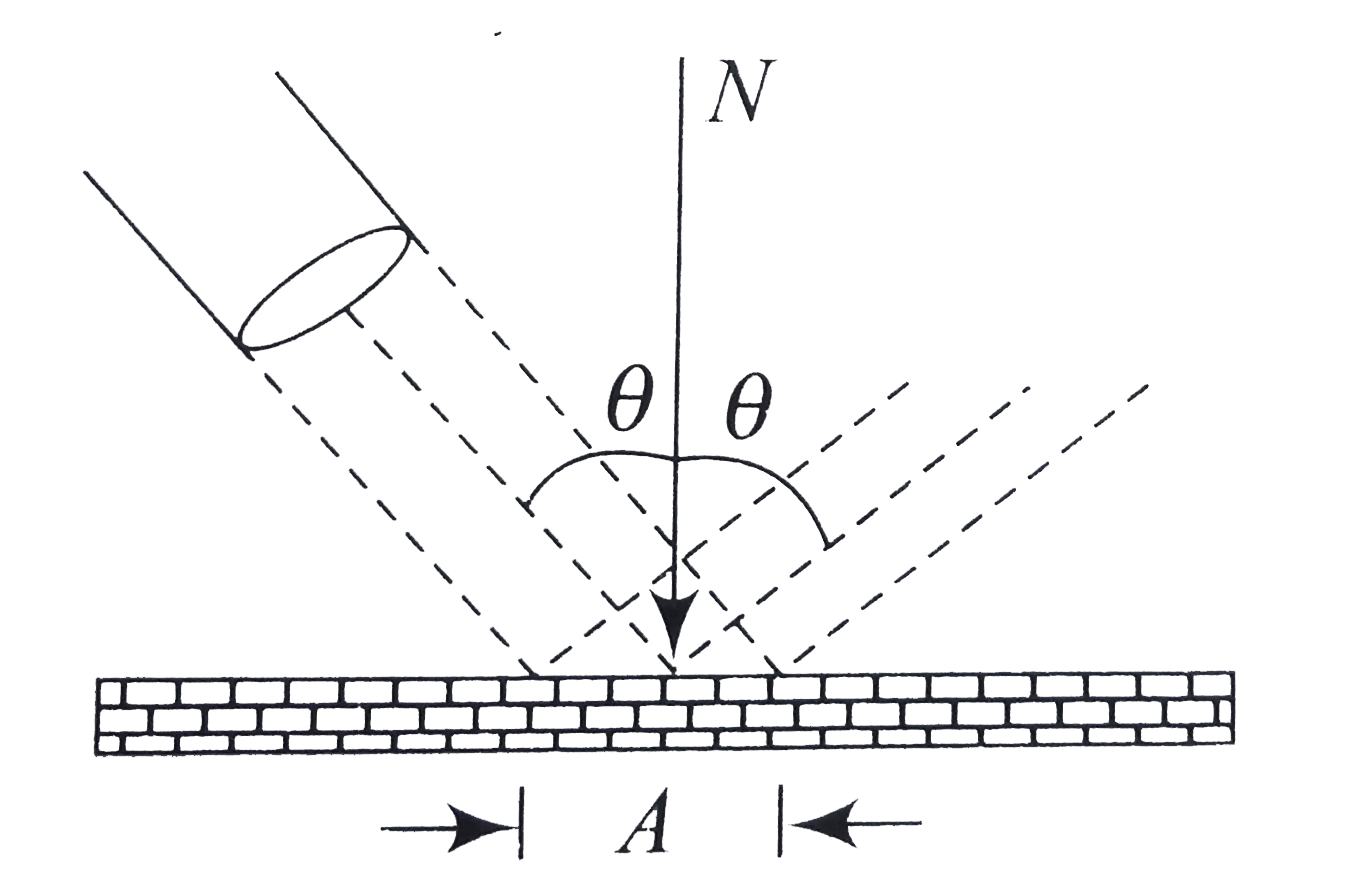
A nozzle throws a stream of gas against a wall with a velocity v much larger than the thermal agitation of the molecules. The wall deflects the molecules without changing the magnitude of their velocity. Also, assume that the force exerted on the wall by the molecules is perpendicular to the wall. (This is not strictly true of a rough wall). Find the force exerted on the wall

A

`Anmv^2cos^2theta`

B

`2Anmv^2cos^2theta`

C

`2nmv^2sin^2theta`

D

`Anmv^2costheta`

Text Solution

Verified by Experts

The correct Answer is:
B


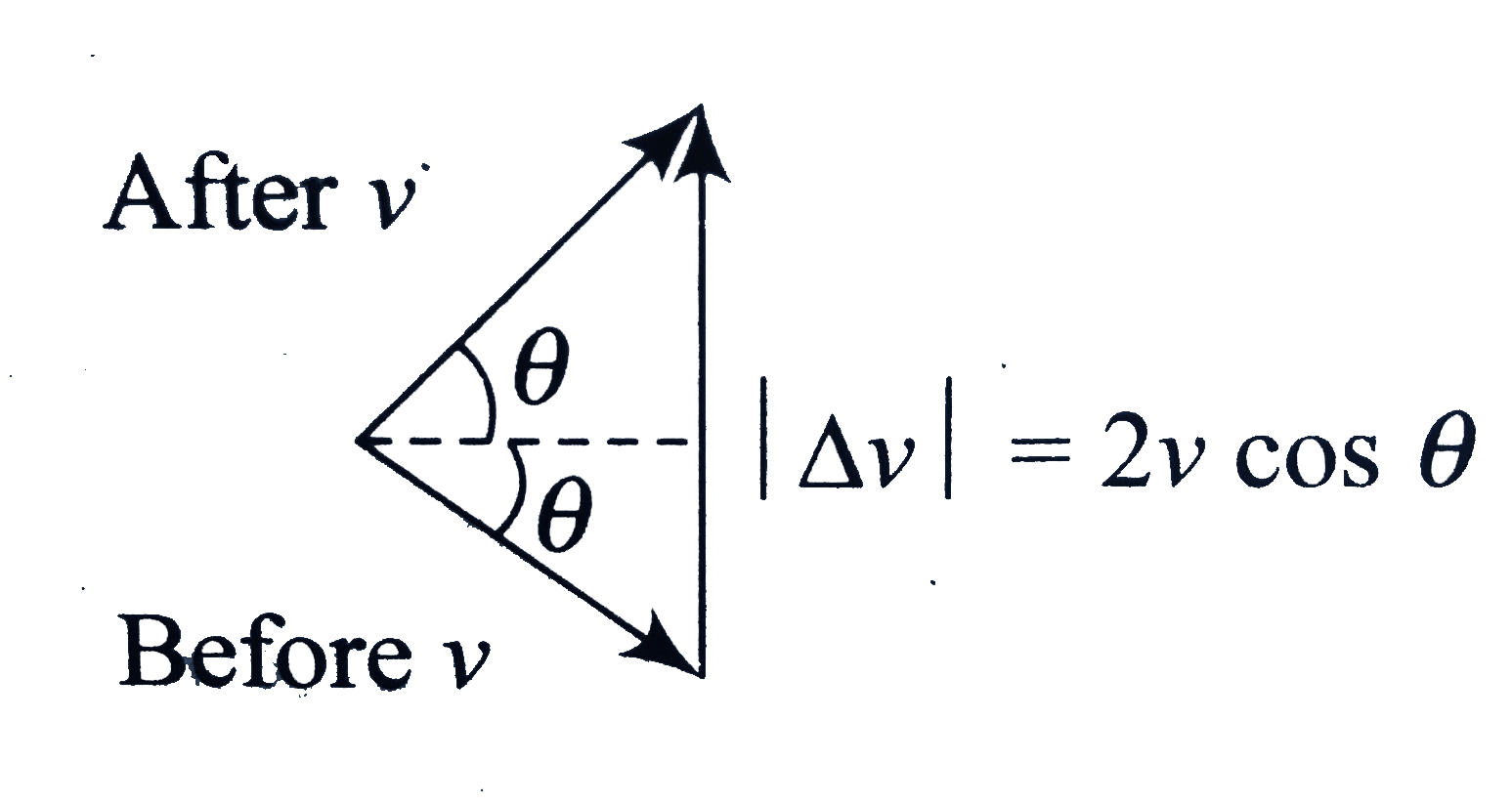
Since the molecules rebound from the wall, the component of velocity perpendicular to the wall is reversed, whole its velocity parallel to the wall does not change. The change is velocity of molecules is parallel to normal N. The magnitude of change is
`|trianglevecv|=2vcostheta`
The change is momentum of a molecule is
`|trianglevecp|=m|trianglevecv|=2mvcostheta`
in the direction of normal N. Let n be the number of molecules per unit volume. The number of molecules arriving at an area A of the wall per unit time is the number in a slanted cylinder whose length is equal to the velocity v and whose cross section as `Acostheta`.
Number of molecules`=n(Avcostheta)`
Each molecule suffers a change of momentum `2mvcostheta`.
Change of momentum of a steam of gas in a direction perpendicular to the wall is equal to `(nAvcostheta)xx(2mvcostheta)=2Anmv^2cos^2theta`.
Hence, force exerted on stream of gas by the wall,
`F=2Anmv^2cos^2theta`
This is also the force exerted by gas molecules on the wall.
pressure=(normal force)/(Area)`=(F)/(A)=2nmv^2cos^2theta`
Remark: for oblique incidence, the change in momentum of the radiation per unit volume at the perfectly reflecting surface is `2pcostheta` and the corresponding radiation pressure is `P_(rad)=2pccos^2theta=2Ecos^2theta`
Promotional Banner

Topper's Solved these Questions

  • PHOTOELECTRIC EFFECT

    CENGAGE PHYSICS ENGLISH|Exercise Multiple Correct|10 Videos
  • PHOTOELECTRIC EFFECT

    CENGAGE PHYSICS ENGLISH|Exercise Linked Comprehension|44 Videos
  • PHOTOELECTRIC EFFECT

    CENGAGE PHYSICS ENGLISH|Exercise Subjective|16 Videos
  • NUCLEAR PHYSICS

    CENGAGE PHYSICS ENGLISH|Exercise ddp.5.5|14 Videos
  • RAY OPTICS

    CENGAGE PHYSICS ENGLISH|Exercise DPP 1.6|12 Videos

Similar Questions

Explore conceptually related problems

A nozzle throws a stream of gas against a wall with a velocity v much larger than the thermal agitation of the molecules. After collision of the molecules with wall the magnitude of their velocity remains same. Also assume that the force exerted on the wall by the molecule is perpendicular to wall. (This is not strictly true for a rough wall.) Find the pressure exerted on the wall. (n = number of molecules per unit volume, m = mass of a gas molecule)

Attractive force of cell walls of xylem for water molecules is termed as

A body of mass m collides against a wall with the velocity v and rebounds with the same speed. Its magnitude of change of momentum is

In turbulent flow the velocity of the liquid molecules in contact with the walls of the tube.

A molecule of mass m moving at a velocity v impinges elastically on the wall at an angle alpha with the wall. Then

A particle of mass m strikes elastically on a wall with velocity v, at an angle of 60^(@) from the wall then magnitude of change in momentum of ball along the wall is

A jet of water with cross section of 6 cm^(2) strikes a wall at an angle of 60^(@) to the normal and rebounds elastically from the wall without losing energy. If the velocity of the water in the jet is 12 m//s , the force acting on the wall is

Wind with a velocity 100km h^(-1) blows normally against one of the walls of a house with an area of 108 m^(2) . Calculate the force exerted on the wall if the air moves parallel to the wall after striking it and has a density of 1.2 kg m^(-3) .

A stream of a liquid of density p flowin horizontally with speed v rushes out of a tube of radius r and hits a verticla wall nearly normally. Assumi g that the liquid does not rebound from the wall, the force exerted o the wall by the impact of the liquid is given by

CENGAGE PHYSICS ENGLISH-PHOTOELECTRIC EFFECT-Single Correct
  1. A monochromatic source of lightis placed at a large distance d From a ...

    Text Solution

    |

  2. A. How many photons of a tradiation of wavelength lamda=5xx10^(-7) m m...

    Text Solution

    |

  3. A nozzle throws a stream of gas against a wall with a velocity v much ...

    Text Solution

    |

  4. A plane light wave of intensity I=0.20Wcm^-2 falls on a plane mirror s...

    Text Solution

    |

  5. A plane wave of intensity I=0.70W cm^(-2) illuminates a sphere with id...

    Text Solution

    |

  6. Light of wavelength lamda from a small 0.5 mW He-Ne laser source, used...

    Text Solution

    |

  7. An electron is accelerated by a potential difference of 50 V. Find the...

    Text Solution

    |

  8. An alpha-particle and a proton are fired through the same magnetic fie...

    Text Solution

    |

  9. Find the ratio of de Broglie wavelength of a proton and as alpha-parti...

    Text Solution

    |

  10. All electrons ejected from a surface by incident light of wavelength 2...

    Text Solution

    |

  11. If the short wavelength limit of the continous spectrum coming out of ...

    Text Solution

    |

  12. In a photoelectric effect, electrons are emitted

    Text Solution

    |

  13. A particle of mass m is projected form ground with velocity u making a...

    Text Solution

    |

  14. A 60 W bulb is placed at a distance of 4 m from you. The bulb is emtt...

    Text Solution

    |

  15. Two electrons are moving with non-relativistic speeds perpendicular t...

    Text Solution

    |

  16. A photosensitive material is at 9m to the left of the origin and the s...

    Text Solution

    |

  17. A sodium metal piece is illuminated with light of wavelength 0.3 mum. ...

    Text Solution

    |

  18. The kinetic energy of a particle is equal to the energy of a photon. T...

    Text Solution

    |

  19. The resolving power of an electron microscope operated at 16kV is R. T...

    Text Solution

    |

  20. With respect to electromegnetic theory of light, the photoelectric eff...

    Text Solution

    |

