

Home
Class 12
PHYSICS
A radioactiev nuleus X deays to a stable...

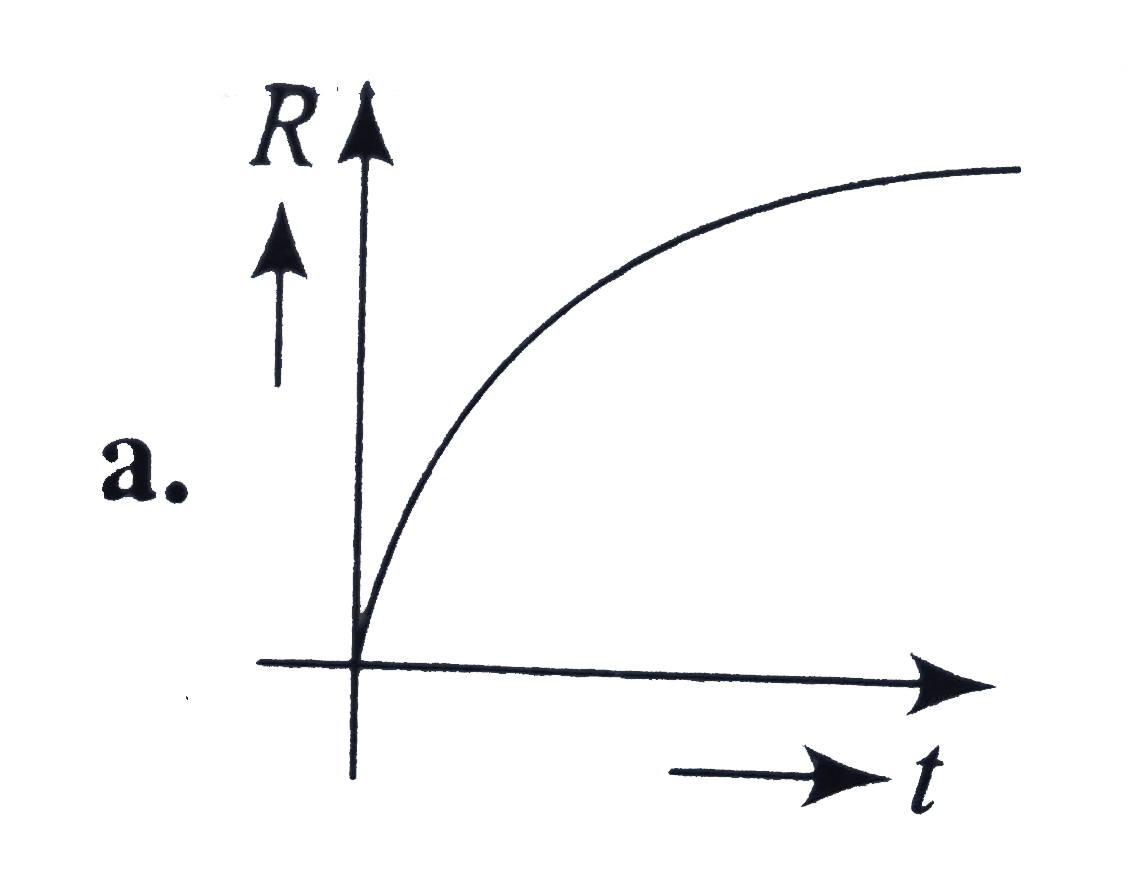
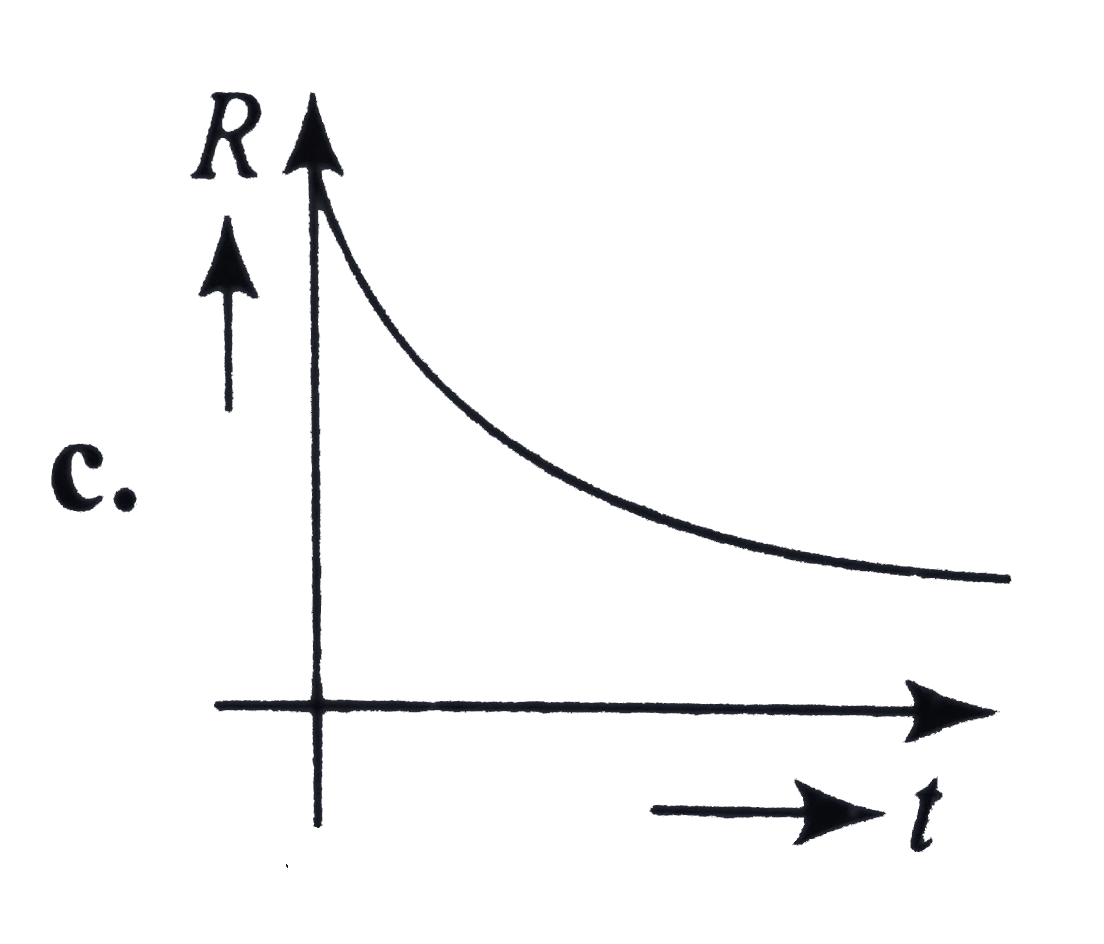
A radioactiev nuleus `X` deays to a stable nuleus `Y`. Then, time graph of rate of formation of `Y` against time `t` will be:

A

B

C

D

Text Solution

AI Generated Solution

The correct Answer is:

To solve the problem of determining the time graph of the rate of formation of stable nucleus Y from radioactive nucleus X, we can follow these steps: ### Step 1: Understand the Decay Process Radioactive nucleus X decays over time into stable nucleus Y. The decay process can be described by the exponential decay law, which states that the number of radioactive nuclei decreases over time. ### Step 2: Write the Decay Law The number of undecayed nuclei \( N(t) \) at time \( t \) can be expressed as: \[ N(t) = N_0 e^{-\alpha t} \] where \( N_0 \) is the initial number of nuclei, and \( \alpha \) is the decay constant. ### Step 3: Determine the Rate of Formation of Y As nucleus X decays, nucleus Y is formed. The rate of formation of Y, \( R_Y(t) \), is equal to the rate of decay of X, which can be expressed as: \[ R_Y(t) = -\frac{dN(t)}{dt} \] Calculating this derivative gives: \[ R_Y(t) = \alpha N_0 e^{-\alpha t} \] This shows that the rate of formation of Y is proportional to the number of undecayed nuclei of X. ### Step 4: Analyze the Graph of \( R_Y(t) \) From the equation \( R_Y(t) = \alpha N_0 e^{-\alpha t} \), we can see that: - At \( t = 0 \), \( R_Y(0) = \alpha N_0 \) (maximum rate of formation). - As time increases, \( e^{-\alpha t} \) decreases, leading to a decrease in \( R_Y(t) \). ### Step 5: Sketch the Graph The graph of \( R_Y(t) \) against time \( t \) will start at a maximum value when \( t = 0 \) and will decrease exponentially towards zero as time progresses. This graph will resemble a decaying exponential curve. ### Conclusion Thus, the time graph of the rate of formation of Y against time \( t \) will show a decreasing exponential trend. ### Final Answer The correct option for the graph of the rate of formation of Y against time is option C. ---

To solve the problem of determining the time graph of the rate of formation of stable nucleus Y from radioactive nucleus X, we can follow these steps: ### Step 1: Understand the Decay Process Radioactive nucleus X decays over time into stable nucleus Y. The decay process can be described by the exponential decay law, which states that the number of radioactive nuclei decreases over time. ### Step 2: Write the Decay Law The number of undecayed nuclei \( N(t) \) at time \( t \) can be expressed as: \[ N(t) = N_0 e^{-\alpha t} \] ...
Promotional Banner

Topper's Solved these Questions

  • NUCLEAR PHYSICS

    CENGAGE PHYSICS ENGLISH|Exercise Linked Comprehension|29 Videos
  • NUCLEAR PHYSICS

    CENGAGE PHYSICS ENGLISH|Exercise Integer|6 Videos
  • NUCLEAR PHYSICS

    CENGAGE PHYSICS ENGLISH|Exercise Subjective|35 Videos
  • MISCELLANEOUS VOLUME 5

    CENGAGE PHYSICS ENGLISH|Exercise Integer|12 Videos
  • PHOTOELECTRIC EFFECT

    CENGAGE PHYSICS ENGLISH|Exercise Integer Type|4 Videos

Similar Questions

Explore conceptually related problems

If decompositon reaction A(g)toB(g) follows first order linetics then the graph of rate of formation (R ) of B against time t will be :

Radioactive element decays to form a stable nuclide, then the rate of decay of reactant ((d N)/(d t)) will vary with time (t) as shown in figure.

The graph represents the decay of a newly-prepared sample of radioactive nuclide X to a stable nuclide Y. The half-life of X is t. The growth curve for Y intersects the decay curve for X after time T. What is the time T ?

A radioactive element X with half life 2 h decays giving a stable element Y. After a time t, ratio of X and Y atoms is 1:16 .Time t is

A radioactive nucleus X decays to a nucleus Y with a decay constant lambda_X=0.1s^-1 , Y further decays to a stable nucleus Z with a decay constant lambda_Y=1//30s^-1 . Initially, there are only X nuclei and their number is N _0=10^20 . Set up the rate equations for the populations of X, Y and Z. The population of Y nucleus as a function of time is given by N_Y(t)={N _0lambda_X//(lambda_X-lambda_Y)}[exp(-lambda_Yt)-exp(-lambda_Xt)] . Find the time at which N_Y is maximum and determine the population X and Z at that instant.

Nuclei of a radioactive element X are being produced at a constant rate K and this element decays to a stable nucleus Y with a decay constant lambda and half-life T_(1//3) . At the time t=0 , there are N_(0) nuclei of the element X. The number N_(Y) of nuclei of Y at time t is .

Nuclei of a radioactive element X are being produced at a constant rate K and this element decays to a stable nucleus Y with a decay constant lambda and half-life T_(1//2) . At the time t=0 , there are N_(0) nuclei of the element X . The number N_(X) of nuclei of X at time t=T_(1//2) is .

A stone is projected at time t=0 with a speed v_(0) at an angle theta with the horizontal in a uniform gravitational field. The rate of work done (P) by the gravitational force plotted against time (t) will be as.

A radioactive element X converts into another stable elemnet Y . Half-life of X is 2h . Initally, only X is present. After time t , the ratio of atoms of X and Y is found to be 1:4 Then t in hours is .

Nuclei X and Y convert into a stable nucleus Z. At t=0 , the number of nuclei of X is 8 times that of Y. Half life of X is 1 hour and half life of y=2 hour. Find the time (in hour) at which rate of disintegration of X and Y are equal.

CENGAGE PHYSICS ENGLISH-NUCLEAR PHYSICS-Single Correct Option
  1. A sample of radioactive material decays simultaneouly by two processes...

    Text Solution

    |

  2. In which of the following processes, the number of protons in the nule...

    Text Solution

    |

  3. A radioactiev nuleus X deays to a stable nuleus Y. Then, time graph of...

    Text Solution

    |

  4. A heavy nuleus having mass number 200 gets disintegrated into two smal...

    Text Solution

    |

  5. An element X decays , first by positron emission and then two alpha-pa...

    Text Solution

    |

  6. 90% of a radioactive sample is left undecayed after time t has elapsed...

    Text Solution

    |

  7. A radioactive element X converts into another stable element. Y half-l...

    Text Solution

    |

  8. A radioactive element P disintegrates into Q which further disintegrat...

    Text Solution

    |

  9. The binding energy of an electron in the ground state of He is equal t...

    Text Solution

    |

  10. The mean life time of a radionuclide, if the activity decrease by 4% ...

    Text Solution

    |

  11. On an average, a neutron loses half of its energy per collision with a...

    Text Solution

    |

  12. Masses of two isobars .(29)Cu^(64) and .(30)Zn^(64) are 63.9298 u and ...

    Text Solution

    |

  13. If a nucleus such as .^(226)Ra that is initially at rest undergoes al...

    Text Solution

    |

  14. If the Q value of an endothermic reaction is 11.32 MeV, then the minim...

    Text Solution

    |

  15. 1.00 kg of .^(235)U undergoes fission process. If energy released per ...

    Text Solution

    |

  16. Mark out the incoreect statemnet.

    Text Solution

    |

  17. U-235 can decay by many ways , let us here consider only two ways, A a...

    Text Solution

    |

  18. A radio isotope X with a half life 1.4xx10^(9) yr decays of Y which is...

    Text Solution

    |

  19. What is the probability of a radioactive nucleus to survive one mean l...

    Text Solution

    |

  20. Consider one of fission reactions of ^(235)U by thermal neutrons .(92)...

    Text Solution

    |
