Home
Class 12
PHYSICS
Various rules of thumb have seen propose...

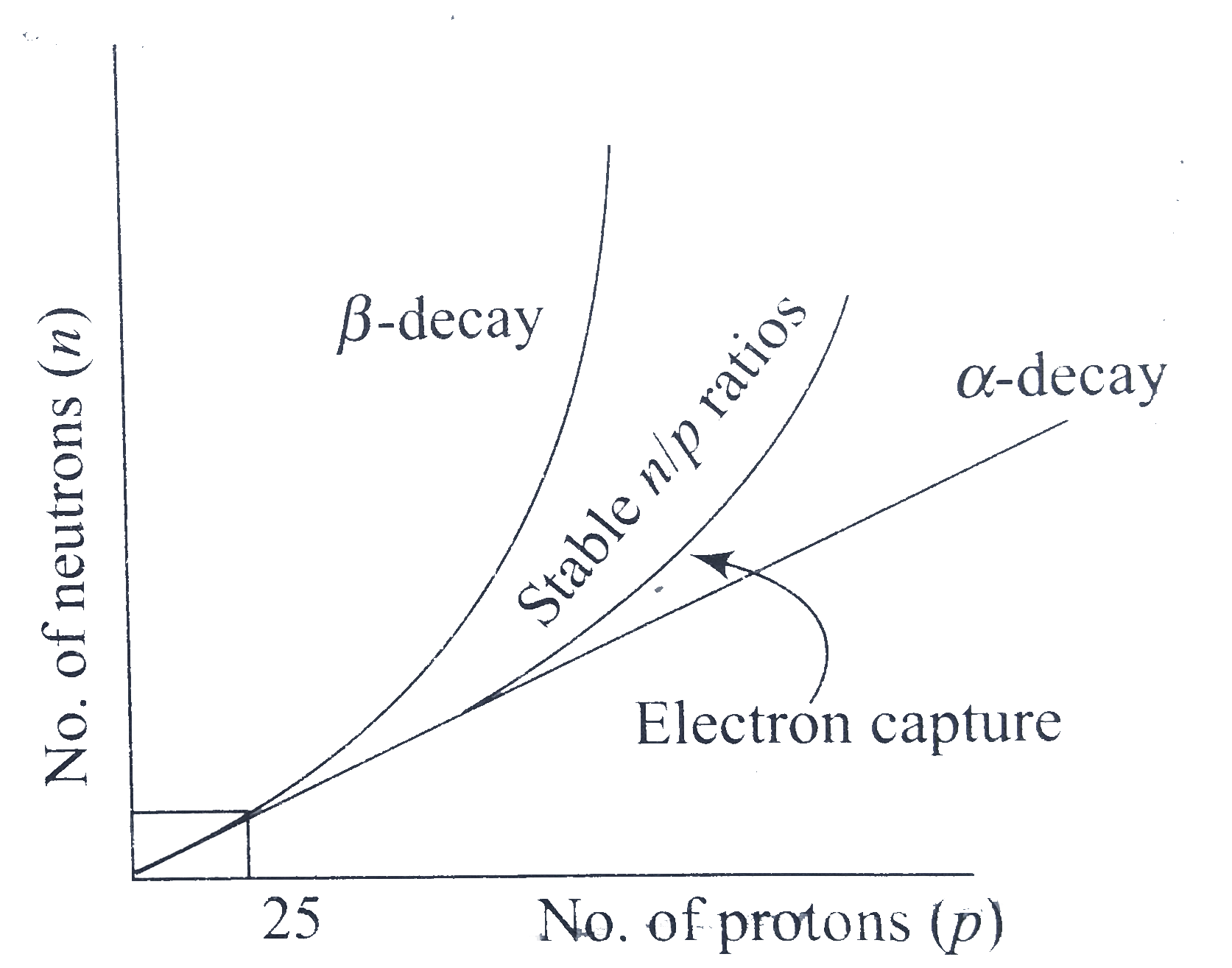
Various rules of thumb have seen proposed by the scientific community to expalin the mode of radioactive decay by various radioisotopes. One of the major rules is called the `n//p` ratio. If all the known isotopes of the elemnts are plotted on a graph of number of neutrons (n) versus number of protons (p), it is observed that all isotopes lying outside of a ''stable'' `n//p` ratio region are radioactive as shown f The graph exhibits straight line behaviour with unit slope up to `p=25`. Above `p=25`, tgose isotopes with `n//p` ratios lying above the stable region usually undergo beta decay. Very heavy isotopes `(pgt83)` are unstable because of their relativley large nuclei and they undergo alpha decay. Gamma ray emission does not involve the release of a particle. It represnts a change in an atom from a higher energy level to a lower energy level.

`Th-230` undergoes a series of radioactive decay processes resulting in `Bi-214` being the final product. What was the sequence of the processes that occured?

A

`alpha,alpha,alpha,g,beta`

B

`alpha,alpha,alpha,alpha,beta`

C

`alpha,alpha,beta,beta`

D

`alpha,beta,beta,beta,gamma`

Text Solution

Verified by Experts

The correct Answer is:

b

`._(90)^(230)Th rarr ._(83)^(214)Bi + x._(1)^(0)e^(bar) +y._(2)^(4)He^(2+)+z ("gamma ray")`
Since the sum of the atomic numbers and mass numbers on either side of the equation must be equal (matter cannot be created or destroyed),we get
`90=83-x+2y` and `230=214+4y`
Solving, we get
`y=4` and `x=1`
The order of the reactions is irrelevant (i.e., `alpha, beta`,...) Since gamma rays have no atomic number or mass number, the value of z does not affect this particular calculation.
Promotional Banner

Topper's Solved these Questions

  • NUCLEAR PHYSICS

    CENGAGE PHYSICS ENGLISH|Exercise Integer|6 Videos
  • NUCLEAR PHYSICS

    CENGAGE PHYSICS ENGLISH|Exercise Fill In The Blanks|5 Videos
  • NUCLEAR PHYSICS

    CENGAGE PHYSICS ENGLISH|Exercise Single Correct Option|182 Videos
  • MISCELLANEOUS VOLUME 5

    CENGAGE PHYSICS ENGLISH|Exercise Integer|12 Videos
  • PHOTOELECTRIC EFFECT

    CENGAGE PHYSICS ENGLISH|Exercise Integer Type|4 Videos

Similar Questions

Explore conceptually related problems

Various rules of thumb have seen proposed by the scientific community to expalin the mode of radioactive decay by various radioisotopes. One of the major rules is called the n//p ratio. If all the known isotopes of the elemnts are plotted on a graph of number of neutrons (n) versus number of protons (p), it is observed that all isotopes lying outside of a ''stable'' n//p ratio region are radioactive as shown fig. The graph exhibits straight line behaviour with unit slope up to p=25 . Above p=25 , tgose isotopes with n//p ratios lying above the stable region usually undergo beta decay. Very heavy isotopes (pgt83) are unstable because of their relativley large nuclei and they undergo alpha decay. Gamma ray emission does not involve the release of a particle. It represnts a change in an atom from a higher energy level to a lower energy level. How would the radioisotope of magnesium with atomic mass 27 undergo radioactive decay?.

Various rules of thumb have seen proposed by the scientific community to expalin the mode of radioactive decay by various radioisotopes. One of the major rules is called the n//p ratio. If all the known isotopes of the elemnts are plotted on a graph of number of neutrons (n) versus number of protons (p), it is observed that all isotopes lying outside of a ''stable'' n//p ratio region are radioactive as shown fig.5.28. The graph exhibits straight line behaviour with unit slope up to p=25 . Above p=25 , tgose isotopes with n//p ratios lying above the stable region usually undergo beta decay. Very heavy isotopes (pgt83) are unstable because of their relativley large nuclei and they undergo alpha decay. Gamma ray emission does not involve the release of a particle. It represnts a change in an atom from a higher energy level to a lower energy level. Which of the following represents the relative penetrating power of the three types of radioactive emission in decreasing order?

In beta- decay n//p ratio :

Define radioactivity. Name various radioactive elements.

The number of neutrons in the radioactive isotope of hydrogen is

The possible sum of the number of neutrons and protons in the isotope of hydrogen is :

Deduce the expression, N=N_(0)^(-lambdat) for the law of radioactive decay.

The sum of the number of neutrons and protons in the isotopes of hydrogen is :

Assertion : All the isotopes of a given element show same chemical behaviour. Reason : Isotopes have different number of neutrons present in the nucleus.

CENGAGE PHYSICS ENGLISH-NUCLEAR PHYSICS-Linked Comprehension
  1. A radioactive with decay constant lambda is being produced in a nuclea...

    Text Solution

    |

  2. Various rules of thumb have seen proposed by the scientific community ...

    Text Solution

    |

  3. Various rules of thumb have seen proposed by the scientific community ...

    Text Solution

    |

  4. Various rules of thumb have seen proposed by the scientific community ...

    Text Solution

    |

  5. The radionuclide .^(56)Mn is being produced in a cyclontron at a const...

    Text Solution

    |

  6. The radionuclide .^(56)Mn is being produced in a cyclontron at a const...

    Text Solution

    |

  7. The radionuclide .^(56)Mn is being produced in a cyclontron at a const...

    Text Solution

    |

  8. Many unstable nuclie can decay spontaneously to a nucleus of lower mas...

    Text Solution

    |

  9. Many unstable nuclie can decay spontaneously to a nucleus of lower mas...

    Text Solution

    |

  10. Many unstable nuclie can decay spontaneously to a nucleus of lower mas...

    Text Solution

    |

  11. All nuclei consist of two types of particles- protaon and neutrons. Nu...

    Text Solution

    |

  12. All nuclei consist of two types of particles- protaon and neutrons. Nu...

    Text Solution

    |

  13. All nuclei consist of two types of particles- protaon and neutrons. Nu...

    Text Solution

    |

  14. The compound unstabel nucleus .(92)^(236)U often decays in accordance ...

    Text Solution

    |

  15. The compound unstabel nucleus .(92)^(236)U often decays in accordance ...

    Text Solution

    |

  16. The compound unstabel nucleus .(92)^(236)U often decays in accordance ...

    Text Solution

    |

  17. The compound unstabel nucleus .(92)^(236)U often decays in accordance ...

    Text Solution

    |

  18. A beam of alpha paricles is incident on a target of lead. A particular...

    Text Solution

    |

  19. A beam of alpha paricles is incident on a target of lead. A particular...

    Text Solution

    |

  20. A beam of alpha paricles is incident on a target of lead. A particular...

    Text Solution

    |
