Home
Class 12
PHYSICS
The compound unstabel nucleus .(92)^(236...

The compound unstabel nucleus `._(92)^(236)U` often decays in accordance with the following reaction
`._(92)^(236)U rarr ._(54)^(140)Xe +._(38)^(94)Sr ` + other particles
During the reaction, the uranium nucleus ''fissions'' (splits) into the two smaller nuceli have higher nuclear binding energy per nucleon (although the lighter nuclei have lower total nuclear binding energies, because they contain fewer nucleons).
Inside a nucleus, the nucleons (protonsa and neutrons)attract each other with a ''strong nuclear'' force. All neutrons exert approxiamtely the same strong nuclear force on each other. This force holds the nuclear are very close together at intranuclear distances.
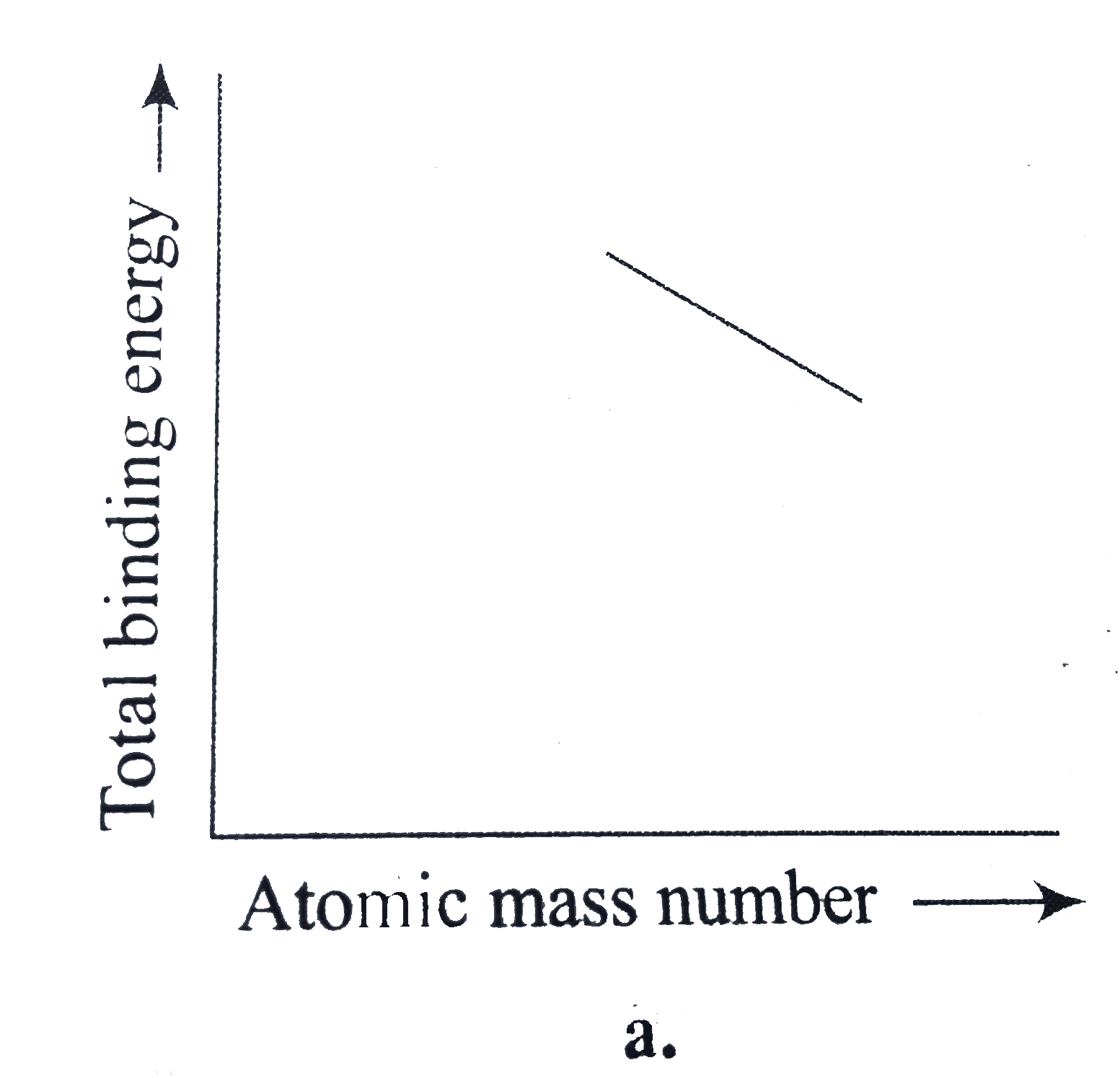
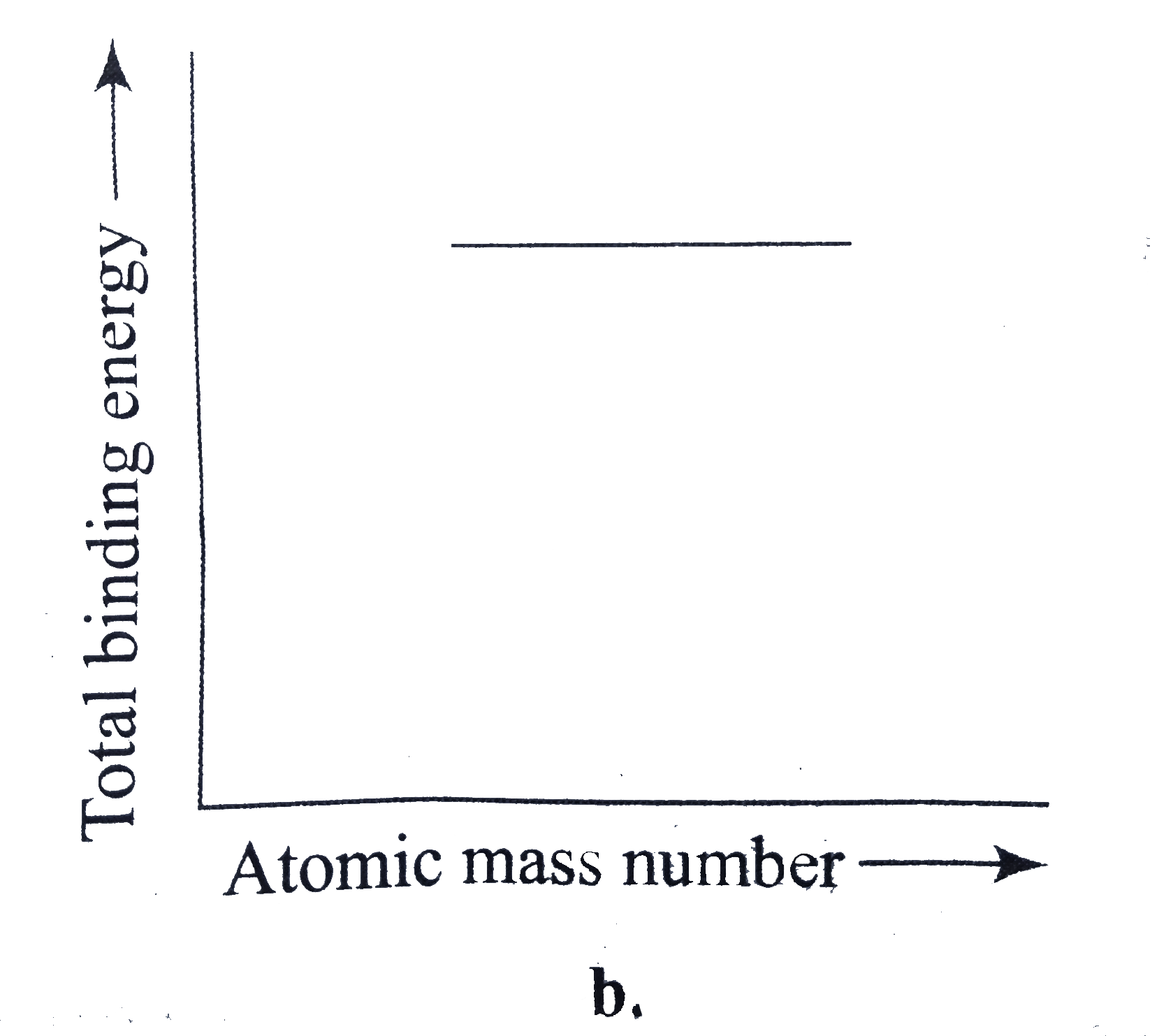
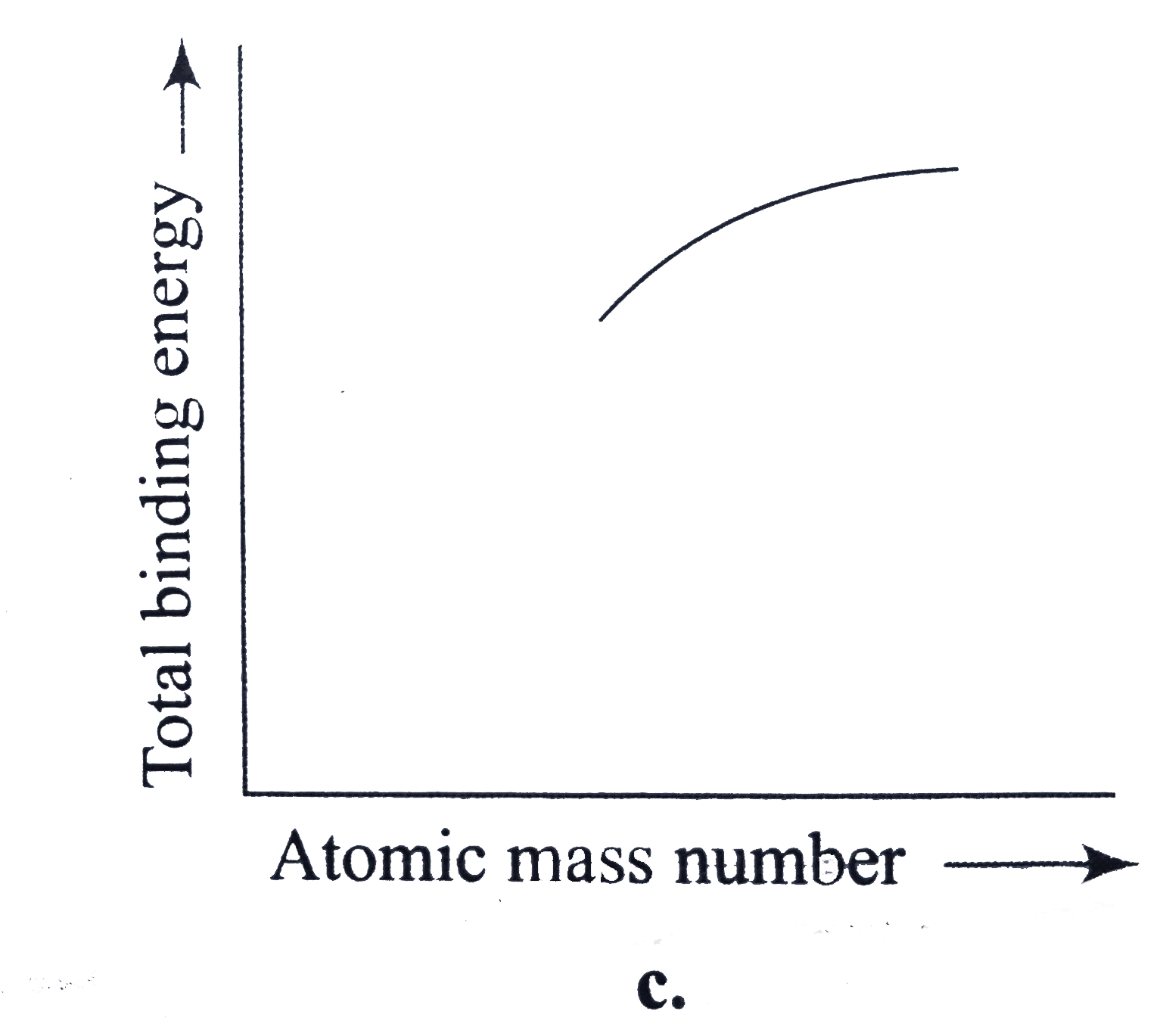
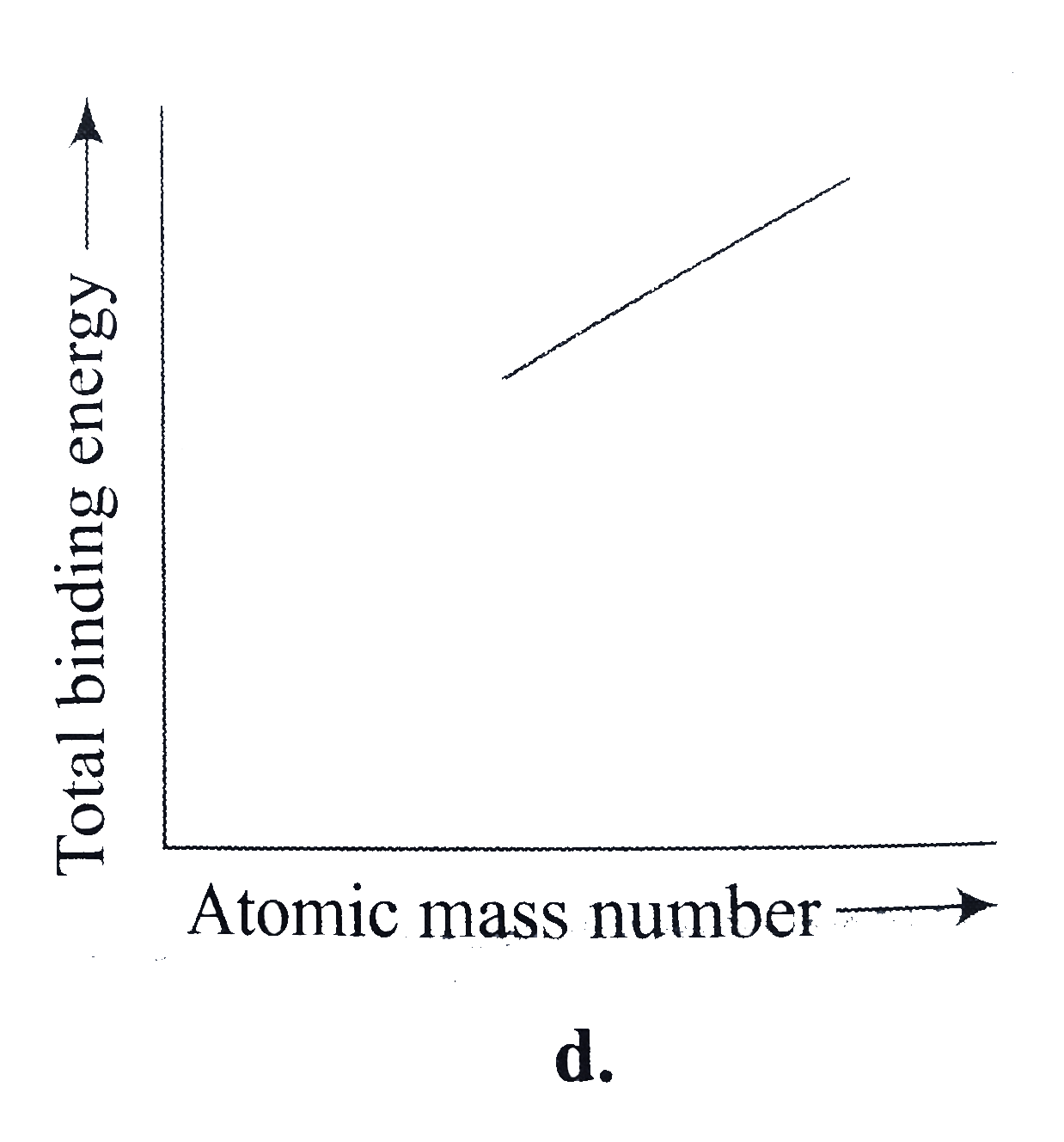
Which of the following graphs might represent the relationship between atomic number (i.e., ''atomic weight'') and the total binding energy of the nucleus, for nuclei heavier than `._(38)^(94)Sr` ?

A

B

C

D

Text Solution

AI Generated Solution

The correct Answer is:

To solve the problem, we need to analyze the relationship between atomic number (or atomic weight) and the total binding energy of the nucleus, particularly for nuclei heavier than Strontium (Sr). ### Step-by-Step Solution: 1. **Understanding the Reaction**: The decay reaction given is: \[ \,_{92}^{236}U \rightarrow \,_{54}^{140}Xe + \,_{38}^{94}Sr + \text{other particles} \] Here, uranium (U) fissions into xenon (Xe) and strontium (Sr), along with other particles. 2. **Binding Energy Concepts**: - **Total Binding Energy**: This is the energy required to disassemble a nucleus into its individual nucleons. It is proportional to the number of nucleons in the nucleus. - **Binding Energy per Nucleon**: This is the total binding energy divided by the number of nucleons. It indicates how tightly the nucleons are bound within the nucleus. 3. **Behavior of Binding Energy**: - For heavier nuclei (like uranium), the total binding energy is relatively high, but the binding energy per nucleon tends to decrease as the nucleus gets heavier. - For lighter nuclei (like strontium and xenon), they have a higher binding energy per nucleon but a lower total binding energy due to having fewer nucleons. 4. **Analyzing the Graph**: - We need to find a graph that shows the relationship between atomic number (or atomic weight) and total binding energy for nuclei heavier than strontium. - As we move to heavier elements, the total binding energy should increase because the total number of nucleons is increasing, even if the binding energy per nucleon decreases. 5. **Selecting the Correct Graph**: - The correct graph should show an increasing trend for total binding energy as the atomic number increases. - Among the options provided, we look for a graph where the total binding energy rises with increasing atomic number. ### Conclusion: The correct graph that represents the relationship between atomic number and total binding energy for nuclei heavier than \(_{38}^{94}Sr\) is the one that shows an increasing trend in total binding energy with increasing atomic number.

To solve the problem, we need to analyze the relationship between atomic number (or atomic weight) and the total binding energy of the nucleus, particularly for nuclei heavier than Strontium (Sr). ### Step-by-Step Solution: 1. **Understanding the Reaction**: The decay reaction given is: \[ \,_{92}^{236}U \rightarrow \,_{54}^{140}Xe + \,_{38}^{94}Sr + \text{other particles} ...
Promotional Banner

Topper's Solved these Questions

  • NUCLEAR PHYSICS

    CENGAGE PHYSICS ENGLISH|Exercise Integer|6 Videos
  • NUCLEAR PHYSICS

    CENGAGE PHYSICS ENGLISH|Exercise Fill In The Blanks|5 Videos
  • NUCLEAR PHYSICS

    CENGAGE PHYSICS ENGLISH|Exercise Single Correct Option|182 Videos
  • MISCELLANEOUS VOLUME 5

    CENGAGE PHYSICS ENGLISH|Exercise Integer|12 Videos
  • PHOTOELECTRIC EFFECT

    CENGAGE PHYSICS ENGLISH|Exercise Integer Type|4 Videos

Similar Questions

Explore conceptually related problems

The compound unstabel nucleus ._(92)^(236)U often decays in accordance with the following reaction _(92)^(236)U rarr ._(54)^(140)Xe +_(38)^(94)Sr+ other particles During the reaction, the uranium nucleus ''fissions'' (splits) into the two smaller nuceli have higher nuclear binding energy per nucleon (although the lighter nuclei have lower total nuclear binding energies, because they contain fewer nucleons). Inside a nucleus, the nucleons (protonsa and neutrons)attract each other with a ''strong nuclear'' force. All neutrons exert approxiamtely the same strong nuclear force on each other. This force holds the nuclear are very close together at intranuclear distances. In the nuclear reaction presented above, the ''other particles'' might be .

The compound unstabel nucleus ._(92)^(236)U often decays in accordance with the following reaction ._(92)^(236)U rarr ._(54)^(140)Xe +._(38)^(94)Sr + other particles During the reaction, the uranium nucleus ''fissions'' (splits) into the two smaller nuceli have higher nuclear binding energy per nucleon (although the lighter nuclei have lower total nuclear binding energies, because they contain fewer nucleons). Inside a nucleus, the nucleons (protons and neutrons)attract each other with a ''strong nuclear'' force. All neutrons exert approxiamtely the same strong nuclear force on each other. This force holds the nuclear are very close together at intranuclear distances. Why is a ._2^4He nucleus more stable than a ._3^4Li nucleus?

The compound unstabel nucleus ._(92)^(236)U often decays in accordance with the following reaction ._(92)^(236)U rarr ._(54)^(140)Xe +._(38)^(94)Sr + other particles During the reaction, the uranium nucleus ''fissions'' (splits) into the two smaller nuceli have higher nuclear binding energy per nucleon (although the lighter nuclei have lower total nuclear binding energies, because they contain fewer nucleons). Inside a nucleus, the nucleons (protonsa and neutrons)attract each other with a ''strong nuclear'' force. All neutrons exert approxiamtely the same strong nuclear force on each other. This force holds the nuclear are very close together at intranuclear distances. A proton and a neutron are both shot at 100 m s^(-1) toward a ._6^(12)C nucleus. Which particle, if either, is more likely to be absorbed by the nucleus?

The value of binding energy per nucleon is

Binding energy of a nucleus is.

The binding energy per nucleon is maximum in the case of.

The binding energy per nucleon is maximum in the case of.

Average binding energy per nucleon over a wide range is

As the mass number A increases, the binding energy per nucleon in a nucleus.

When two nuclei (with A=8) join to form a heavier nucleus , the binding energy (B.E) per nucleon of the heavier nuclei is

CENGAGE PHYSICS ENGLISH-NUCLEAR PHYSICS-Linked Comprehension
  1. Many unstable nuclie can decay spontaneously to a nucleus of lower mas...

    Text Solution

    |

  2. Many unstable nuclie can decay spontaneously to a nucleus of lower mas...

    Text Solution

    |

  3. All nuclei consist of two types of particles- protaon and neutrons. Nu...

    Text Solution

    |

  4. All nuclei consist of two types of particles- protaon and neutrons. Nu...

    Text Solution

    |

  5. All nuclei consist of two types of particles- protaon and neutrons. Nu...

    Text Solution

    |

  6. The compound unstabel nucleus .(92)^(236)U often decays in accordance ...

    Text Solution

    |

  7. The compound unstabel nucleus .(92)^(236)U often decays in accordance ...

    Text Solution

    |

  8. The compound unstabel nucleus .(92)^(236)U often decays in accordance ...

    Text Solution

    |

  9. The compound unstabel nucleus .(92)^(236)U often decays in accordance ...

    Text Solution

    |

  10. A beam of alpha paricles is incident on a target of lead. A particular...

    Text Solution

    |

  11. A beam of alpha paricles is incident on a target of lead. A particular...

    Text Solution

    |

  12. A beam of alpha paricles is incident on a target of lead. A particular...

    Text Solution

    |

  13. A nucleus kept at rest in free space, brakes up into smaller nuclei of...

    Text Solution

    |

  14. A nucleus kept at rest in free space, brakes up into smaller nuclei of...

    Text Solution

    |

  15. A nucleus kept at rest in free space, brakes up into smaller nuclei of...

    Text Solution

    |

  16. Nuceli A and B convert into a stable nucleus C. Nucleus A is converted...

    Text Solution

    |

  17. The half-life of a radioactive nucleus is 20 hours. What fraction of o...

    Text Solution

    |

  18. A radioactive sample has 8.0xx10^(18) active nuclei at a certain insta...

    Text Solution

    |

  19. A radioactive sample decays with an average life of 20 ms. A capacitor...

    Text Solution

    |

  20. A radioactive sample decays through two different decay processes alph...

    Text Solution

    |
