Home
Class 12
PHYSICS
A charge particle of mass m and charge q...

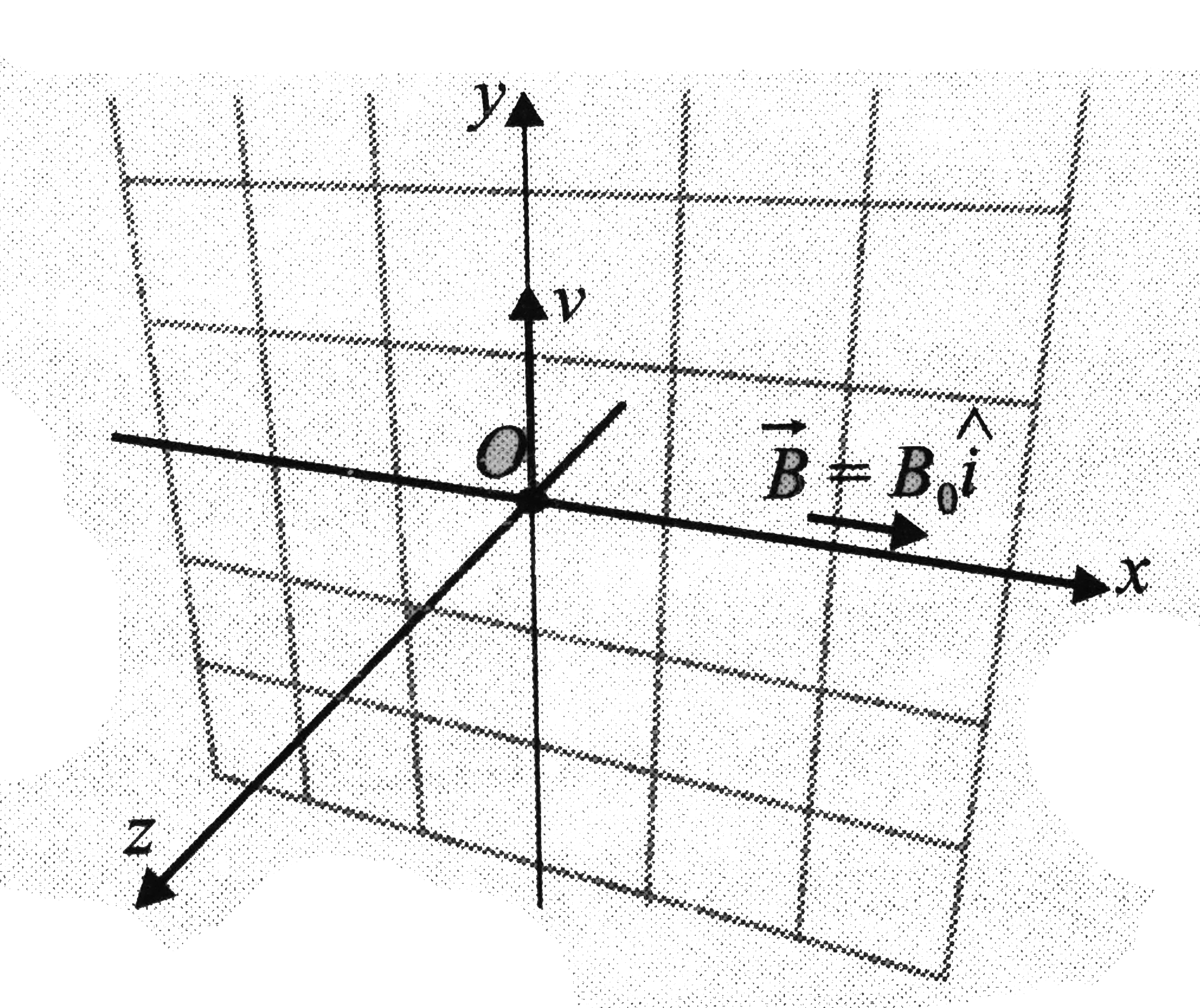
A charge particle of mass m and charge q is projected with velocity v along y-axis at `t=0.`

Find the velocity vector and position vector of the particle `vec v (t) and vec r (t)` in relation with time.

Text Solution

Verified by Experts
Radius of the circular path `R=(mv)/(qB)`
Angular velocity of the particle `omega=v/R=(qB)/m`
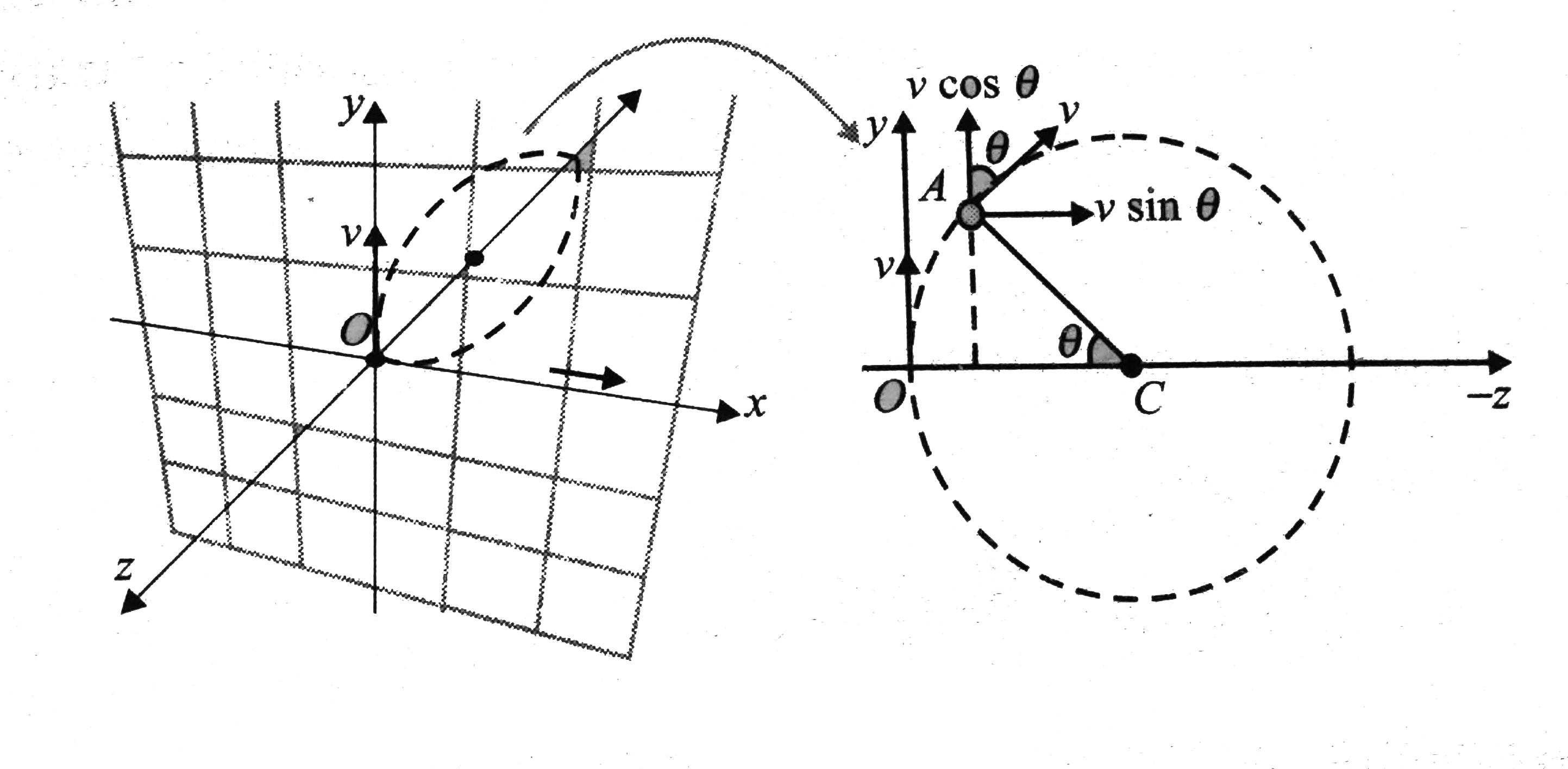
The speed of the particle will remain unchanged. The centre of circular path will be located on z-axis at point C. Let us take time interval t. during this time interval the particle will rotate an angel `theta=omegat=(qBt)/m`.
Let us draw the front view of the circular path and locate the instantaneous position of the particle.

Writing velocity vector at time t.
`vecv=v cos theta hatj-v sin theta hatk`
`vecv(t)=vcos ((qBt)/(m))hatj-v sin ((qBt)/(m))hatk`
Now writing y and z coordinates of the particle.
y-coordinate of `P=R sin theta`
z-coordinate of `P=-(R-R cos theta)`
`vecr(t)=r sin.(qBt)/(m) j-R(1-cos.(qBt)/(m))hatk`
[where `R=(mv)/(qB)`].
Promotional Banner

Topper's Solved these Questions

  • MAGNETIC FIELD AND MAGNETIC FORCES

    CENGAGE PHYSICS ENGLISH|Exercise Solved Example|25 Videos
  • MAGNETIC FIELD AND MAGNETIC FORCES

    CENGAGE PHYSICS ENGLISH|Exercise Exercise 1.1|22 Videos
  • INDUCTANCE

    CENGAGE PHYSICS ENGLISH|Exercise Concept Based|8 Videos
  • MISCELLANEOUS VOLUME 3

    CENGAGE PHYSICS ENGLISH|Exercise True and False|3 Videos

Similar Questions

Explore conceptually related problems

A positive charge particle of mass m and charge q is projected with velocity v as shown in Fig. If radius of curvature of charge particle in magnetic field region is greater than d, then find the time spent by the charge particle in magnetic field.

There exist uniform magnetic field vec(B)=-B_(0)hatk in region of space with 0ltxltd and 2dltxlt3d as shown in the figure. A positive charged particle of mass m and charge q is projected with velocity vec(v)=vhat(i) as shown in the figure. If radius of curvature of path of the charged particle in magnetic field is R(2dltRlt3d) then time elapse by charged particle in magnetic field regions is

A particle of mass m is moving along the line y-b with constant acceleration a. The areal velocity of the position vector of the particle at time t is (u=0)

A positively charged particle of mass m and charge q is projected on a rough horizontal x-y plane surface with z-axis in the vertically upward direction. Both electric and magnetic fields are acting in the region and given by vec E = - E_0 hat k and vec B= -B_0 hat k , respectively. The particle enters into the field at (a_0, 0, 0) with velocity vec v = v_0 hat j . The particle starts moving in some curved path on the plane. If the coefficient of friction between the particle and the plane is mu . Then calculate the (a) time when the particle will come to rest (b) distance travelled by the particle when it comes to rest.

A positively charged particle of mass m and charge q is projected on a rough horizontal x-y plane surface with z-axis in the vertically upward direction. Both electric and magnetic fields are acting in the region and given by vec E = - E_0 hat k and vec B= -B_0 hat k , respectively. The particle enters into the field at (a_0, 0, 0) with velocity vec v = v_0 hat j . The particle starts moving in some curved path on the plane. If the coefficient of friction between the particle and the plane is mu . Then calculate the (a) time when the particle will come to rest (b) distance travelled by the particle when it comes to rest.

The velocity vector of the motion described by the position vector of a particle, r = 2t hati + t^(2) hatj is given by

If in previous illustration, The charge particle is projected at angle alpha with x-axis with magnitude of velocity. Find a. velocity vector in function of time vec v (t). b. position vector in function of time vec r (t).

A particle of mass m is travelling with a constant velocity v=v_(0)hati along the line y=b,z=0 . Let dA be the area swept out by the position vector from origin to the particle in time dt and L the magnitude of angular momentum of particle about origin at any time t. Then

There exist uniform magnetic and electric fields of manitudes 1T and 1Vm^-1 respectively, along positive y-axis. A charged particle of mass 1kg and charge 1C is having velocity 1ms^-1 along x-axis and is at origin at t=0. Then, the coordinates of the particle at time pis will be

There exist uniform magnetic and electric fields of manitudes 1T and 1Vm^-1 respectively, along positive y-axis. A charged particle of mass 1kg and charge 1C is having velocity 1ms^-1 along x-axis and is at origin at t=0. Then, the coordinates of the particle at time pis will be

