Home
Class 12
PHYSICS
A proton beam passes without deviation t...

A proton beam passes without deviation through a region of space, where there are uniform tranverse mutully perpendicular electric and magnetic field with E = 220 kV/m and B = 50 mT.Then the beam strikes a grounded target.Find the force imparted by the beam on the target, if beam current is equal to i = 0.80 mA

Text Solution

Verified by Experts
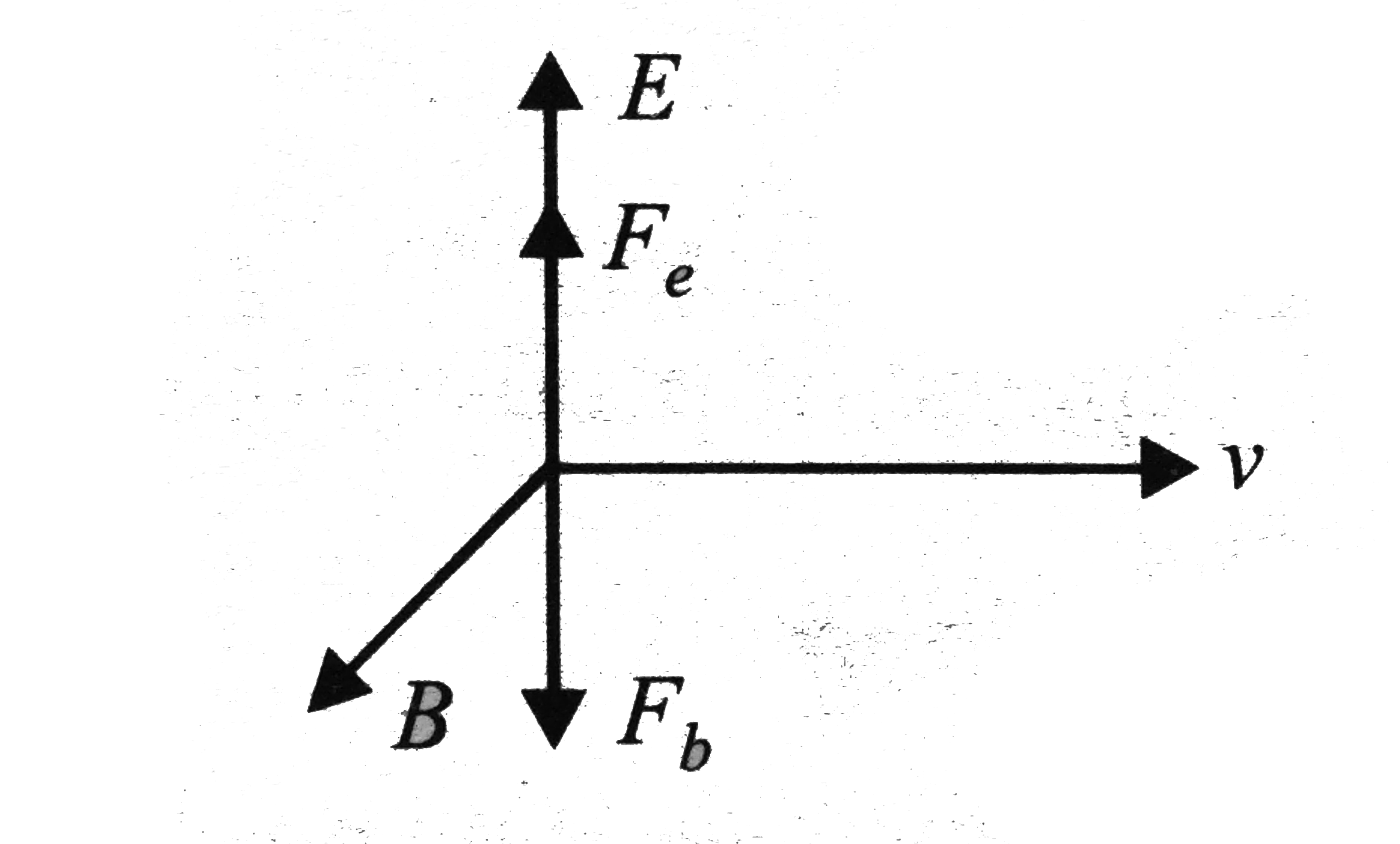
Here the proton beam passes without deviation, hence
`F_b = F_e impliesBev=eE`
`:. V=E/B=(120xx10^3)/(50xx10^-3)=2.4xx10^6 ms^-1`
Number of protons reaching per second
`(nq)/t=0.8xx10^-3`
or `(nxx1.6xx10^-19)/1=0.8xx10^-3 or n=5xx10^15`
Total mass of proton reaching per second
`=(5xx10^15)xx(1.67xx10^-27)=8.35xx10^-12kg`
`Force= ("Change in momentum")/("time")`
`=[(8.35xx10^-12)(2.4xx10^6)]//1`
`20.04xx10^-6N=20.04muN`
.
Promotional Banner

Topper's Solved these Questions

  • MAGNETIC FIELD AND MAGNETIC FORCES

    CENGAGE PHYSICS ENGLISH|Exercise Solved Example|25 Videos
  • MAGNETIC FIELD AND MAGNETIC FORCES

    CENGAGE PHYSICS ENGLISH|Exercise Exercise 1.1|22 Videos
  • INDUCTANCE

    CENGAGE PHYSICS ENGLISH|Exercise Concept Based|8 Videos
  • MISCELLANEOUS VOLUME 3

    CENGAGE PHYSICS ENGLISH|Exercise True and False|3 Videos

Similar Questions

Explore conceptually related problems

A proton beam passes without deviation through a region of space where there are uniform transverse mutually perpendicular electric and magnetic field with E and B Then the beam strikes a grounded target. Find the force imparted by the beam on the target if the beam current is equal to I .

A non-relativistic proton beam passes without deviation through a region of space where there are uniform transverse mutually perpendicular electric and magnetic fields with E= 120 kVm^-1 and B=50 mT. Then the beam strikes a grounded target. Find the force which the beam acts on the target if the beam current is equal to i=0.8 mA . Mass of protons = 1.67xx10^(-27) kg .

Non-relativistic protons move reactilinearly in the region of space where there are uniform mutually perpendicular electric and magnetic fields with E and B. The trajectory of the protons lie in the plane X-Y as shown in Fig. 1.107 and forms an angle phi with X-axis. Find the pitch of the helical trajectory along which the protons will move after the electric field is switched off.

Protons move rectilinearly in the region of space where there are uniform mutually perpendicular electric and magnetic fields E and B . The trajectory of protons lies in the plane xz as shown in the figure and forms an angle 9 with x-axis. Find the pitch of the helical trajectory along which the protons will move after the electric field is switched off.

A proton moving with a constant velocity passes through a region of space without any changing its velocity. If E and B represent the electric and magnetic fields, respectively. Then, this region of space may have

A proton moving with a constant velocity passes through a region of space without any changing its velocity. If E and B represent the electric and magnetic fields, respectively. Then, this region of space may have

A beam of electrons is moving with uniform velocity in a region having transverse uniform electric and magnetic field of strength. 100 V/m and 0.1 T respectively at right angles to the direction of beam. The velocity of the electrons is

Assertion A beam of electron can pass undeflected through a region of E and B. Reason Force on moving charged particle due to magnetic field may be zero in some cases.

A beam of electrons is moving with constant velocity in a region having simultaneous perpendicular electric and magnetic fields of strength 20Vm^(-1) and 0.5 T, respectively at right angles to the direction of motion of the electrons. Then, to move undeflected the velocity of electrons must be (a) 8 m//s (b) 20 m//s (c) 40 m//s (d) (1)/(40)m//s

Following experiment was performed by J.J. Thomson in order to measure ratio of charge e and mass m of electron. Electrons emitted from a hot filament are accelerated by a potential difference V. As the electrons pass through deflecting plates, they encounter both electric and magnetic fields. the entire region in which electrons leave the plates they enters a field free region that extends to fluorescent screen. The entire region in which electrons travel is evacuated. Firstly, electric and magnetic fields were made zero and position of undeflected electron beam on the screen was noted. The electric field was turned on and resulting deflection was noted. Deflection is given by d_(1) = (eEL^(2))/(2mV^(2)) where L = length of deflecting plate and v = speed of electron. In second part of experiment, magnetic field was adjusted so as to exactly cancel the electric force leaving the electron beam undeflected. This gives eE = evB . Using expression for d_(1) we can find out (e)/(m) = (2d_(1)E)/(B^(2)L^(2)) A beam of electron with velocity 3 xx 10^(7) m s^(-1) is deflected 2 mm while passing through 10 cm in an electric field of 1800 V//m perpendicular to its path. e//m for electron is

