Home
Class 12
PHYSICS
A positively charged particle of charge ...

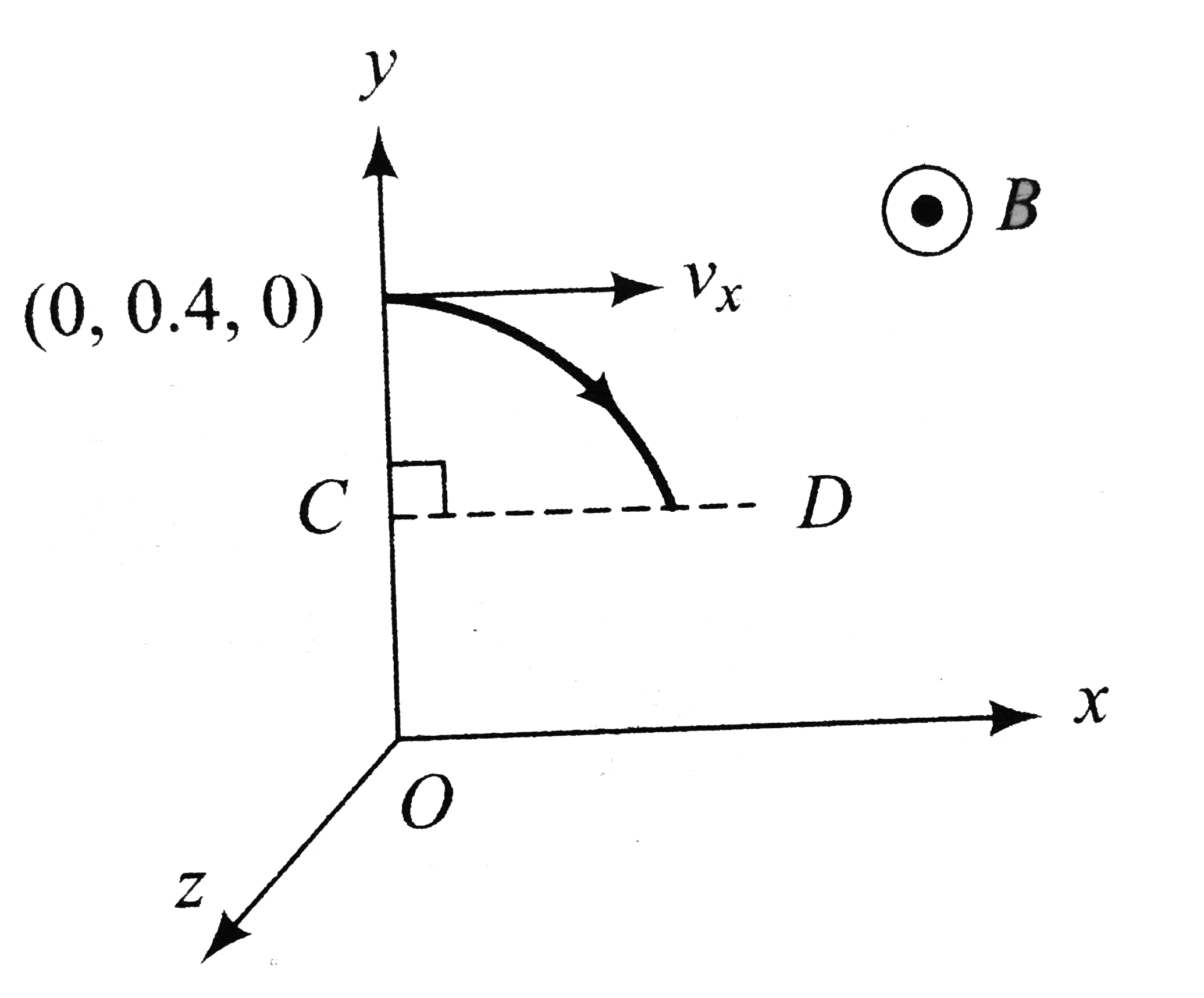
A positively charged particle of charge `1 C` and mass `40 g`, is revolving along a circle, of radius `40 cm` with velocity `5 m/s` in a uniform magnetic field with centre at origin 0 in xy-plane. At `t = 0`, the particle was at (`0, 0.4 m, 0`) and velocity was directed along positive x-direction. Another particle having charge `1 C` and mass `10 g` moving uniformly parallel to z-direction 40 with velocity `40/pi m/s`collides with revolving particle at `t = 0` andgets stuck with it. Neglecting `7C` gravitational force and colombians force, calculate `x, y` and `z`-coordinates of the combined particle at `t=pi/40sec`

Text Solution

Verified by Experts
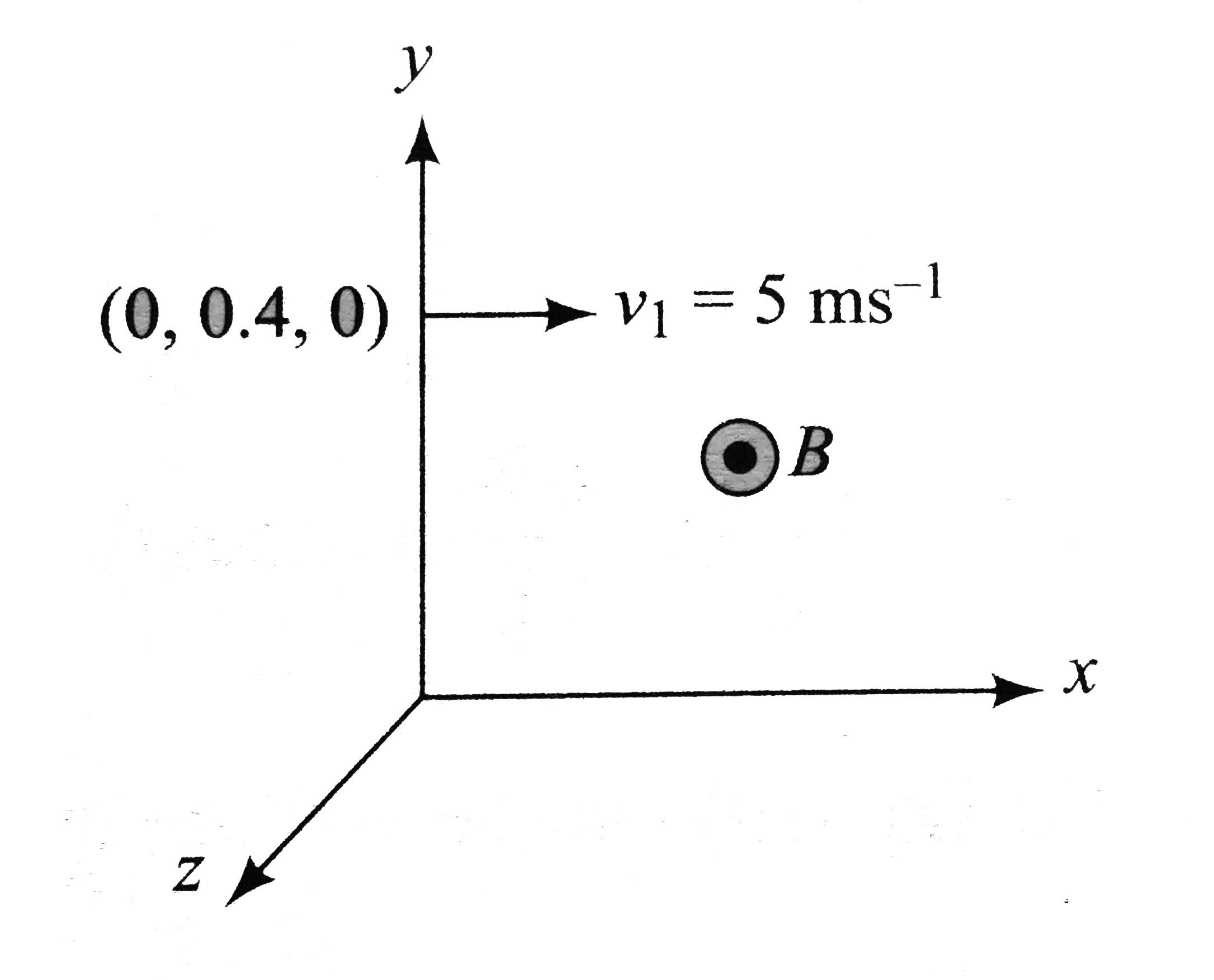
In three dimensional co-ordinate system, axes are assumed according to right hand screw rule.
Consider such a system shown in Fig. In this system positive z direction is normal to plane of paper and is directed towards the reader.
The particle is positively charged, centre of its circular path is at origin and when the particle is on positive y-axis , its velocity is directed along positive x-direction, it means that the particle is moving clockwise

Since the particle is positively charged, therefore, current associated with its motion is also clockwise or along positive x direction at (0,0.4,0).
Lorentz's force is toward origin. Therefore, according to Fleming's left hand rule, magnetic induction B must be along positive z-direction.
Radius of circular path followed by this particle is `r_1=0.4m`
But `r_1=(m_1v_1)/(q_1B) implies B=(m_1v_1)/(q_1r_1)0.5T`
Now the second particle collides and gets struck with it. Velocity of combined particle can be found out by applying law of conservation of momentum.
`(m_1+m_2)vecv=m_1vecv_1+m_2vecv_2`
`(40xx10^-3+10xx10^-3)vecv`
`=(40xx10^-3)xx5hati+(10xx10^-3)40/pi hatk`
`:.` x-direction of velocity of combined particle is `v_x=4ms^-1`
and z-direction, `v_z=8/pi ms^-1`
Due to `v_x`, combined particle tries to move clockwise along a circular path and due to `v_z`it ties to move uniformly along z-axis.
Therefore, its ultimate path becomes helix. Radius of this helix is
`R=((m_1+m_2)v_x)/((q_1+q_2)B)=0.2m`
and period of revolution `T=(2pi(m_1+m_2))/((q_1+q_2)B)=pi/10s`
The particle turns by angle `pi//2` in time `pi//4s`.
`:.` x-coordinate of new position of combined particle `=R= 0.2m`
`to` y-coordinate`=r_1-R=0.2m`
and z-direction `=v_zt=0.2m`
.
Promotional Banner

Topper's Solved these Questions

  • MAGNETIC FIELD AND MAGNETIC FORCES

    CENGAGE PHYSICS ENGLISH|Exercise Exercise 1.1|22 Videos
  • MAGNETIC FIELD AND MAGNETIC FORCES

    CENGAGE PHYSICS ENGLISH|Exercise Exercise 1.2|13 Videos
  • MAGNETIC FIELD AND MAGNETIC FORCES

    CENGAGE PHYSICS ENGLISH|Exercise Multiple Correct Answer type|2 Videos
  • INDUCTANCE

    CENGAGE PHYSICS ENGLISH|Exercise Concept Based|8 Videos
  • MISCELLANEOUS VOLUME 3

    CENGAGE PHYSICS ENGLISH|Exercise True and False|3 Videos

Similar Questions

Explore conceptually related problems

A positively charged particle having charge q_1 = 1 C and mass m_1 =40 gm is revolving along a circle of radius R=40 cm with velocity v_1 = 5 ms^-1 in a uniform magnetic field with center of circle at origin O of a three-dimensional system. At t=0 , the particle was at (0, 0.4m, 0) and velocity was directed along positive x direction. Another particle having charge q_2 = 1 C and mass m_2 = 10g moving uniformly parallel to positive z-direction with velocity v_2 = 40//pi ms^-1 collides with revolving particle at t=0 and gets stuck to it. Neglecting gravitational force and coulomb force, calculate x-, y- and z-coordinates of the combined particle at t= pi//40 s .

A charged particle of charge 1 mC and mass 2g is moving with a speed of 5m/s in a uniform magnetic field of 0.5 tesla. Find the maximum acceleration of the charged particle

A charged particle of charge 1 mC and mass 2g is moving with a speed of 5m/s in a uniform magnetic field of 0.5 tesla. Find the maximum acceleration of the charged particle

A charge particle of charge q and mass m is moving with velocity v as shown in fig In a uniform magnetic field B along -ve z-direction.Select the correct alternative (s).

A particle of charge 1 mu C & mass 1 g moving with a velocity of 4 m//s is subjected to a uniform electric field of magnitude 300 V m for 10 sec . Then it's final speed cannot be :

A charged particle of mass m is moving with a speed u in a circle of radius r. If the magnetic field induction at the centre is B, the charge on the particle is

A charged particle of mass m and charge q is released from rest the position (x_0,0) in a uniform electric field E_0hatj . The angular momentum of the particle about origin.

A particle having a charge 20mu C and mass 20mug moves along a circle of radius 5.0 cm under the action of a magnetic field 5.0 cm under the action of a magnetic field B = 1.0 T. When the particle is at a point P, a uniform electric field is switched on and it is found that the particla continues on the tangent through P qith a uniform velocity. Find the electric field.

A charged particle of specific charge (i.e.,Charge per unit mass 0 0.2 C/kg has velocity 2hati-3hatjms^(-1) at some instant in a uniform magnetic field 5hati+2hatj (tesla).Find the acceleration of the particle at this instant

A particle having a charge of 10.0muC and mass 1mug moves in a circle of radius 10 cm under the influence of a magnetic field of induction 0.1T. When the particle is at a point P, a uniform electric field is switched on so that the particle starts moving along the tangent with a uniform velocity. The electric field is

CENGAGE PHYSICS ENGLISH-MAGNETIC FIELD AND MAGNETIC FORCES-Solved Example
  1. An electron in the ground state of hydrogen atom is removing in unanti...

    Text Solution

    |

  2. A particle of mass m and charge q is moving in a region where uniform,...

    Text Solution

    |

  3. A uniform constant magnetic field B is directed at an angle of 45^(@) ...

    Text Solution

    |

  4. The region between x=0 and x=L is filled with uniform steady magnetic ...

    Text Solution

    |

  5. A rectangular loop PQRS made from a uniform wire has length a, width ...

    Text Solution

    |

  6. A ring of radius R having uniformly distributed charge Q. is mounted o...

    Text Solution

    |

  7. In a moving coil galvanometer, torque on the coil can be experessed as...

    Text Solution

    |

  8. A slightly divergent beam of charged particles accelerated by a Potent...

    Text Solution

    |

  9. A small charged ball having mass m and charge q is suspended from a ri...

    Text Solution

    |

  10. Non-relativistic protons move reactilinearly in the region of space wh...

    Text Solution

    |

  11. A current i, indicated by the crosses in figure, is established in a s...

    Text Solution

    |

  12. A straight conductor of weight 1 N and length 0.5 m, is located in a p...

    Text Solution

    |

  13. There is a constant homogeneous electric field of 100 Vm^-1 within the...

    Text Solution

    |

  14. A positively charged particle of mass m and charge q is projected on a...

    Text Solution

    |

  15. A loop of flexible conducting wire of length 0.5 m lies in a magnetic ...

    Text Solution

    |

  16. A circular coil of 100 turns has an effective radius of 0.05 m and car...

    Text Solution

    |

  17. A positively charged particle of charge 1 C and mass 40 g, is revolvin...

    Text Solution

    |

  18. An electron accelerated by a potential difference V= 3 volt first ente...

    Text Solution

    |

  19. A particle having mass m and charge q is released from the origin in a...

    Text Solution

    |

  20. A non-relativistic charge q of mass m originates at a point A lying on...

    Text Solution

    |