Home
Class 12
PHYSICS
A particle of mass mand charge q, moving...

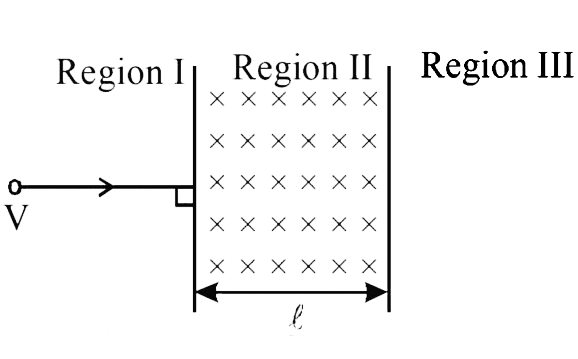
A particle of mass `m`and charge `q`, moving with velocity `v` enters Region `II` normal to the boundary as shown in the figure. Region `II` has a uniform magnetic field `B` perpendicular to the plane of the paper . The length of the region `II` is `l`. Choose the correct choice(s).

A

The particle enters Region III only if its velocity `Vgt(qlB)/m`

B

The particle enters Region III only if its velocity `Vlt(qlB)/m`

C

Path length of the particle in Region II is maximum when velocity `V=(qlB)/m`

D

Time spent in Region II is same for any velocity V as long as the particle returns to Regions I

Text Solution

Verified by Experts

The correct Answer is:
(a,c,d)

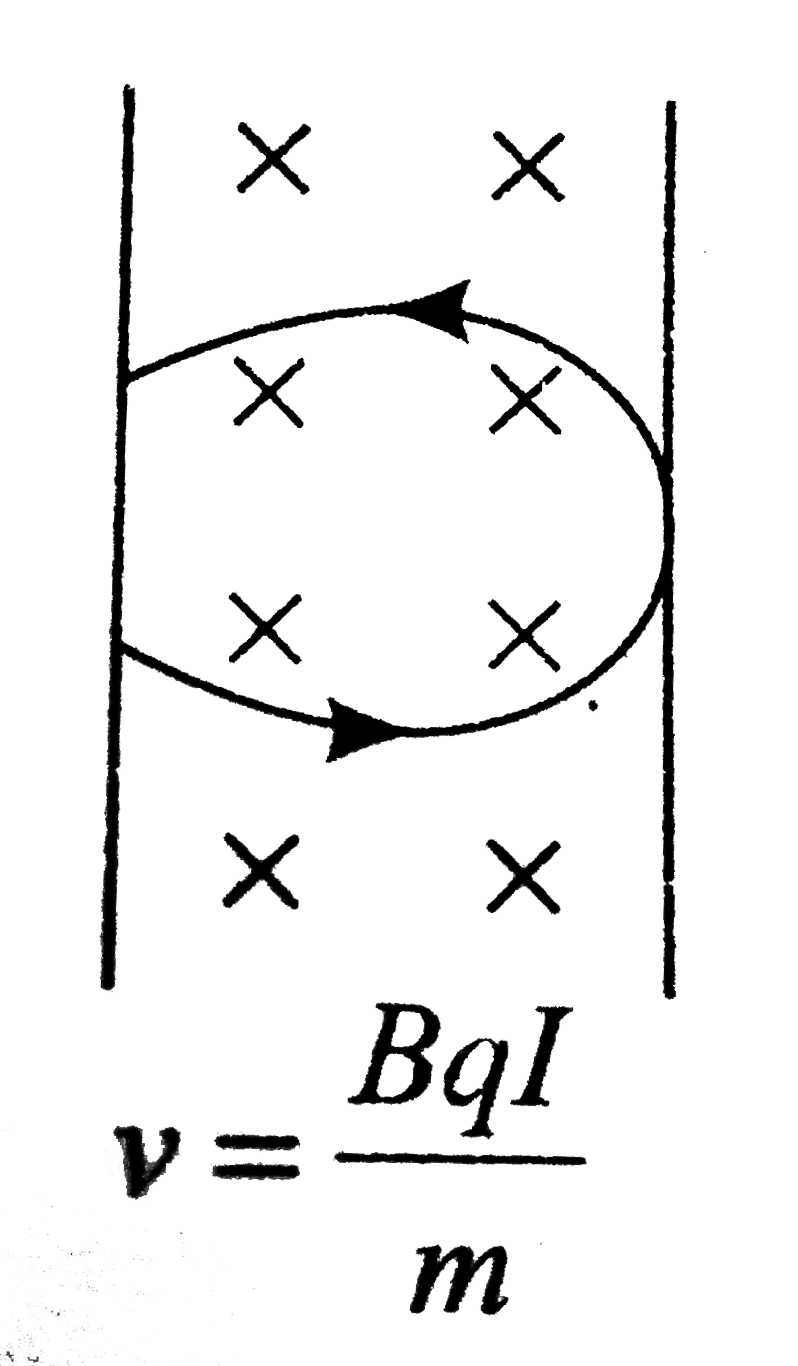
`vec(v) bot vec(B)` in region II. Therefore, path of particle is circle in region II. Particle enters in region III, if radius of circular path, rgtl
or `(mv)/(Bq)gtl or vgt(Bql)/m`
If `v=(Bql)/m, r=(mv)/(Bq) =l`, particle will turn back and path length will be maximum. If particle returns to region I, time spent in region II will be
`t=T/2 =(pim)/(Bq)`, which is independent of v
Promotional Banner

Topper's Solved these Questions

  • MAGNETIC FIELD AND MAGNETIC FORCES

    CENGAGE PHYSICS ENGLISH|Exercise Archives Comprehension|2 Videos
  • MAGNETIC FIELD AND MAGNETIC FORCES

    CENGAGE PHYSICS ENGLISH|Exercise Archives Integer|1 Videos
  • MAGNETIC FIELD AND MAGNETIC FORCES

    CENGAGE PHYSICS ENGLISH|Exercise Archives Single Correct|18 Videos
  • INDUCTANCE

    CENGAGE PHYSICS ENGLISH|Exercise Concept Based|8 Videos
  • MISCELLANEOUS VOLUME 3

    CENGAGE PHYSICS ENGLISH|Exercise True and False|3 Videos

Similar Questions

Explore conceptually related problems

A particle of mass m and charge q, moving with velocity v enters region II normal to the boundary as shown in the figure. Region II has a uniform magnetic field B perpendicular to plane of the paper. The length of the Region II is l.. Choose the correct choice (s):

A particle of mass m and charge Q moving with a velocity v enters a region on uniform field of induction B Then its path in the region is s

A charge particle of mass m and charge q enters in a region of uniform magnetic field as shown in figure.The magnitude of change in linear momentum due to magnetic field will be

A particle with mass m and charge q moving with a velocity v , enters a region of uniform magnetic field B , shown, in the figure above. The particle strikes the wall at a distance d from the entance slit. If the paticle's velocity stays the same but its charge to mass ratio is doubled, distance frm the entrance slit where the particle strike the wall is d/n , then find n

A particle with mass m and charge q moving with a velocity v , enters a region of uniform magnetic field B , shown, in the figure above. The particle strikes the wall at a distance d from the entance slit. If the paticle's velocity stays the same but its charge to mass ratio is doubled, distance frm the entrance slit where the particle strike the wall is d/n , then find n

A particle of mass m carrying charge q is accelerated by a potential difference V. It enters perpendicularly in a region of uniform magnetic field B and executes circular arc of radius R, then q/m equals

A charged particle ( mass m and charge q) moves along X axis with velocity V_0 . When it passes through the origin it enters a region having uniform electric field vecE=-E hatj which extends upto x=d . Equation of path of electron in the region . x gt d is :

A particle of charge q and mass m moving with a velocity v along the x-axis enters the region xgt0 with uniform magnetic field B along the hatk direction. The particle will penetrate in this region in the x -direction upto a distance d equal to

A particle of mass m having a charge q enters into a circular region of radius R with velocity v directed towards the centre. The strength of magnetic field is B . Find the deviation in the path of the particle.

A charged particle of mass m and charge q is accelerated through a potential differences of V volts. It enters of uniform magnetic field B which is directed perpendicular to the direction of motion of the particle. The particle will move on a circular path of radius

