Home
Class 12
PHYSICS
CDEF is a fixed conducting smooth frame ...

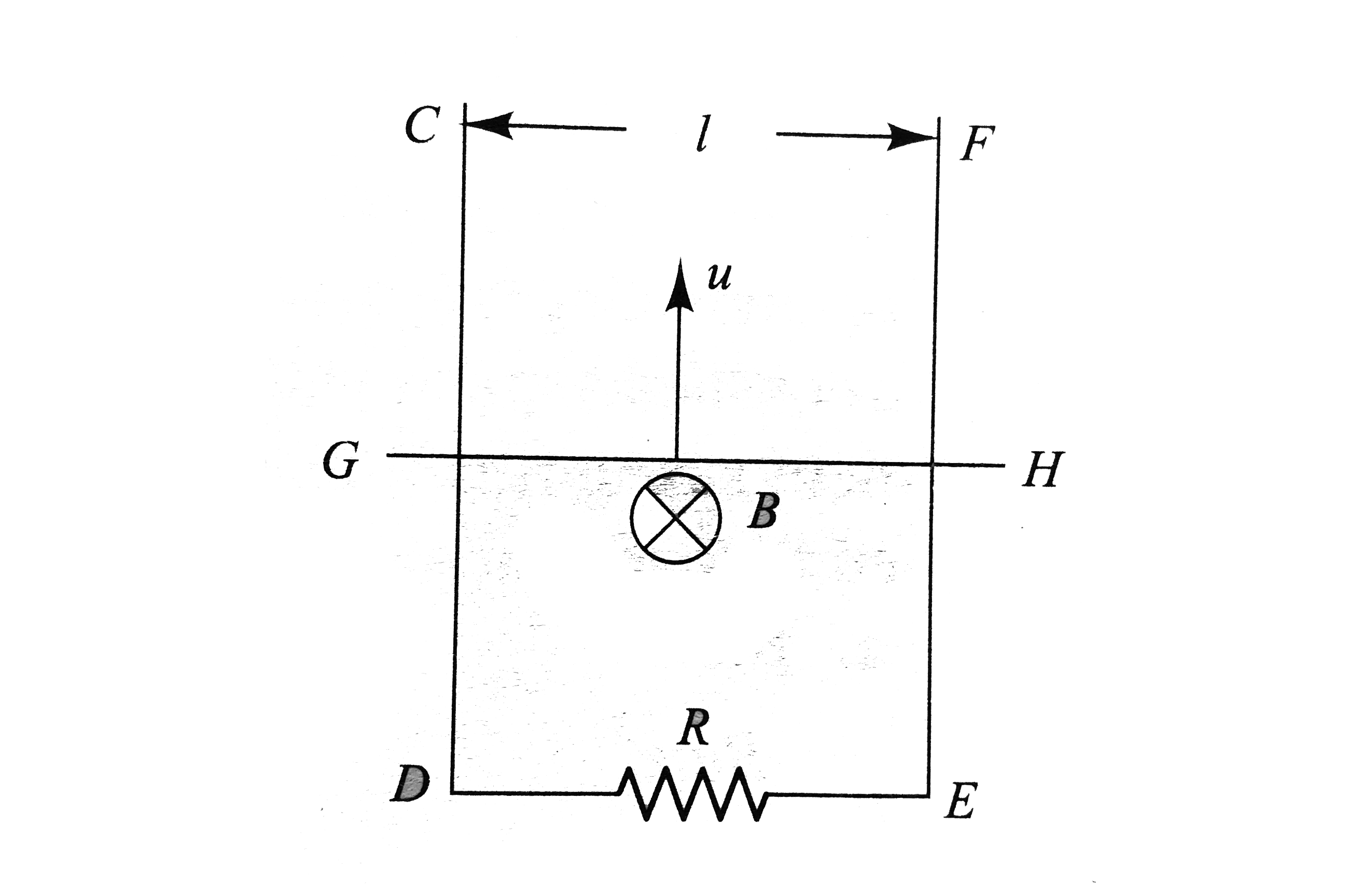
`CDEF` is a fixed conducting smooth frame in vertical plane. A conducting uniform rod `GH` of mass `m` can move vertically and smoothly without losing contact with the frame. `Gh` always remains horizontal and is given velocity `u` upward and released. Taking the acceleration due to gravity as `g` and present other than `R`. Find out the time tasken by the rod to reach the highest point.

Text Solution

Verified by Experts

The correct Answer is:
`(mR)/(B^(2)l^(2))1n((mgR + B^(2)l^(2)u)/(mg R))`

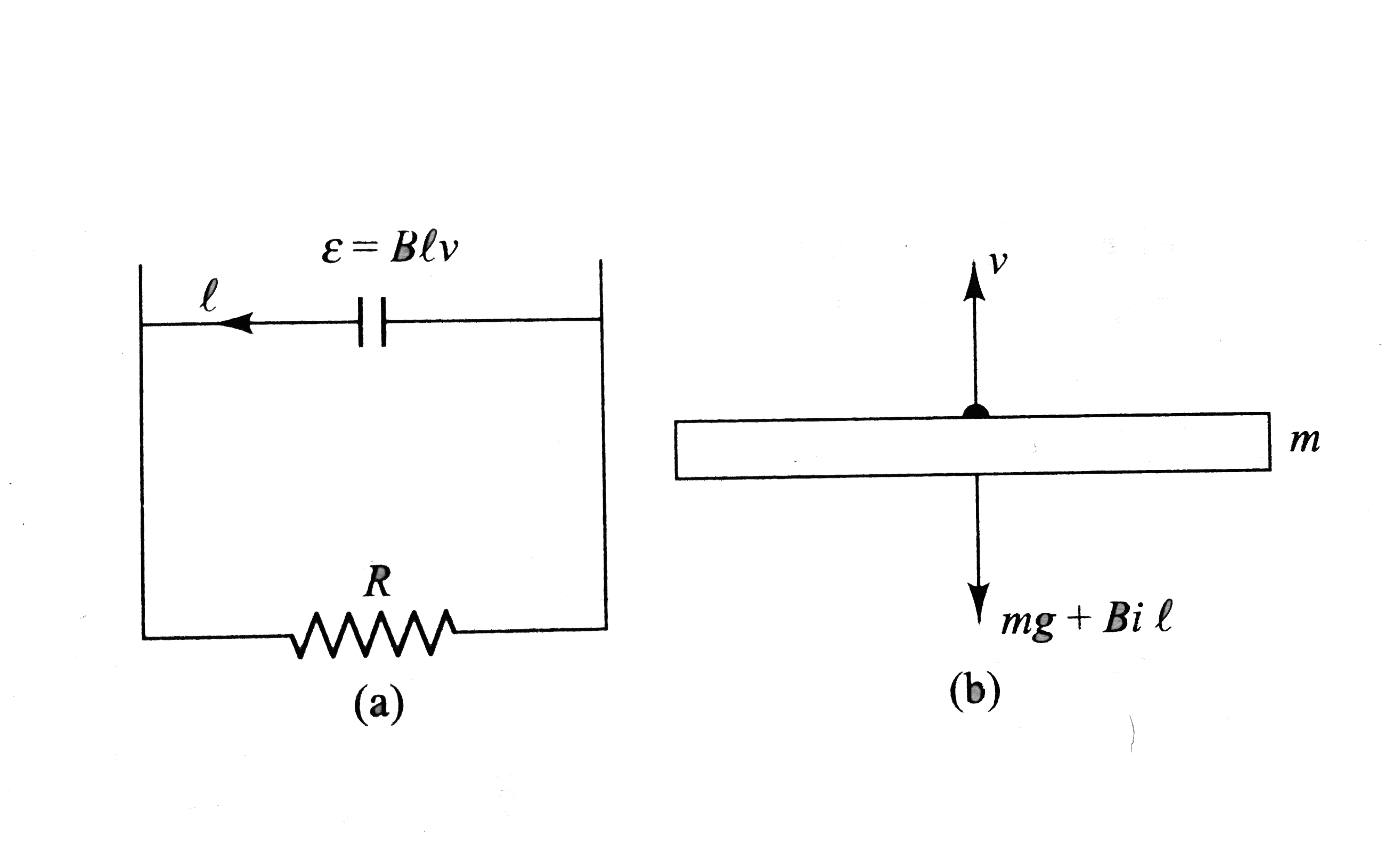
Let `v` be the speed of the rod at any time. Then the equivalent and free body diagrams of rod are shown in . Applying Newton's second law to the rod,
,
`(mdv)/(dt) = -(mg + Bil)`
where `i = (Blv)/(R)`
From equation (i) and (ii)
`(mdv)/(dt) = -(mg + (B^(2)l^(2)v^(2))/(R))`
Integrating over proper limits we get,
`int_(u)^(0)(mdv)/(mg + (B^(2)l^(2)v)/(R)) = int_(0)^(t)-dt`
`rarr` `t = (mR)/(B^(2)l^(2))1n((mgR + B^(2)l^(2)u)/(mgR))`
Promotional Banner

Topper's Solved these Questions

  • ELECTROMAGNETIC INDUCTION

    CENGAGE PHYSICS ENGLISH|Exercise Exercises Single Correct|79 Videos
  • ELECTROMAGNETIC INDUCTION

    CENGAGE PHYSICS ENGLISH|Exercise Exercises Multiple Correct|23 Videos
  • ELECTROMAGNETIC INDUCTION

    CENGAGE PHYSICS ENGLISH|Exercise Exercise 3.2|27 Videos
  • ELECTRICAL MEASURING INSTRUMENTS

    CENGAGE PHYSICS ENGLISH|Exercise M.C.Q|2 Videos
  • ELECTRON,PHONTS,PHOTOELECTRIC EFFECT & X-RAYS

    CENGAGE PHYSICS ENGLISH|Exercise dpp 3.3|15 Videos

Similar Questions

Explore conceptually related problems

In the figure, CDEF is a fixed conducting smooth frame in vertical plane.A conducting uniform rod GH of mass m=1 g can move vertically and smoothly without losing contact with the frame. GH always remains horizontal.It is given velocity u=1m//s upwards and released.Taking the acceleration due to gravity as g and assuming that no resistance is present other than R .Time taken by rod to reach the highest point is equal to (ln10)/x second.Find out value of x .

A conducting frame abcd is kept in a vertical plane. A conducting rod of of mass m and length l can slide smoothly on it remaining always horizontal. The resistance of the loop is negligible and inductance is constant having value L . The rod is left from rest and allowed to fall under gravity and inductor has no initial current. A magnetic field of constant magnitude Bis present throughout the loop pointing inwards. Determine (a) position of the rod as a function of time assuming initial position of the rod to be x=0 and vertically downward as the positive x-axis. (b) the maximum current in the circuit. (c) maximum velocity of the rod

A uniform rod of mass m and length l can rotate in vertical plane about a smooth horizontal axis hinged at point H . Find angular acceleration alpha of the rod just after it is released from initial position making an angle of 37^@ with horizontal from rest?

A uniform rod of mass m and length l can rotate in a vertical plane abota smooth horizontal axis hinged at point H . Find the force exerted by the hinge just after rod is released from rest, from initial horizontal position?

L is a smooth conducting loop of radius l=1.0 m & fixed in a horizontal plane.A conducting rod of mass m=1.0 kg and length slightly greater than l higed at the centre of the loop can rotate in the horizontal plane such that the free end slides on the rim of the loop.There is a uniform magnetic field of strength B=1.0 T directed vertically downward.The rod is rotated with angular velocity omega_(0)=1.0 rad//s and left.The fixed end of the rod and the rim of the loop are connected through a battery of e.m.f E a resistance R=1 Omega , and initially uncharged capacitor of capacitance C=1.0 F in series.Find (i)the time dependence of e.m.f M such that the current I_(0)=1.0 A in the circuit is contant. (ii)energy supplied by the battery by the time rod stops.

L is a smooth conducting loop of radius l=1.0 m & fixed in a horizontal plane. A conducting rod of mass m=1.0 kg and length slightly greater than l hinged at the centre of the loop can rotate in the horizontal plane such that the free end slide on the rim of the loop. There is a uniform magnetic field of strength B=1.0 T directed vertically downward. The rod is rotated with angular velocity omega_(0)=1.0 rad//s and left. The fixed end of the rod and the rim of the loop are connected through a battery of emf . E, a resistor of resistance R =1.0 Omega , and intially uncharged capacitor of capacitance C=1.0 F in series. Find : (i) the time dependence of emf . E such that the current I_(0)=1.0A in the circuit is constant. (ii) energy supplied by the battery by the time rod stops.

A uniform rod of mass m and length l can rotate in a vertical plane about a smooth horizontal axis point H . a. Find angular acceleration alpha of the rod. just after it is released from initial horizontal position from rest'? b. Calculate the acceleration (tangential and radial) , point A at this moment.

In Fig. ABCD is a fixed smooth conducting frame in horizontal plane. T is bulb of power 100 W , P is a smooth pulley and OQ is a conducting rod. Neglect the self-inductance of the loop and resistance of any part other than the bulb. The mass M is moving down with constant velocity 10 ms^(-1) . Bulb lights at its rated power due to induced emf in the loop due to earth's magnetic field. Find the mass M (in kg) of teh block. (g = 10 ms^(2))

A unifrom rod AB of length 4m and mass 12 kg is thrown such that just after the projection the centre of mass of the rod moves vertically upwards with a velocity 10 m//s and at the same time its is rotating with an angular velocity (pi)/(2) rad//sec about a horizontal axis passing through its mid point. Just after the rod is thrown it is horizontal and is as shown in the figure. Find the acceleration (in m//sec^(2) ) of the point A in m//s^(2) when the centre of mass is at the highest point. (Take = 10 m//s^(2) and pi^(2) = 10 )

Statement I: A resistance R is connected between the two ends of the parallel smooth conducting rails. A conducting rod lies on these fixed horizontal rails and a uniform constant magnetic field B exists perpendicular to the plane of the rails as shown in Fig. if the rod is given a velocity upsilon and released as shown in Fig. 3.188, it will stop after some time. the total work done by magnetic field negative. Statement II: If force acts opposite to direction of velocity its work done is negative.

