Home
Class 12
PHYSICS
Two parallel, long, straight conductor l...

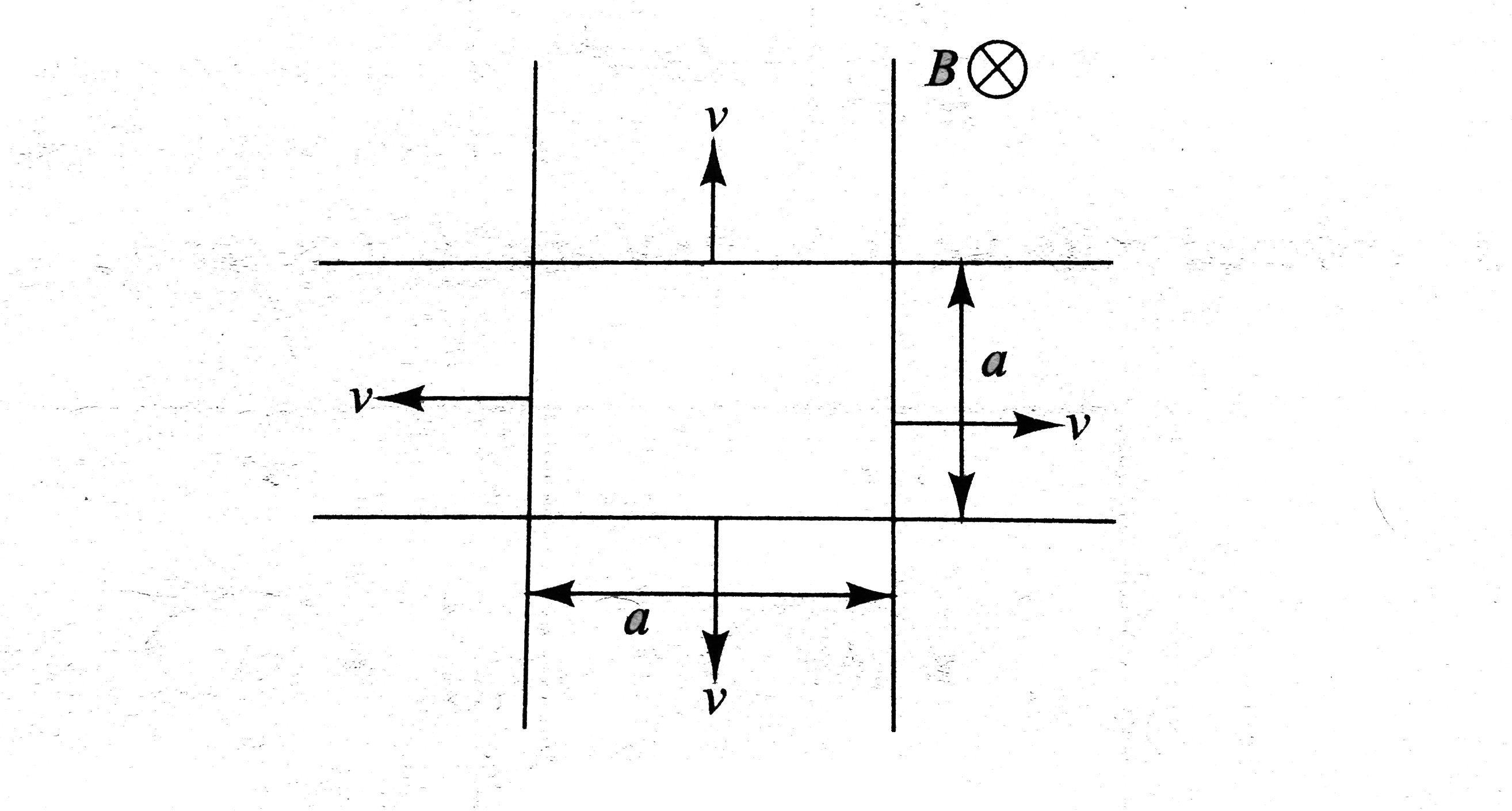
Two parallel, long, straight conductor lie on a smooth plane surface. Two other parallel so as to form a square of side a initially. A uniform magnetic field `B` exists at right angles to the plane containing the cinductors. Now they start moving out with a constant velocity `v`.
(A) Will the induced emf be time dependent?
(b) Will the current be time dependent ?

Text Solution

Verified by Experts

The correct Answer is:
(a) Yes; (b) No

(a) suppose the magnetic field is into the plane of the page.

after time `t`, the length of each side of the square is `l = a + 2vt`
area of square,
`l^(2) = (a + 2 vt)^(2)`
`= (a^(2) + 4v^(2)t^(2) + 4avt)`
`phi = Bl^(2) = Ba^(2) + 4Bv^(2)t^(2) + 4ba vt`
`|epsilon| = (dphi)/(dt) = 8Bv^(2)t + 4B va = 4Bv(2 vt + a)`
Hence, emf is time-dependent.
(b) The emf and resistance both are time dependent, but at any time `t` the resistance of loop is `R = 4mu(a + 2vt)`, where `mu` is resistance per unit length of wire
`rarr` `i = (4Bv(a + 2vt))/(4mu(a + 2vt)) = (Bv)/(mu) constant`
Promotional Banner

Topper's Solved these Questions

  • ELECTROMAGNETIC INDUCTION

    CENGAGE PHYSICS ENGLISH|Exercise Exercises Single Correct|79 Videos
  • ELECTROMAGNETIC INDUCTION

    CENGAGE PHYSICS ENGLISH|Exercise Exercises Multiple Correct|23 Videos
  • ELECTROMAGNETIC INDUCTION

    CENGAGE PHYSICS ENGLISH|Exercise Exercise 3.2|27 Videos
  • ELECTRICAL MEASURING INSTRUMENTS

    CENGAGE PHYSICS ENGLISH|Exercise M.C.Q|2 Videos
  • ELECTRON,PHONTS,PHOTOELECTRIC EFFECT & X-RAYS

    CENGAGE PHYSICS ENGLISH|Exercise dpp 3.3|15 Videos

Similar Questions

Explore conceptually related problems

Two parallel long straight conductors lie on a smooth plane surface. Two other parallel conductors rest on them at right angle so as to form a square of side a. A uniform magnetic field B exists at right angle to the plane containing the conductors. Now, conductors starts moving outward witha constant velocity v_0 at t=0 . Then, induced current in the loop at any time is (lamda is resistance per unit length of the conductors)

Two parallel long straight conductors lie on a smooth horizontal surface. Two other parallel conductor rest on them at right angles so as from B exits vertical. A uniform magnetic field B exists a vertical direction. Now all the four conductors stock moving outwards with a constant velocity v. The induced emf e and induced current i will vary wide time t as

A square loop of side L, resistance R placed in a uniform magnetic field B acting normally to the plane of the loop. If we attempt to pull it out of the field with a constant velocity v, then the power needed is

Figure shows a wire sliding on two parallel, conducting rails placed at a separation L . A magnetic field B exists in a direction perpendicular to the plane of the rails. What force is necessary to keep the wire moving at a constant velocity V ?

Shows a wire sliding on two parallel, conducting rails placed at a separaton l. A magnetic feld B exists in a direction perpendicular to the plane of the rails. What force is necessary to keep the wire moving at a constatn velocity v ?

Figure shows a wire of resistance R sliding on two parallel, conducting fixed thick rails placed at a separation l. A magnetic fild B exist in a direction perpendicular to the plane of the rails. The wire is moving with a constant velocity v. Find current through the wire

A conducting square loop is placed in a magnetic field B with its plane perpendicular to the field. Now the sides of the loop start shrinking at a constant rate alpha. the induced emf in the loop at an instant when its side is a is

A square frame with side a and a long straight wire carrying a current i are located in the same plane as m shown in figure. The fram translates to the right with a constant velocity v . Find the emf induced in the frame as a function of distance x .

Two parallel fixed conducting rails are l distance apart. They are connected by a conducting wire xy. A uniform magnetic field B is applied normal to its plane. Two other rods PQ and RT(RS = ST) are moved with a constant velocity v. Resistance/ length of these two rods are lamda no other wire has resistance. Then :

A conducting square frame of side 'a' and a long straight wire carrying current I are located in the same plane as shown in the figure. The frame moves to the right with a constant velocity 'V' . The emf induced in the frame will be proportional to

