Home
Class 12
PHYSICS
What is the mutual inducatance of a syst...

What is the mutual inducatance of a system of coaxical cables carrying current in opposite directions a sshows in Fig. 4.3. Their radii are `a` and `b`, respectively.

Text Solution

Verified by Experts
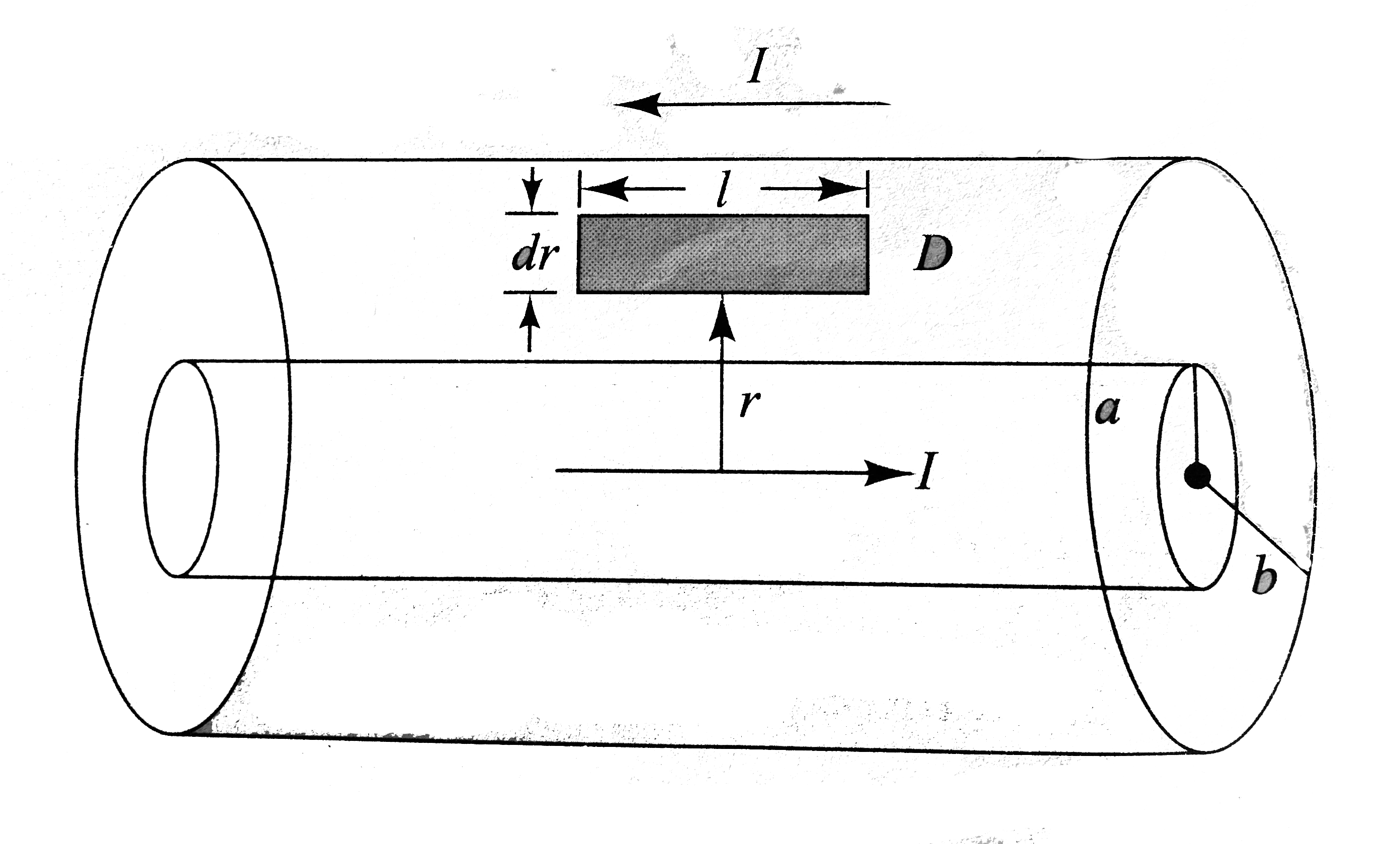
`B` between the space of the cables is `B = mu_(0)l//2 pi r`.
Ampere's law tells that `B` outside the cable is zero as the net current through the Amperian loop would be zero.

Taking an element of length `l` and thickness `dr`, flux through it is
`d phi = (mu_(0)l)/(2 pi r) ldr rArr phi = (mu_(0) Il)/(2 pi) int_(a)^(b) (1)/(r) dr = (mu_(0)lI)/(2 pi)` In `(b)/(a)`
`L = (phi)/(I) = (mu_(0)l)/(2 pi)` In `((b)/(a))`
Promotional Banner

Topper's Solved these Questions

  • INDUCTANCE

    CENGAGE PHYSICS ENGLISH|Exercise Solved Examples|3 Videos
  • INDUCTANCE

    CENGAGE PHYSICS ENGLISH|Exercise Exercise 4.1|24 Videos
  • HEATING EFFECT OF CURRENT

    CENGAGE PHYSICS ENGLISH|Exercise Thermal Power in Resistance Connected in Circuit|27 Videos
  • MAGNETIC FIELD AND MAGNETIC FORCES

    CENGAGE PHYSICS ENGLISH|Exercise Multiple Correct Answer type|2 Videos

Similar Questions

Explore conceptually related problems

What is the mutual inductance of a system of co-axial cables carrying current in opposite directions as shown ? Their radii are a and b respectively and its length l .

An otherwise infinite, straight wire has two concentric loops of radii a and b carrying equal currents in opposite directions as shown in Fig. The magnetic field at the common centre is zero for

Infinite wires, each carrying a current 0.5 A, are kept parallel to y-axis and intersecting x-axis at x=+-1 m, +02 m , +-4 m , +-8m etc. Wires kept at positive values of x carry current in the same direction while wires kept at negative values of x carry current successively in opposite directions as shown in Fig. A wire is kept parallel to x-axis and intersecting y-axis at y=2 m. It carries a current i. Assuming this wire to be insulated from others then the current i in it such that magnetic induction at O is zero is (assuming each wire to be infinitely long)

The figure shows the cross section of two long coaxial tubes carrying equal current I in opposites directions. If B_1 and B_2 are magnetic fields at point 1 and 2 as shown in figure then

Find the magnetic dipole moment of the spiral of total number of turns N, carrying current I having inner and outer radii v and b respectively

A carboard tube is wrapped with two winding of insulated wire wound in opposite directions as shown in Fig. 3.24. Terminal a and b of winding A may be connected to a battery through a reversing switch. State whether the induced current in the resistor R from left to right or from right to left in the following cicumstances. (a) The current in winding A is from a to b and is increasing. (b) The current in winding A is from b to a and is decreasing. ( c) The current in winding A is from b to a and is increasing.

Consider a system of two long coaxial cylinders: solid (of radius a carrying i current in positive z direction) and hollow (or radius b carrying current i in negative z direction). Find the magnetic field at a point distant r from of the cylinders for (i) r le a (ii) a lt r lt b (iii) r gt b

In a coaxial, straight cable, the central conductor and the outer conductor carry equal currents in opposite directions. The magnetic field is zero.

Two parallel wires P and Q placed at a separation d =6 cm on x-axis carry electric current i_(1) = 5A and i_(2) = 2 A in opposite directions as shown in Fig. Find the point on the line PQ where the resultant mgnetic field is zero.

Answer the following: (a)Define SI unit of current in terms of the force between two parallel current carrying conductors. (b) Two long straight parallel conductors carrying steady currents I_(a)andI_(b) along the same direction are separated by a distance d. How does one explain the force of attraction between them? If a third conductor carrying a current I_(c) in the opposite direction is placed just in the middle of these conductors , find the resultant force acting on the third conductor.

