Home
Class 12
PHYSICS
Two infinitely long straight parallel wi...

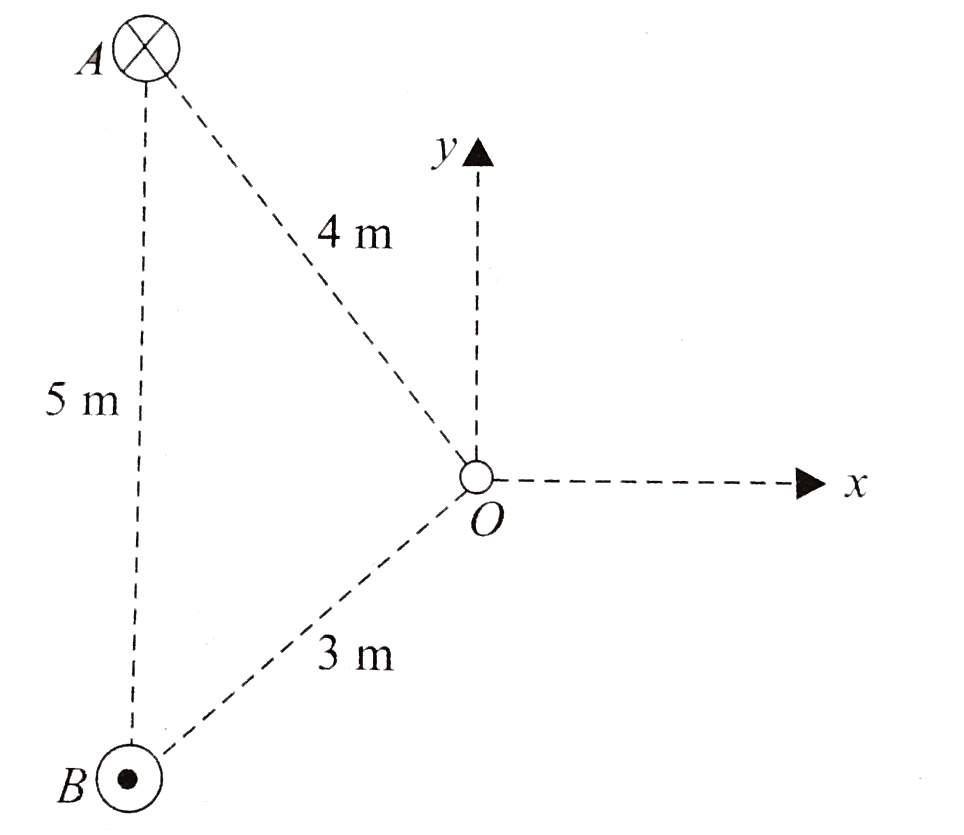
Two infinitely long straight parallel wire are 5 m apart, perpendicular to the plane of paper. One of the wires, as it passes perpendicular to the plane of paper, intersects it at A and carries current I in the downward direction. The other wire intersects the plane of paper at point B and carries current k int the outward direction O in the plane of paper as shown in Fig. With x and y axis shown, magnetic induction at O in the component form can be expressed as

A

`vec(B)=(mu_(0)i)/(2 pi)[-hat(i)+(3hat(j))/(5)]`

B

`vec(B)=(mu_(0)i)/(5 pi)[-hat(i)+(7hat(j))/(24)]`

C

`vec(B)=(mu_(0)i)/(4 pi)[-3hat(i)+(7hat(j))/(18)]`

D

`vec(B)=(mu_(0)i)/(7 pi)[-2hat(i)+(3hat(j))/(5)]`

Text Solution

Verified by Experts

The correct Answer is:
B

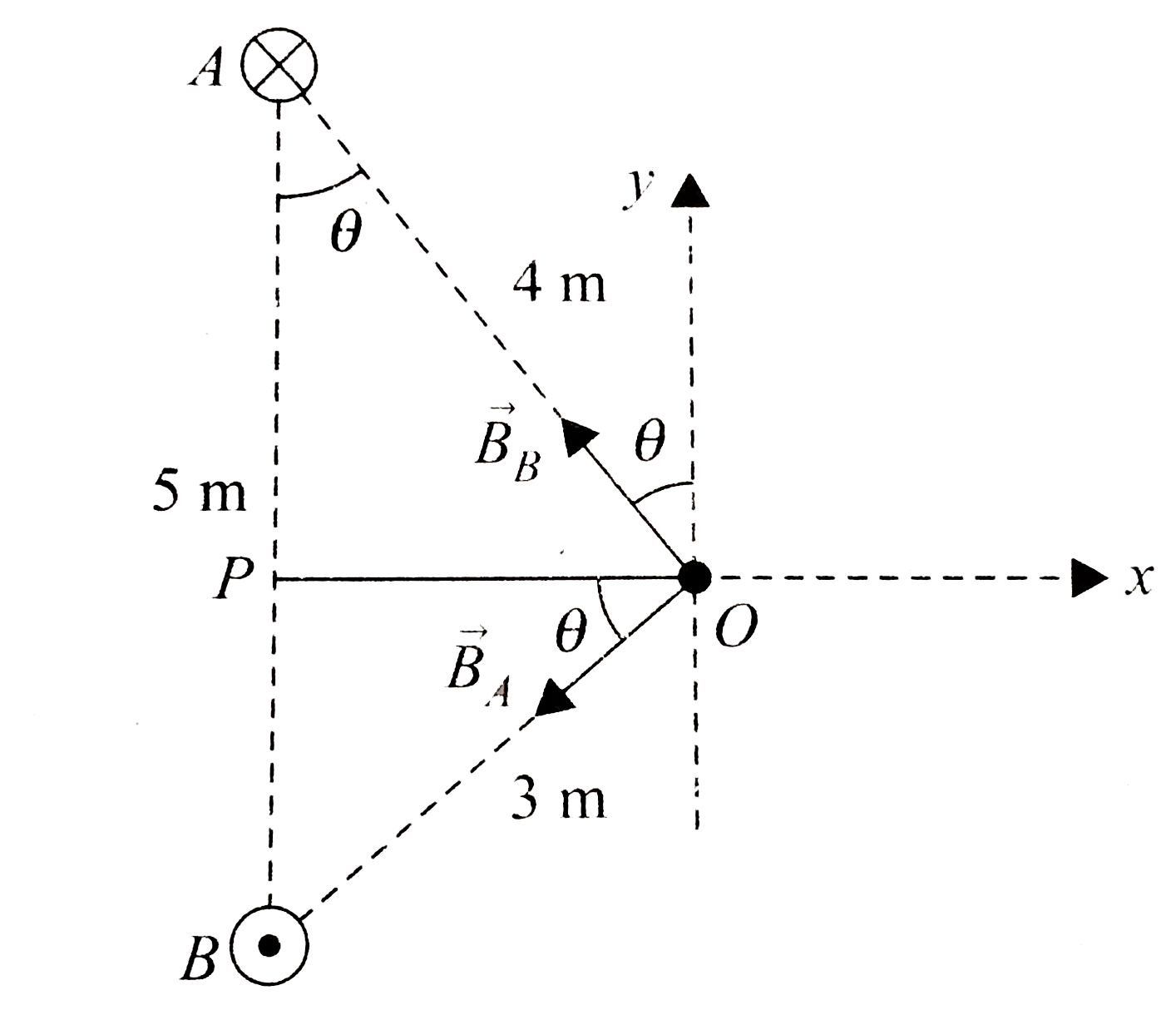
From trogonometry,
`AP=16//5 and PB=9//5`.Thus
`Sin AOP =4//5 and cos AOP =3//5`
`sin BOP=3//5 and cos BOP =4//5`
Magnetic field due to A is `B_(A)=(mu_(0)I)/(8 pi)` which makes angle `theta`
with negative x-axis and lies in third quadrant.

Magnetic field at O due to wire B is `(B_B)=(mu_(0)i)/(6 pi)`which makes angle `theta` with y-axis and lies in second quadrant. In components form,
`vec(B_A)=(mu_(0)i)/(8 pi) (-(4)/(5) i -(3)/(5)j)`
`vec(B_B)=(mu_(0)i)/(6 pi) (-(3)/(5) i -(4)/(5)j)`
Thus, `vec(B_A)+vec(B_B)=(mu_(0)i)/(5 pi) (-i +(7)/(24)j)`.
Promotional Banner

Topper's Solved these Questions

  • MISCELLANEOUS VOLUME 5

    CENGAGE PHYSICS ENGLISH|Exercise Multiple Correct|34 Videos
  • MISCELLANEOUS VOLUME 5

    CENGAGE PHYSICS ENGLISH|Exercise Linked Comprehension|84 Videos
  • MISCELLANEOUS VOLUME 3

    CENGAGE PHYSICS ENGLISH|Exercise True and False|3 Videos
  • NUCLEAR PHYSICS

    CENGAGE PHYSICS ENGLISH|Exercise ddp.5.5|14 Videos

Similar Questions

Explore conceptually related problems

Two wires are held perpendicular to the plane of paper and are 5 m apart. They carry currents of 2.5 A and 5 A in same direction. Then, the magnetic field strength (B) at a point midway between the wires will be

Two long straight parallel wieres are 2m apart, perpendicular to the plane of the paper. The wire A carries a current of 9.6 A , directed into the plane of the paper. The wire B carries a current such that the magnetic field of induction at the point P , at a distance of 10/11 m from the wire B, is zero. find a. the magnitude and directiion of the current in B. b. the magnitude of the magnetic field of induction of the pont S . c. the force per unit length on the wire B .

Two long parallel wire A and B situated perpendicuilar to the plane of the paper at a distance 2a are carrying equal currents I in opposite direction as show in the figure . The value of magnetic induction at point P situated at equal distance r from both the wires will be

An arrangment of three parallel staright wires placed perpendcular to plane of paper carrying same current I along the same direction is shown in figure. Magnitude of force per unit length on the middle wire 'B' is given by

A square loop of wire carrying current I is lying in the plane of paper as shown in Fig. 1.141. The magnetic field is present in the region as shown. The loop will tend to rotate

Two long, straight, parallel wires are 1.00m apart (as shown in Fig). The upper wire carries a current I_1 of 6.00A into the plane of the paper. What is the magnitude of the net field at Q?

Two long, straight, parallel wires are 1.00m apart (as shown in Fig). The upper wire carries a current I_1 of 6.00A into the plane of the paper. What is the magnitude of the net field at S?

A constant current flows in a horizontal wire in the plane of the paper from east to west as shown in figure. The direction of magnetic field at a point will be North to South:

A current I flows in a long straight wire (into the plane of the paper) with cross-section having the from of a circular are of radius R a shown in the figure. Find the magnetic induction at the point O .

A wire frame of given shape, carrying current of 10 A is placed in uniform magnetic field 100 T directed into the plane of paper as shown in figure. The net force acting on frame is

