Home
Class 12
PHYSICS
A magnetic field B exists between OA and...

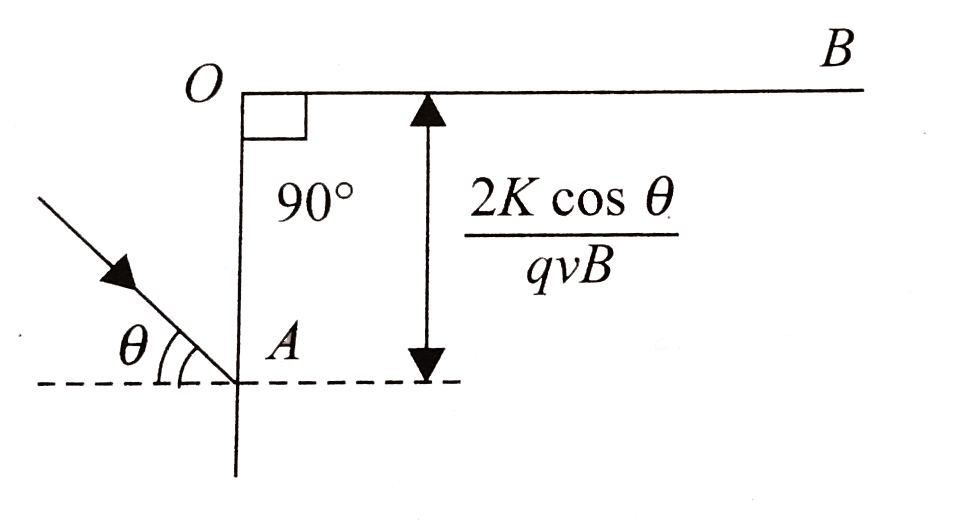
A magnetic field B exists between OA and OB. Inclined at an angle `(theta)`, a charged particle strikes at point A on surface OA, at a distance `(2K cos(theta))(qvB)` from O, where K is kinetic energy, q is the charge and v is the velocity of the particle. At what angle with horizontal (measured from end B) will the charged particle emerge from OB?

A

`theta`

B

`90^(@)-theta`

C

`90^(@)+theta`

D

`90^(@)`

Text Solution

Verified by Experts

The correct Answer is:
D

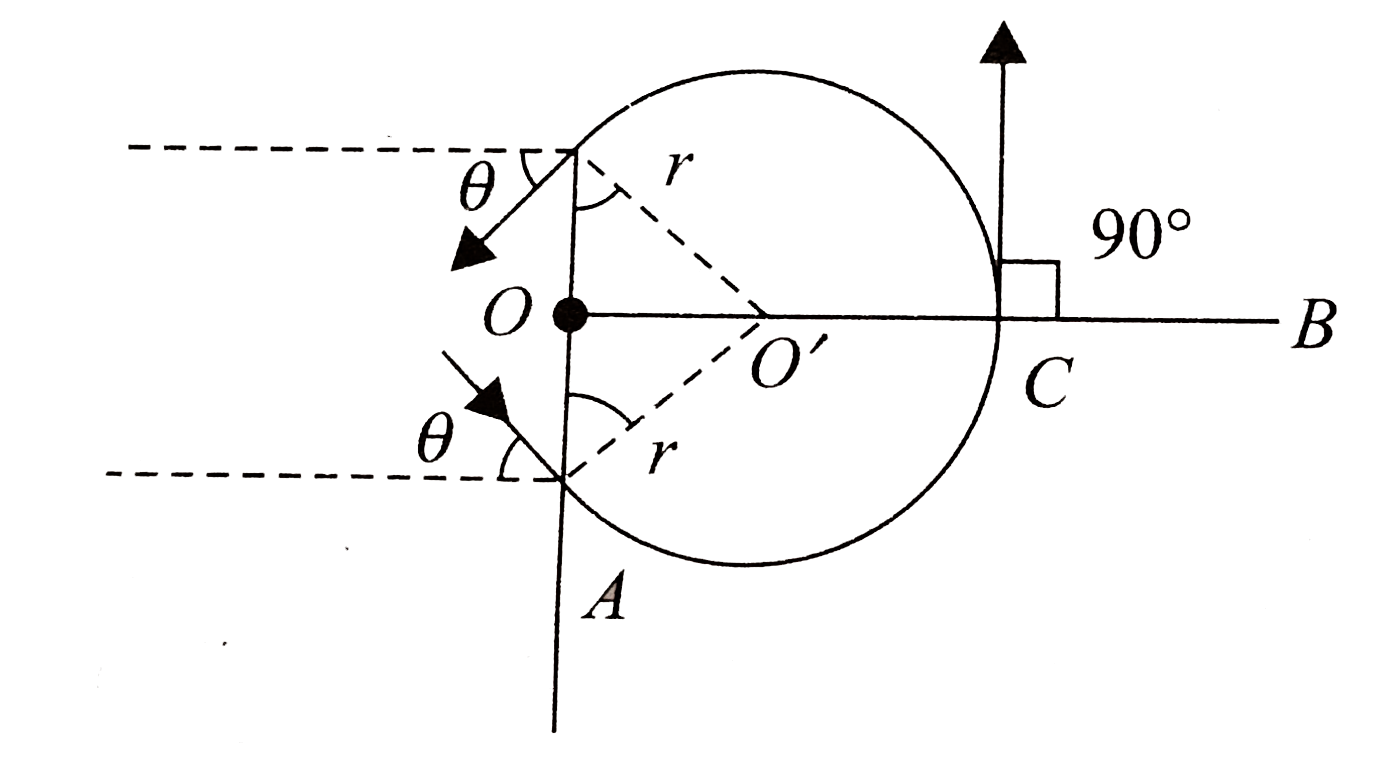
`r=(mv)/(qB)=(2K)/(qvB)`
Thus, `OA = r cos theta (given)`

On line OB, centre O' of part of circle (in which particle moves) lies. The tangent at C with OB makes an angle of `90^(@)`. Particle leaves circular path at C. thus, required angle `90^(@)`.
Promotional Banner

Topper's Solved these Questions

  • MISCELLANEOUS VOLUME 5

    CENGAGE PHYSICS ENGLISH|Exercise Multiple Correct|34 Videos
  • MISCELLANEOUS VOLUME 5

    CENGAGE PHYSICS ENGLISH|Exercise Linked Comprehension|84 Videos
  • MISCELLANEOUS VOLUME 3

    CENGAGE PHYSICS ENGLISH|Exercise True and False|3 Videos
  • NUCLEAR PHYSICS

    CENGAGE PHYSICS ENGLISH|Exercise ddp.5.5|14 Videos

Similar Questions

Explore conceptually related problems

A particle is projected at an angle theta from the horizontal with kinetic energy (T). What is the kinetic energy of the particle at the highest point ?

AB and AC are boundary lines within which a magnetic field B exists. If the magnetic field is absent, a charged particle of mass m and charge q must have passed through a point P on angle bisector of -BAC, at a distance r(sqrt2) from A, if it has fallen on AB normally at a point Q such that QP =r. If the magnetic field is present, how much time the charged particle will take to come out of the magnetic field

A particle is projected with velocity v at an angle theta aith horizontal. The average angle velocity of the particle from the point of projection to impact equals

A charged particle of mass m and charge q is released from rest in an electric field of constant magnitude E . The kinetic energy of the particle after time t is

A particle describes an angle theta in a circular path with a constant speed v . Find the a charge in the velocity of the particle and b average acceleration of the particle during the motion in the curve (circle). .

A particle is projected horizontally with a speed u from the top of plane inclined at an angle theta with the horizontal. How far from the point of projection will the particle strike the plane ?

What is the radius of curvature of the parabola traced out by the projectile in which a particle is projected with a speed u at an angle theta with the horizontal, at a point where the velocity of particle makes an angle theta//2 with the horizontal.

A charged particle moving along +ve x-direction with a velocity v enters a region where there is a uniform magnetic field B_0(-hat k), from x=0 to x=d. The particle gets deflected at an angle theta from its initial path. The specific charge of the particle is

A charged particle enters a magnetic field at right angles to the field. The field exists for a length equal to 1.5 times the radius of circular path of particle. The particle will be deviated from its path by

In the cylindrical region of radius R=2m , there exists a time varying magnetic field B such that (dB)/(dt)=2"Tesla"//sec . A charged particle having charge q=2C is placed at the point P at a distance d from its center O . Now, the particle is moved in the direction perpendicular to line OP by an external agent up to infinity so that there is no gain in kinetic energy of charged particle. Then

