Home
Class 12
PHYSICS
The magnetic field exists along negative...

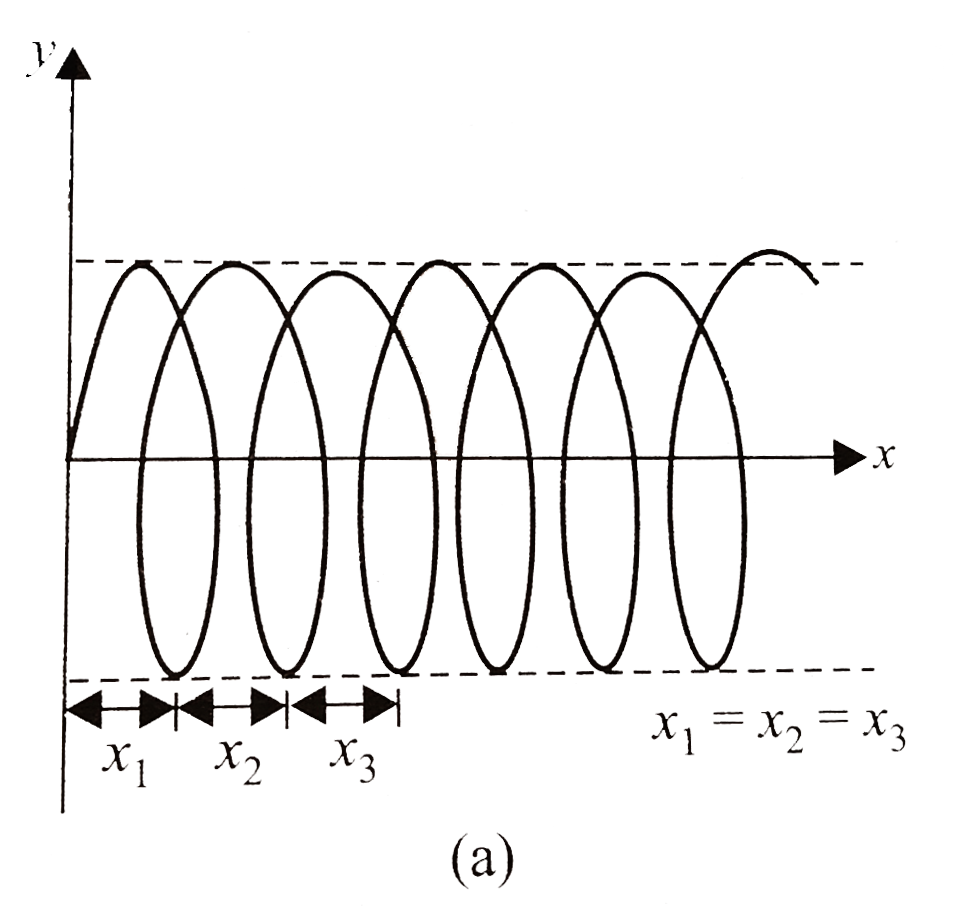
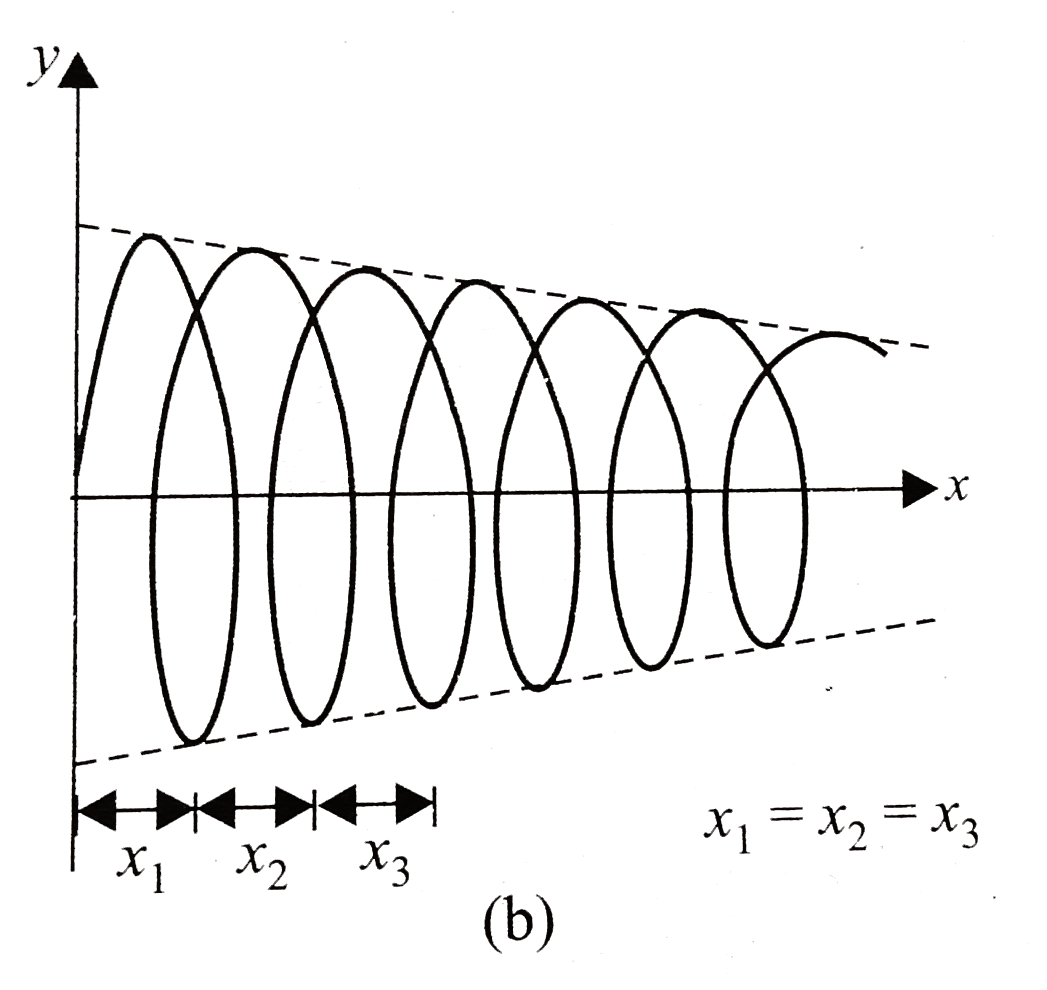
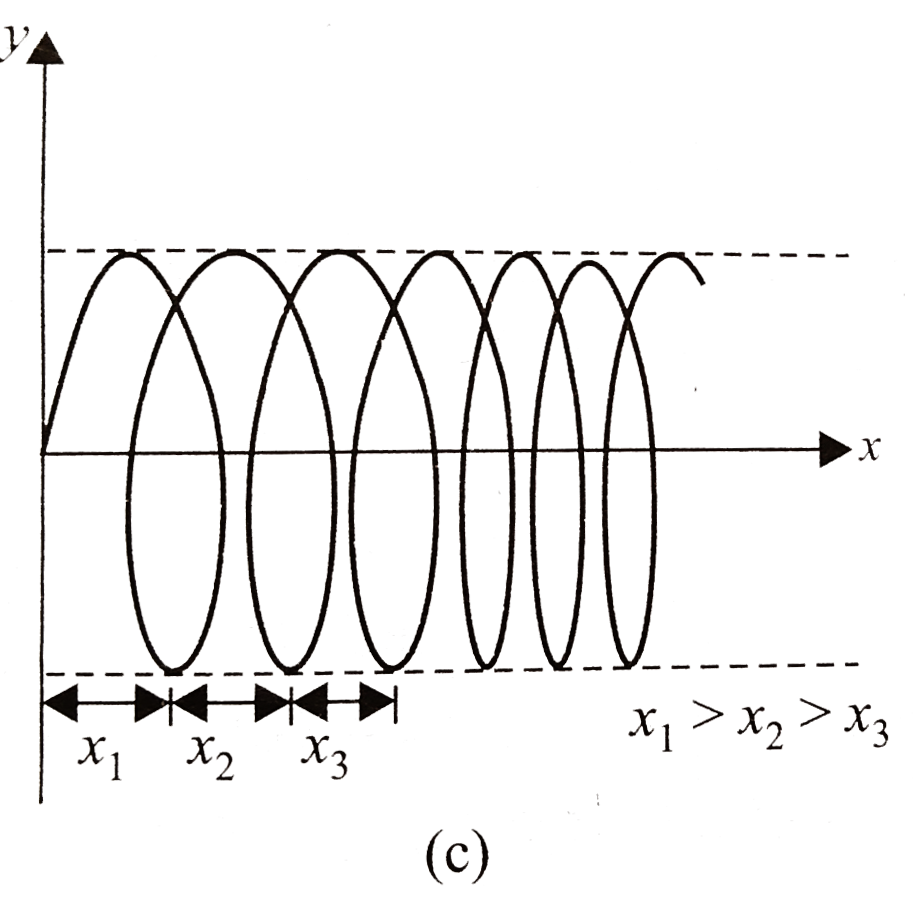
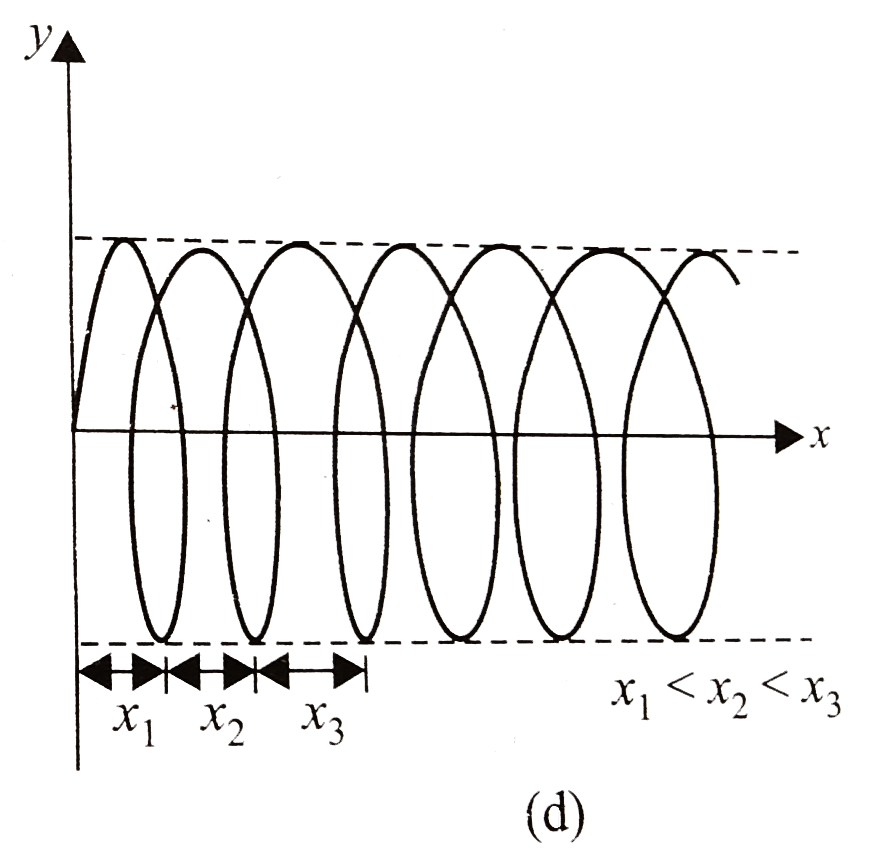
The magnetic field exists along negative x-axis and electric field exists along positive x-axis. A charged particle moves with a velocity inclined at an angle `(theta)` with vertical in (x-y) plane. What will be the correct diagram of the helical path?

A

B

C

D

Text Solution

AI Generated Solution

The correct Answer is:

To solve the problem, we need to analyze the motion of a charged particle in the presence of both electric and magnetic fields. Here’s a step-by-step breakdown of the solution: ### Step 1: Understand the Fields - The magnetic field (B) is directed along the negative x-axis. - The electric field (E) is directed along the positive x-axis. ### Step 2: Analyze the Velocity of the Charged Particle - The charged particle moves with a velocity (V) that is inclined at an angle (θ) with the vertical in the x-y plane. - We can resolve this velocity into two components: - **Vertical Component (V_y)**: This is the component of velocity in the y-direction, given by \( V_y = V \cos(\theta) \). - **Horizontal Component (V_x)**: This is the component of velocity in the x-direction, given by \( V_x = V \sin(\theta) \). ### Step 3: Determine the Forces Acting on the Particle - The particle experiences a magnetic force due to the magnetic field. The magnetic force (F_m) is given by: \[ F_m = q(V_y \times B) \] where \( q \) is the charge of the particle and \( B \) is the magnetic field strength. Since the magnetic field is along the negative x-axis, the force will act in a direction perpendicular to both the velocity and the magnetic field. - The particle also experiences an electric force (F_e) due to the electric field, which is given by: \[ F_e = qE \] This force acts in the positive x-direction. ### Step 4: Motion of the Particle - The component of velocity perpendicular to the magnetic field (V_y) will cause the particle to move in a circular path due to the magnetic force. - The electric field will exert a constant force in the positive x-direction, resulting in an acceleration in that direction. ### Step 5: Resulting Path of the Particle - The combination of circular motion due to the magnetic field and linear acceleration due to the electric field results in a helical path. - As the particle accelerates in the x-direction, the radius of the circular motion remains constant, but the pitch of the helix increases. ### Step 6: Identify the Correct Diagram - The correct diagram should show a helical path that is increasing in the x-direction, indicating that the particle is accelerating. - Among the options provided, the one that shows the particle moving in a helical path with increasing x-coordinates (x1 < x2 < x3) is the correct answer. ### Conclusion - The correct option is **Option D**, which illustrates the particle accelerating in the positive x-direction while moving in a helical path.

To solve the problem, we need to analyze the motion of a charged particle in the presence of both electric and magnetic fields. Here’s a step-by-step breakdown of the solution: ### Step 1: Understand the Fields - The magnetic field (B) is directed along the negative x-axis. - The electric field (E) is directed along the positive x-axis. ### Step 2: Analyze the Velocity of the Charged Particle - The charged particle moves with a velocity (V) that is inclined at an angle (θ) with the vertical in the x-y plane. ...
Promotional Banner

Topper's Solved these Questions

  • MISCELLANEOUS VOLUME 5

    CENGAGE PHYSICS ENGLISH|Exercise Multiple Correct|34 Videos
  • MISCELLANEOUS VOLUME 5

    CENGAGE PHYSICS ENGLISH|Exercise Linked Comprehension|84 Videos
  • MISCELLANEOUS VOLUME 3

    CENGAGE PHYSICS ENGLISH|Exercise True and False|3 Videos
  • NUCLEAR PHYSICS

    CENGAGE PHYSICS ENGLISH|Exercise ddp.5.5|14 Videos

Similar Questions

Explore conceptually related problems

Equipotential surfaces associated with a uniform electric field along positive x-axis are planes parallel to

There exist uniform magnetic and electric fields of manitudes 1T and 1Vm^-1 respectively, along positive y-axis. A charged particle of mass 1kg and charge 1C is having velocity 1ms^-1 along x-axis and is at origin at t=0. Then, the coordinates of the particle at time pis will be

There exist uniform magnetic and electric fields of manitudes 1T and 1Vm^-1 respectively, along positive y-axis. A charged particle of mass 1kg and charge 1C is having velocity 1ms^-1 along x-axis and is at origin at t=0. Then, the coordinates of the particle at time pis will be

A particle of mass m and charge q is lying at the origin in a uniform magnetic field B directed along x-axis. At time t = 0, it is given a velocity v_0 , at an angle theta with the y-axis in the xy-plane. Find the coordinates of the particle after one revolution.

An electron is moving along positive x-axis. To get it moving on an anticlockwise circular path in x-y plane, a magnetic field is applied

An electron is moving along positive x-axis. To get it moving on an anticlockwise circular path in x-y plane, a magnetic field is applied

A positively charged particle, having charge q, is accelerated by a potential difference V. This particle moving along the x-axis enters a region where an electric field E exists. The direction of the electric field is along positive y-axis. The electric field exists in the region bounded by the lines x=0 and x=a. Beyond the line x=a (i.e., in the region xgta ), there exists a magnetic field of strength B, directed along the positive y-axis. Find a. at which point does the particle meet the line x=a . b. the pitch of the helix formed after the particle enters the region xgea. (Mass of the particle is m.)

A proton is moving along the negative direction of X-axis in a magnetic field directed along the positive direction of Y-axis. The proton will be deflected along the negative direction of

In a certain region of space, there exists a uniform and constant electric field of magnitude E along the positive y-axis of a coordinate system. A charged particle of mass m and charge -q (qgt0) is projected form the origin with speed 2v at an angle of 60^@ with the positive x-axis in x-y plane. When the x-coordinate of particle becomes sqrt3mv^2//qE a uniform and constant magnetic field of strength B is also switched on along positive y-axis. Velocity of the particle just before the magnetic field is switched on is

In a certain region of space, there exists a uniform and constant electric field of magnitude E along the positive y-axis of a coordinate system. A charged particle of mass m and charge -q (qgt0) is projected form the origin with speed 2v at an angle of 60^@ with the positive x-axis in x-y plane. When the x-coordinate of particle becomes sqrt3mv^2//qE a uniform and constant magnetic. field of strength B is also switched on along positive y-axis. x-coordinate of the particle as a function of time after the magnetic field is switched on is
