Home
Class 12
PHYSICS
A velocity filter uses the properties of...

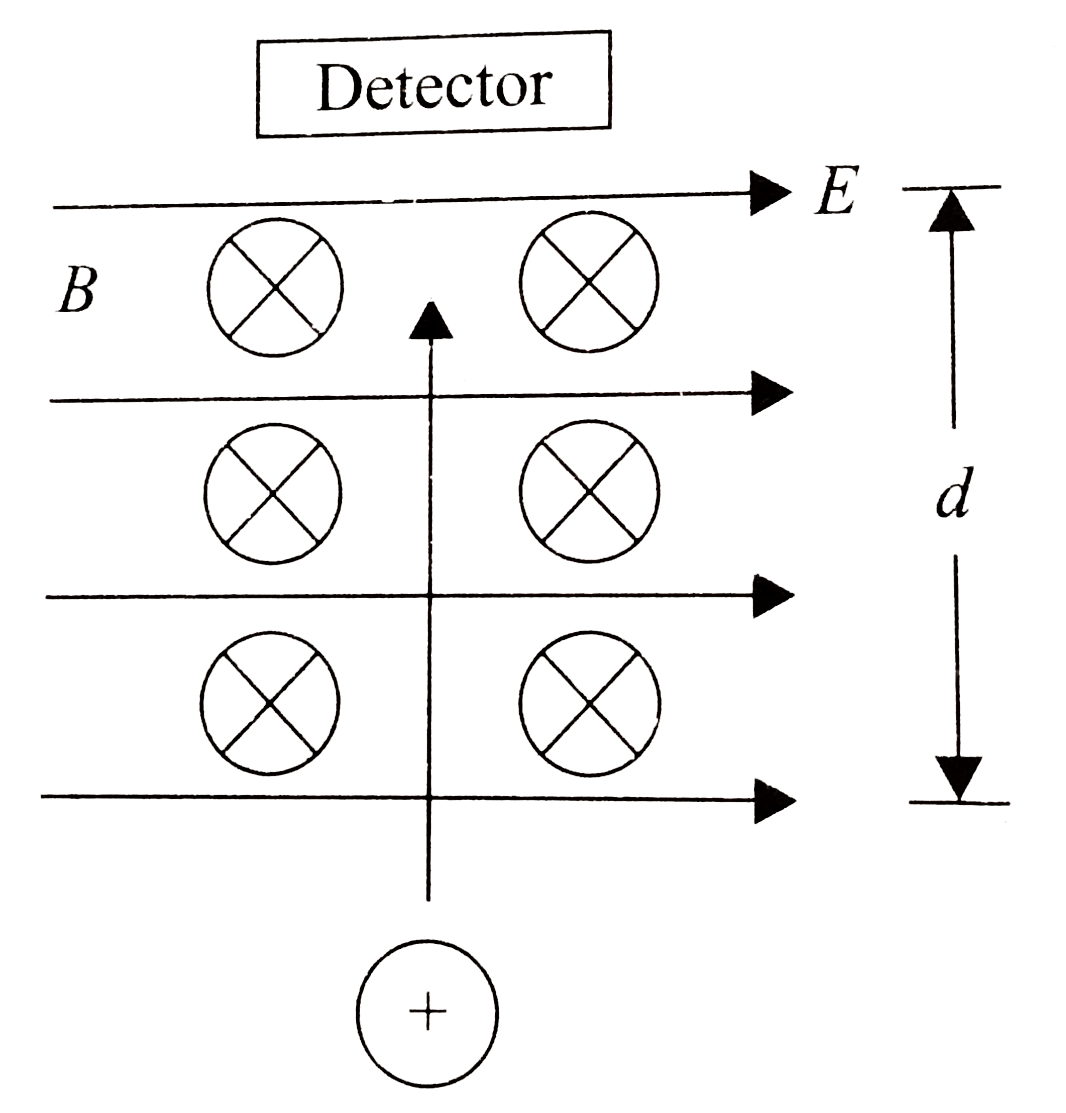
A velocity filter uses the properties of electric and magnetic field to select particles that are moving with a specifice velocity. Charged particles with varying speeds are directed into the filter as shown. The filter consistt of an electric field E and a magnetic field B, each of constant magnitude, directed perpendicular to each other as shown, The charge particles will experience a force due to electric field given by F = qE. If positively charged particles are used, this force is towards right.

The moving particle will also experience a force due to magnetic field given by `F = qvB`. When forces due to the two fields are of equal magnitude, the net force on the particle will be zero, the particle will pass through centre with its path unaltered. The electric and magnetic fields can be adjusted t choose the specific velocity to be filtered. The efect of gravity can be neglected.
The electric and magnetic fields are adjusted to detect particles with positive charge q of certain speed `v_(0)`. which of the following expressions is equal to this speed?

A

it would not work with negatively charged particles.

B

wider the detector entrance, the narrower the range of speed detected.

C

greater the distance d, the narrower the range of speed detected.

D

The detector may not detect a charged particles with desired filter speed if its charge is too high.

Text Solution

Verified by Experts

The correct Answer is:

C

Greater the distance d, larger would be the deviation produced in the path. Hence the particle will be unable to enter the detector for greater distance d, thus narrowing the range of speeds detected.
Promotional Banner

Topper's Solved these Questions

  • MISCELLANEOUS VOLUME 5

    CENGAGE PHYSICS ENGLISH|Exercise Integer|12 Videos
  • MISCELLANEOUS VOLUME 5

    CENGAGE PHYSICS ENGLISH|Exercise Multiple Correct|34 Videos
  • MISCELLANEOUS VOLUME 3

    CENGAGE PHYSICS ENGLISH|Exercise True and False|3 Videos
  • NUCLEAR PHYSICS

    CENGAGE PHYSICS ENGLISH|Exercise ddp.5.5|14 Videos

Similar Questions

Explore conceptually related problems

A velocity filter uses the properties of electric and magnetic field to select particles that are moving with a specifice velocity. Charged particles with varying speeds are directed into the filter as shown. The filter consistt of an electric field E and a magnetic field B, each of constant magnitude, directed perpendicular to each other as shown, The charge particles will experience a force due to electric field given by F = qE. If positively charged particles are used, this force is towards right. The moving particle will also experience a force due to magnetic field given by F = qvB. When forces due to the two fields are of equal magnitude, the net force on the particle will be zero, the particle will pass through centre with its path unaltered. The electric and magnetic fields can be adjusted t choose the specific velocity to be filtered. The efect of gravity can be neglected. If the filter is set to detect particles of speed v_(0) , which one of the following diagrams best illustrates how the magnitude of the particle acceleration (a) depends on velocity v?

An electric field (vec E) and a magnetic field (vec B)exist in a region . The fields are not perpendicular to each other.

The path of a charged particle in a uniform magnetic field, when the velocity and the magnetic field are perpendicular to each other is a

A charged particle is moved along a magnetic field line. The magnetic force on the particle is

A charge q moves region in a electric field E and the magnetic field B both exist, then the force on its is

In a region where both non-zero uniform electric field and magnetic field coexist, the path of a charged particle

A particle having charge q moves with a velocity v through a region in which both an electric field vecE and a magnetic field B are present. The force on the particle is

If a charged particle at rest experiences no electromagnetic force, then electric field in that region

A charged particle moving in a magnetic field experiences a resultant force

If a charged particle at rest experiences no electromagnetic force, then The electric field must be zero

CENGAGE PHYSICS ENGLISH-MISCELLANEOUS VOLUME 5-Linked Comprehension
  1. The fact tht a changing magnetic flux produces an electric field is ba...

    Text Solution

    |

  2. A velocity filter uses the properties of electric and magnetic field t...

    Text Solution

    |

  3. A velocity filter uses the properties of electric and magnetic field t...

    Text Solution

    |

  4. A velocity filter uses the properties of electric and magnetic field t...

    Text Solution

    |

  5. In the given arrangement, the space between a pair of co-axial cylindr...

    Text Solution

    |

  6. In the given arrangement, the space between a pair of co-axial cylindr...

    Text Solution

    |

  7. In the given arrangement, the space between a pair of co-axial cylindr...

    Text Solution

    |

  8. The path of a charged particle in a uniform magnetic field depends on ...

    Text Solution

    |

  9. The path of a charged particle in a uniform magnetic field depends on ...

    Text Solution

    |

  10. The path of a charged particle in a uniform magnetic field depends on ...

    Text Solution

    |

  11. Magnetic force on a charged particle is given by vec F(m) = q(vec(v) x...

    Text Solution

    |

  12. A particle having charge q=1 C and mass m=1kg is released from rest at...

    Text Solution

    |

  13. Magnetic force on a charged particle is given by vec F(m) = q(vec(v) x...

    Text Solution

    |

  14. Following experiment was performed by J.J. Thomson in order to measure...

    Text Solution

    |

  15. Following experiment was performed by J.J. Thomson in order to measure...

    Text Solution

    |

  16. Following experiment was performed by J.J. Thomson in order to measure...

    Text Solution

    |

  17. In uniform magnetic field, if angle between vec(v) and vec(B) is 0^(@)...

    Text Solution

    |

  18. In uniform magnetic field, if angle between vec(v) and vec(B) is 0^(@)...

    Text Solution

    |

  19. In uniform magnetic field, if angle between vec(v) and vec(B) is 0^(@)...

    Text Solution

    |

  20. A straight segment OC(of length L meter) of a circuit carrying a curre...

    Text Solution

    |
