Home
Class 12
PHYSICS
Consider the circuit shown below. When s...

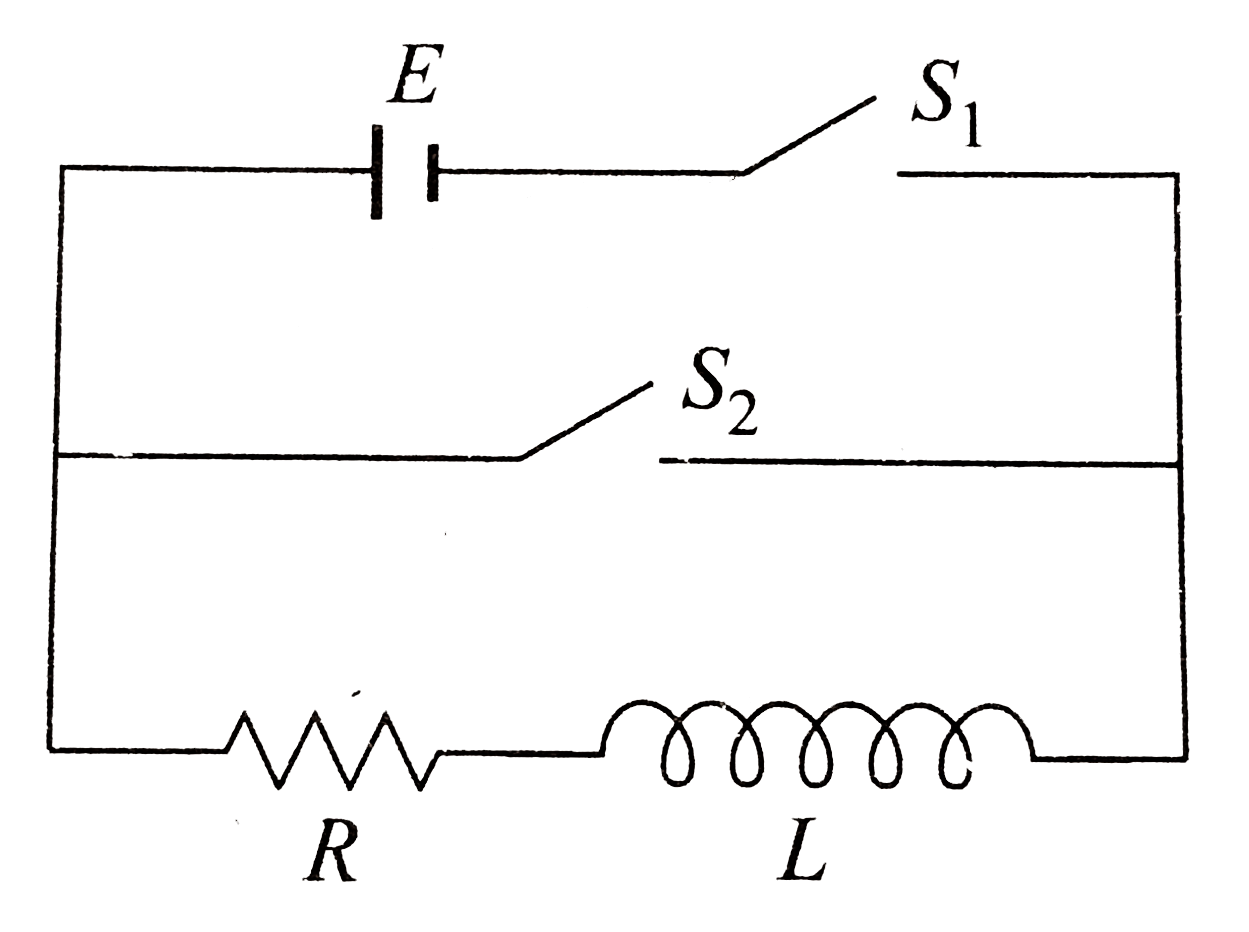
Consider the circuit shown below. When switch `S_(1)` is closed, let I be the current at time t, then applying Kirchhoff's law
`E-iR-L (di)/(dt) = 0 or int_(0)^(i) (di)/(E-iR) = 1/L int_(0)^(1) dt`
`i=E/R (1-e^(-R/l *t))`
`L/R` = time constant of circuit
When current reaches its steady value `(=i_(0)`, open `S_(1)` and close `S_(2)`, the current does reach to zero finally but decays expnentially. The decay equation is given as `i=i_(0)e^(-R/L *T)`.

Three idenctical rings. The first (a). slips without rolling and the second (b) rolls without slipping and the third rolls with slipping .

A

The same emf is induced in all three rings.

B

No emf is induced in any of the rings.

C

In each ring all points are at same potential

D

B develops max. Induced emf and A, the least.

Text Solution

Verified by Experts

The correct Answer is:

A

Current in L-R circuit is given as `i=i_(0)(1-e^(-t//tau))`
where `i_(0)=E/R and tau =L/R`
`Q=int_(0)^(tau) (1-e^(-t//tau)) dt =i_(0)[t-(e^(-t//tau))/(-1//tau)]_(0)^(tau) = (i_(0)tau)/(e)`
`Q = i_(0) tau//e`.
Promotional Banner

Topper's Solved these Questions

  • MISCELLANEOUS VOLUME 5

    CENGAGE PHYSICS ENGLISH|Exercise Integer|12 Videos
  • MISCELLANEOUS VOLUME 5

    CENGAGE PHYSICS ENGLISH|Exercise Multiple Correct|34 Videos
  • MISCELLANEOUS VOLUME 3

    CENGAGE PHYSICS ENGLISH|Exercise True and False|3 Videos
  • NUCLEAR PHYSICS

    CENGAGE PHYSICS ENGLISH|Exercise ddp.5.5|14 Videos

Similar Questions

Explore conceptually related problems

Consider the circuit shown below. When switch S_(1) is closed, let I be the current at time t, then applying Kirchhoff's law E-iR-L (di)/(dt) = 0 or int_(0)^(i) (di)/(E-iR) = 1/L int_(0)^(1) dt i=E/R (1-e^(-R/l *t)) L/R = time constant of circuit When current reaches its steady value (=i_(0) , open S_(1) and close S_(2) , the current does reach to zero finally but decays expnentially. The decay equation is given as i=i_(0)e^(-R/L *T) . A wire is sliding as shown in fig . The angle between the acceleration and velocity of the wire is

Consider the circuit shown below. When switch S_(1) is closed, let I be the current at time t, then applying Kirchhoff's law E-iR-L (di)/(dt) = 0 or int_(0)^(i) (di)/(E-iR) = 1/L int_(0)^(1) dt i=E/R (1-e^(-R/l *t)) L/R = time constant of circuit When current reaches its steady value (=i_(0) , open S_(1) and close S_(2) , the current does reach to zero finally but decays expnentially. The decay equation is given as i=i_(0)e^(-R/L *T) ). When a coil carrying a steady current is short circuited, the current decreases in it eta times in time t_(0) . The time constant of the circuit is

In the circuit shown, the switch is closed at t=0 , the currents I_1, I_2 and I_3 are

In the circuit shown switch S is closed at t=0 . Let i_1 and i_2 be the current at any finite time t then the ratio i_1/i_2

In the circuit shown in figure switch S is closed at time t=0 Current I from the battery at time t is given by

In the circuit shown, the switch 'S' is closed at t = 0 . Then the current through the battery steady state reached is

Switch is closed at t = 0 then the current in the circuit at t = L/2R is

In the circuit shwon in fig. switch S is closed at time t = 0. Let I_1 and I_2 be the currents at any finite time t, then the ratio I_1// I_2

In the circuit shown, switch S is closed at time t = 0 . Find the current through the inductor as a function of time t .

In the circuit shown in figure L=10H, R=5Omega, E=15V. The switch S is closed at t=0 . At t=2s the current in the circuit is

CENGAGE PHYSICS ENGLISH-MISCELLANEOUS VOLUME 5-Linked Comprehension
  1. A stationary circular loop of radius a is located in a magnetic field ...

    Text Solution

    |

  2. A stationary circular loop of radius a is located in a magnetic field ...

    Text Solution

    |

  3. A circular ring of radius a is made from a wire having resistance (lam...

    Text Solution

    |

  4. A circular ring of radius a is made from a wire having resistance (lam...

    Text Solution

    |

  5. A long solenoid having n = 200 turns per metre has a circular cross-se...

    Text Solution

    |

  6. A long solenoid having n = 200 turns per metre has a circular cross-se...

    Text Solution

    |

  7. A long solenoid having n = 200 turns per metre has a circular cross-se...

    Text Solution

    |

  8. A long solenoid having n = 200 turns per metre has a circular cross-se...

    Text Solution

    |

  9. The potential difference across a 2-H inductor as a function of time i...

    Text Solution

    |

  10. The potential difference across a 2-H inductor as a function of time i...

    Text Solution

    |

  11. The potential difference across a 2-H inductor as a function of time i...

    Text Solution

    |

  12. Consider the circuit shown below. When switch S(1) is closed, let I be...

    Text Solution

    |

  13. Consider the circuit shown below. When switch S(1) is closed, let I be...

    Text Solution

    |

  14. Consider the circuit shown below. When switch S(1) is closed, let I be...

    Text Solution

    |

  15. Two long parallel conducting horizontal rails are connected by a condu...

    Text Solution

    |

  16. Two long parallel conducting horizontal rails are connected by a condu...

    Text Solution

    |

  17. A uniform conducting ring of mass pi kg and radius 1 m is kept on smoo...

    Text Solution

    |

  18. A uniform conducting ring of mass pi kg and radius 1 m is kept on smoo...

    Text Solution

    |

  19. A uniform conducting ring of mass pi kg and radius 1 m is kept on smoo...

    Text Solution

    |

  20. A uniform conducting ring of mass pi kg and radius 1 m is kept on smoo...

    Text Solution

    |
