Home
Class 11
PHYSICS
A train approachign a railway crossing a...

A train approachign a railway crossing at a speed of `120 kmh^-1` sounds a short whistle at frequency 640 Hz when it is 300 m away from the crossing. The speed of sound in air is `340 ms^-1`. What will be the frequency heard by a person standing on a road perpendicular to the track through the crossing at a distance of 400 m from the crossing ?

Text Solution

Verified by Experts
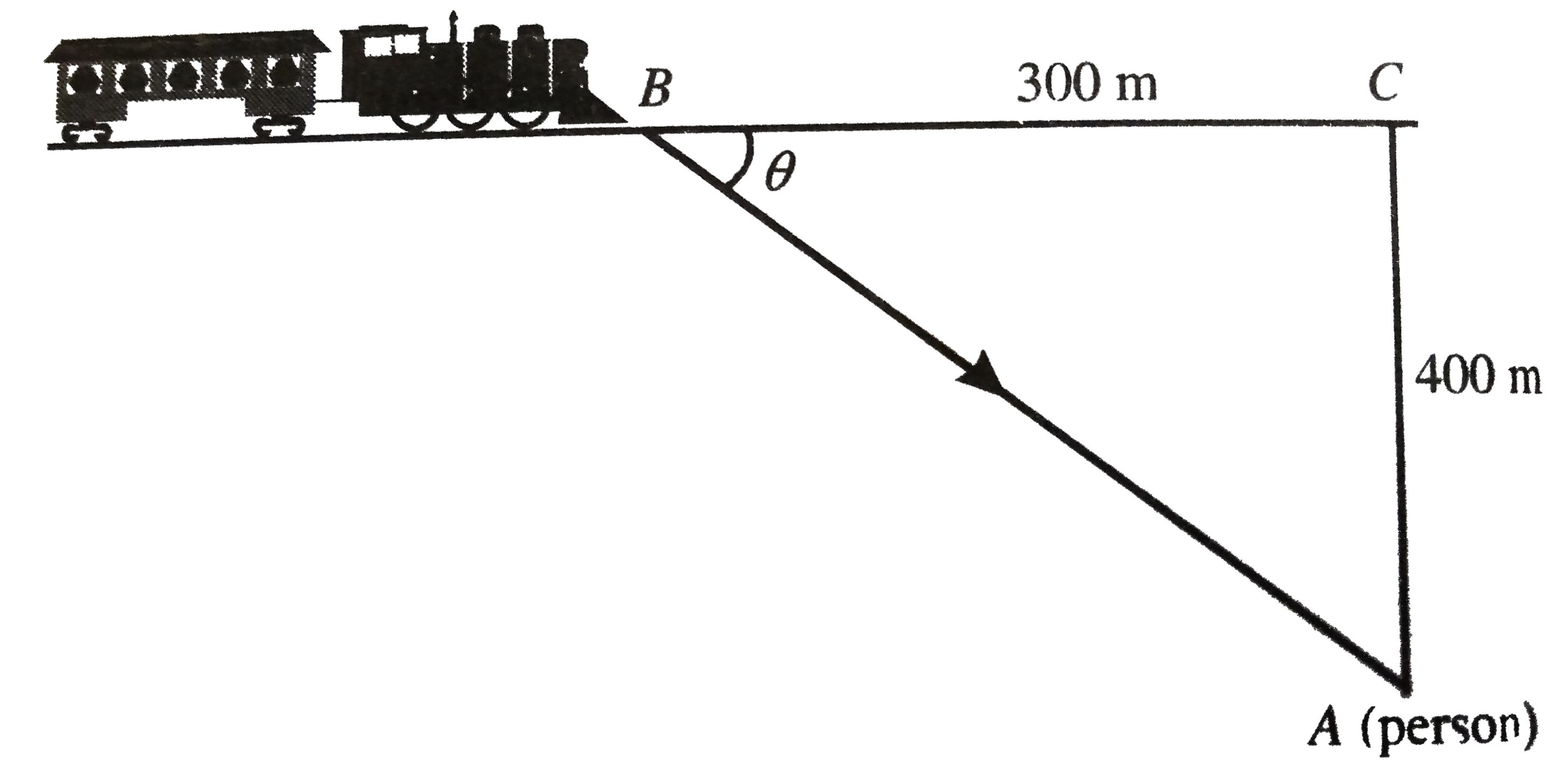

The observer A is at rest with respect to the air and the source is travelling at a velocity of 120 km/s, i.e. `((100)/(3))(m)/(s)`. As is clear from the figure, the person receives the sound of the whistle in direction BA making an angle `theta` with the trach where `costheta=(300)/(500)=(3)/(5)`. The component of the velocity of the source (i.e., of the train) along the direction AB is `((100)/(3))xx((3)/(5))(m)/(s)=20(m)/(s)`. As the source is approaching the person with this component, the frequency heard by the observer is `n'=(v)/(v-ucostheta)n=(340)/(340-20)xx640Hz=680Hz`
Promotional Banner

Topper's Solved these Questions

  • SOUND WAVES AND DOPPLER EFFECT

    CENGAGE PHYSICS ENGLISH|Exercise Examples|56 Videos
  • SOUND WAVES AND DOPPLER EFFECT

    CENGAGE PHYSICS ENGLISH|Exercise Exercise 6.1|56 Videos
  • RIGID BODY DYNAMICS 2

    CENGAGE PHYSICS ENGLISH|Exercise Interger|2 Videos
  • SUPERPOSITION AND STANDING WAVES

    CENGAGE PHYSICS ENGLISH|Exercise Comprehension Type|5 Videos

Similar Questions

Explore conceptually related problems

A locomotive approaching a crossing at a speed of 20 ms^(-1) sounds a whistle of frequency 640 Hz when 1 km from the crossing. There is no wind and the speed of sound in air is 330 ms^(-1) . What frequency is heard by an observer sqrt(3) km on the straight road from the crossing at right angle :-

A car is approching a railway crossing at a speed of 72 kmph . It sounds a horn, when it is 800 m away, at 600 Hz . If the velocity of sound in air is 330 ms^(-1) . The apparent frequency as received by a man at rest near the railway track perpendicular to the road at a distance of 600 m from the crossing the

A locomotive approaching a crossing at a speed of 80 mi/h sounds a whistle of frequency 400 Hz when 1 mi from the crossing. There is no wind, and the speed of sound in air is 0.200mi/s. What frequency is heard by an observer 0.60 mi from the crossing on the straight road which crosses the railroad at right angles?

A locomotive approaching a crossing at a speed of 80 mi/h sounds a whistle of frequency 400 Hz when 1 mi from the crossing. There is no wind, and the speed of sound in air is 0.200mi/s. What frequency is heard by an observer 0.60 mi from the crossing on the straight road which crosses the railroad at right angles?

A car approaching a crossing C at a speed of 20 m//s sounds a horn of frequency 500 H_(Z) when 80 m from the crossing . Speed of sound in air is 330 m//s . What frequency is heard by an observer (at rest) 60m from the crossing on the straight road which crosses car road at right angles ?

A train approaching a railway platform with a speed of 20 m s^(-1) starts blowing the whistle. Speed of sound in air is 340 m s^(-1) . If the frequency of the emitted sound from the whistle is 640 Hz, the frequency of sound as heard by person standing on the platform

A train approaching a hill at a speed of 40 km//hr sounds a whistle of frequency 580 Hz when it is at a distance of 1km from a hill. A wind with a speed of 40km//hr is blowing in the direction of motion of the train Find (i) the frequency of the whistle as heard by an observer on the hill, (ii) the distance from the hill at which the echo from the hill is heard by the driver and its frequency. (Velocity of sound in air = 1, 200 km//hr )

A train approaching a hill at a speed of 40 km//hr sounds a whistle of frequency 580 Hz when it is at a distance of 1km from a hill. A wind with a speed of 40km//hr is blowing in the direction of motion of the train Find (i) the frequency of the whistle as heard by an observer on the hill, (ii) the distance from the hill at which the echo from the hill is heard by the driver and its frequency. (Velocity of sound in air = 1, 200 km//hr )

A source of sound of frequency 600Hz is placed inside of water. The speed of sound is water is 1500m//s and air it is 300m//s . The frequency of sound recorded by an observer who is standing in air is

A train is moving with speed 72 km/h towards a hill blows a whistle of frequency 1240Hz. the frequency of echo heard by driver is(speed of sound=330m/s)

CENGAGE PHYSICS ENGLISH-SOUND WAVES AND DOPPLER EFFECT-Integer
  1. A train approachign a railway crossing at a speed of 120 kmh^-1 sounds...

    Text Solution

    |

  2. The average power transmitted across a cross section by two sound wave...

    Text Solution

    |

  3. Loudness of sound from an isotropic point source at a distace of 70cm ...

    Text Solution

    |

  4. Two sound sources are moving away from a stationary observer in opposi...

    Text Solution

    |

  5. The resultant loudness at a point P is n dB higher than the loudness o...

    Text Solution

    |

  6. The average power transmitted across a cross section by two sound wave...

    Text Solution

    |

  7. Loudness of sound from an isotropic point source at a distace of 70cm ...

    Text Solution

    |

  8. Two sound sources are moving away from a stationary observer in opposi...

    Text Solution

    |

  9. The resultant loudness at a point P is n dB higher than the loudness o...

    Text Solution

    |

  10. The average power transmitted across a cross section by two sound wave...

    Text Solution

    |

  11. Loudness of sound from an isotropic point source at a distace of 70cm ...

    Text Solution

    |

  12. Two sound sources are moving away from a stationary observer in opposi...

    Text Solution

    |

  13. The resultant loudness at a point P is n dB higher than the loudness o...

    Text Solution

    |

  14. The average power transmitted across a cross section by two sound wave...

    Text Solution

    |

  15. Loudness of sound from an isotropic point source at a distace of 70cm ...

    Text Solution

    |

  16. Two sound sources are moving away from a stationary observer in opposi...

    Text Solution

    |

  17. The resultant loudness at a point P is n dB higher than the loudness o...

    Text Solution

    |

