Home
Class 11
PHYSICS
A sonic source, located in a uniform med...

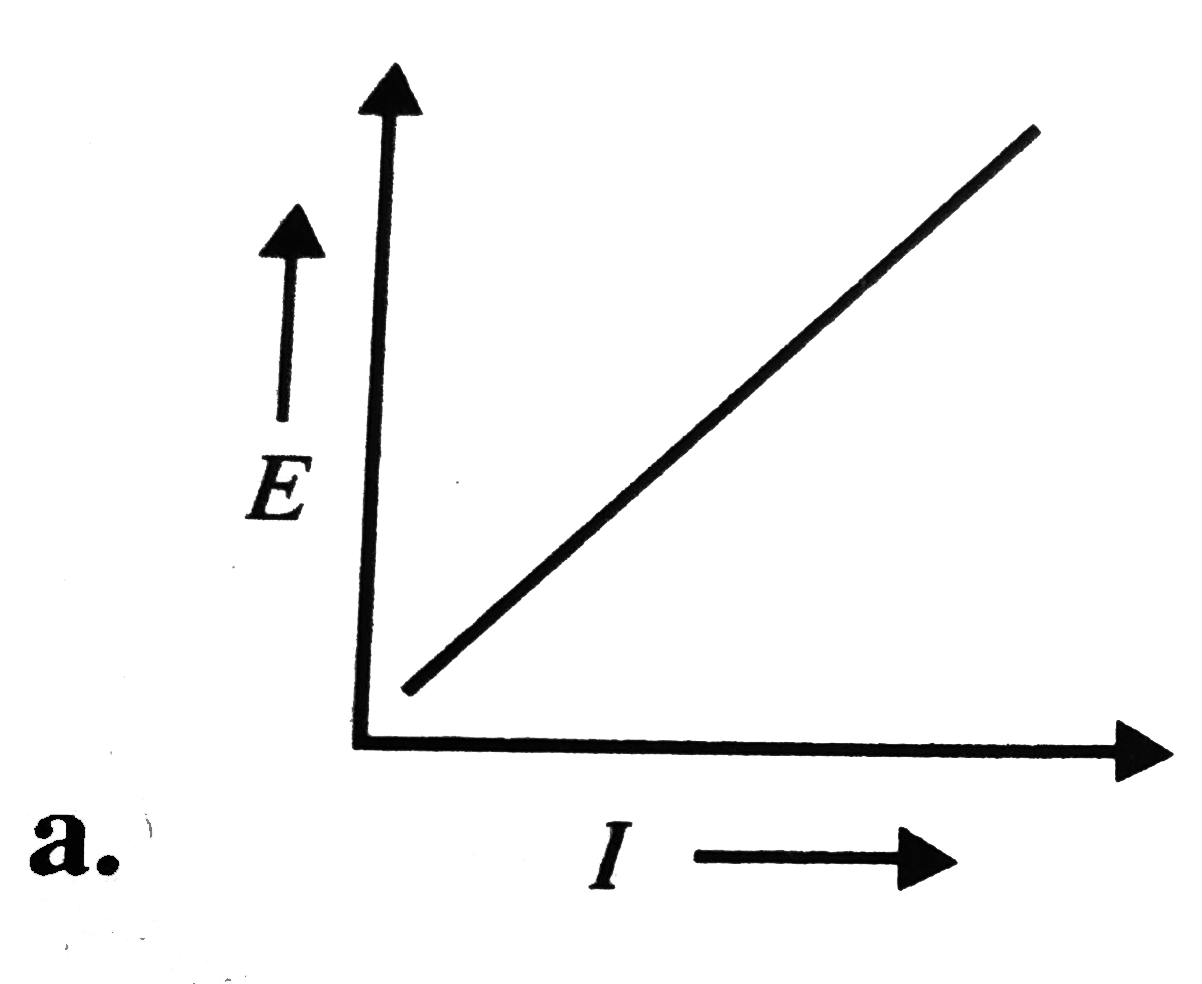
A sonic source, located in a uniform medium, emits waves of frequency `n`. If intensity, energy density (energy per unit volume of the medium) and maximum speed of oscillations of medium particle are, respectively, `I`, `E` and `u_0` at a point, then which of the following graphs are correct?

A

B

C

D

Text Solution

AI Generated Solution

The correct Answer is:

To solve the problem, we need to analyze the relationships between intensity (I), energy density (E), and maximum speed of oscillations of the medium particles (u₀) for a sonic source emitting waves of frequency n. ### Step-by-Step Solution: 1. **Understanding Intensity (I)**: - Intensity (I) is defined as the energy per unit area per unit time. It can be expressed in terms of energy density (E) and the speed of sound in the medium. - The relationship can be given as: \[ I \propto E \] - This implies that intensity is directly proportional to energy density. 2. **Graph of Intensity vs Energy Density**: - Since intensity is proportional to energy density, if we plot intensity (I) on the y-axis and energy density (E) on the x-axis, we will get a straight line passing through the origin. - **Graph**: A straight line graph indicating a linear relationship between I and E. 3. **Understanding Energy Density (E) and Frequency (n)**: - The energy density (E) is related to the frequency (n) of the waves. The relationship can be derived from the formula for intensity: \[ I = 2\pi^2 n^2 A^2 \rho v \] - From this, we can express energy density as: \[ E \propto n^2 \] - This indicates that energy density is proportional to the square of the frequency. 4. **Graph of Energy Density vs Frequency**: - If we plot energy density (E) on the y-axis and frequency (n) on the x-axis, we will get a parabolic graph that is symmetric about the E-axis. - **Graph**: A parabola opening upwards, indicating that as frequency increases, energy density increases quadratically. 5. **Understanding Maximum Speed of Oscillation (u₀)**: - The maximum speed of oscillation (u₀) is related to the amplitude (A) and frequency (n): \[ u_0 = 2\pi n A \] - Squaring both sides gives: \[ E \propto u_0^2 \] - This means energy density is also proportional to the square of the maximum speed of oscillation. 6. **Graph of Energy Density vs Maximum Speed of Oscillation**: - If we plot energy density (E) on the y-axis and maximum speed of oscillation (u₀) on the x-axis, we will again get a parabolic graph that is symmetric about the E-axis. - **Graph**: A parabola opening upwards, indicating that as the maximum speed of oscillation increases, energy density also increases quadratically. ### Summary of Graphs: - **Graph 1**: Intensity (I) vs Energy Density (E) - Straight line through the origin. - **Graph 2**: Energy Density (E) vs Frequency (n) - Parabola opening upwards. - **Graph 3**: Energy Density (E) vs Maximum Speed of Oscillation (u₀) - Parabola opening upwards.

To solve the problem, we need to analyze the relationships between intensity (I), energy density (E), and maximum speed of oscillations of the medium particles (u₀) for a sonic source emitting waves of frequency n. ### Step-by-Step Solution: 1. **Understanding Intensity (I)**: - Intensity (I) is defined as the energy per unit area per unit time. It can be expressed in terms of energy density (E) and the speed of sound in the medium. - The relationship can be given as: \[ ...
Promotional Banner

Topper's Solved these Questions

  • SOUND WAVES AND DOPPLER EFFECT

    CENGAGE PHYSICS ENGLISH|Exercise Assertion-Reasoning|24 Videos
  • SOUND WAVES AND DOPPLER EFFECT

    CENGAGE PHYSICS ENGLISH|Exercise Comprehension|144 Videos
  • SOUND WAVES AND DOPPLER EFFECT

    CENGAGE PHYSICS ENGLISH|Exercise Single Correct|252 Videos
  • RIGID BODY DYNAMICS 2

    CENGAGE PHYSICS ENGLISH|Exercise Interger|2 Videos
  • SUPERPOSITION AND STANDING WAVES

    CENGAGE PHYSICS ENGLISH|Exercise Comprehension Type|5 Videos

Similar Questions

Explore conceptually related problems

If V and u are electric potential and energy density, respectively, at a distance r from a positive point charge, then which of the following graph is correct ?

Energy density E (energy per unit volume ) of the medium ar a distance r from a sound source varies acording to the curve shown in figure. Which of the following are possible?

A particle is projected from a point of an angle with the horizontal. At any instant t, if p is the linear momentum and E the kinetic energy, then which of the following graph is/are correct?

An EM wave from air enters a medium. The electric fields are overset(vec)E_(1)=E_(01)hatx cos[2piv((z)/(c )-t)] in air and overset(vec)E=E_(02)hatx cos [k(2z-ct)] in medium, where the wave number k and frequency v refer to their values in air. The medium is non-magnetic. If in_(r_(1)) and in_(r_(2)) refer to relative permittivities of air and medium respectively, which of the following options is correct ?

Which of the following options is representing average energy per unit volume of a travelling wave? (Where rho is density, omega is angular frequency, A is amplitude)

A source of sound emits sound waves at frequency f_(0) . It is moving towards an observer with fixed speed v_(s)(v_(s) lt v where v is the speed in air). If the observer were to move towards the source with speed v_(0) one of the following two graphs (A and B) will give the correct variation of the frequency f heard by the observer as v_(0) is changed, The variation of f with v_(0) is given correctly by :-

A conductor of length L is placed along the x - axis , with one of its ends at x = 0 and the other at x = L. If the rate of flow of heat energy through the conduct is constant and its thermal resistance per unit length is also constant , then Which of the following graphs is/are correct ?

(A ): Speed of EM wave in a medium depends on electrical permittivity and magnetic permeability of the medium (R) E.M wave transport energy in the form of oscillating electric and magnetic fields

A tuning fork of frequency 440 Hz is attached to a long string of linear mass density 0.01 kg m^-1 kept under a tension of 49 N. The fork produces transverse waves of amplitude 0.50 mm on the string. (a) Find the wave speed and the wavelength of the waves. (b) Find the maximum speed and acceleration of a particle of the string. (c) At what average rate is the tuning fork transmitting energy to the string ?

A block M hangs vertically at the bottom end of a uniform rope of constant mass per unit length. The top end of the rope is attached to a fixed rigid support at O. A transverse wave pulse (Pulse 1) of wavelength lamda_(0) is produced at point O on the rope. The pulse takes time T_(OA) to reach point A. If the wave pulse of wavelength lamda_(0) is produced at point A (Pulse 2) without disturbing the position of M it takes time T_(AO) to reach point O. Which of the following options is/are correct?

CENGAGE PHYSICS ENGLISH-SOUND WAVES AND DOPPLER EFFECT-Multiple Correct
  1. Consider a souce of sound S, and an observer/detector D. The source em...

    Text Solution

    |

  2. An observer A is moving directly towards a stationary sound source whi...

    Text Solution

    |

  3. A sonic source, located in a uniform medium, emits waves of frequency ...

    Text Solution

    |

  4. Plane harmonic waves of frequency 500 Hz are produced in air with disp...

    Text Solution

    |

  5. A driver in a stationary car blows a horn which produces monochromatic...

    Text Solution

    |

  6. In the figure shown, an observer O1 floats (static) on water surface w...

    Text Solution

    |

  7. Which of the following statements are incorrect?

    Text Solution

    |

  8. A source S of sound wave of fixed frequency N and an observer O are lo...

    Text Solution

    |

  9. A vibrating tuning fork is first held in the hand and then its end is ...

    Text Solution

    |

  10. A source of sound and detector are moving as shown in Fig. at t=0. Tak...

    Text Solution

    |

  11. Which of the following statements are correct?

    Text Solution

    |

  12. Consider a source of sound S and an observer P. The sound source is of...

    Text Solution

    |

  13. An observer A is moving directly towards a stationary sound source whi...

    Text Solution

    |

  14. A sonic source, located in a uniform medium, emits waves of frequency ...

    Text Solution

    |

  15. Plane harmonic waves of frequency 500 Hz are produced in air with disp...

    Text Solution

    |

  16. A driver in a stationary car blows a horn which produces monochromatic...

    Text Solution

    |

  17. In the figure shown, an observer O1 floats (static) on water surface w...

    Text Solution

    |

  18. Which of the following statements are incorrect?

    Text Solution

    |

  19. A source S of sound wave of fixed frequency N and an observer O are lo...

    Text Solution

    |

  20. A vibrating tuning fork is first held in the hand and then its end is ...

    Text Solution

    |
