Home
Class 11
PHYSICS
A mercury thermometer is constructed as ...


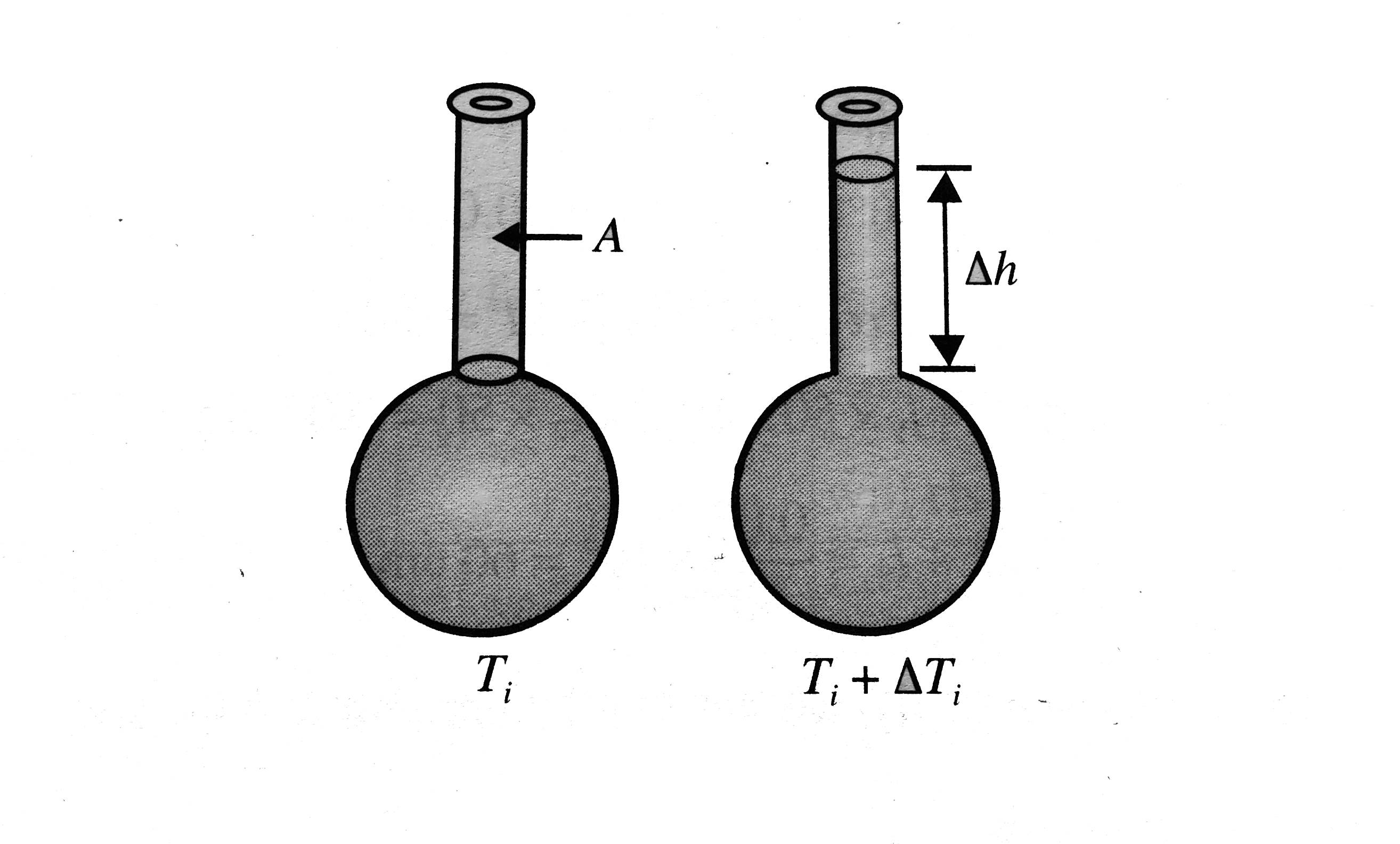
A mercury thermometer is constructed as shown if Fig. 1.9. The capillary tube has a diameter of 0.004 00 cm, and the bulb has a diameter of 0.250 cm. neglecting the expansion of the glass, find the change in height of the mercury column with a temperature change of 30.`0^@C`.

Text Solution

Verified by Experts

For an easy to read thermometer, the column should rise by a few centimetres.
We use the definition of the coefficient of expansion. Neglecting the expansion of the glass, the volume of liquid in the capillary will be `DeltaV=A Delta h`, where A is the cross-sectional area of the capillary. Let `V_i` represent the volume of the bulb.
`DeltaV=V_igammaDeltaT`
`Deltah=((V_i)/(A))gammaDeltaT=[((4)/(3)piR_("bu lb")^3)/(piR_("cap")^2)]gammaDeltaT`
`Deltah=(4)/(3)((0.125cm)^2)/((0.002 00 cm)^2)(1.82xx10^-4//^@C)(30.0^@C)=3.55cm`
This is a practical thermometer. Glass expands so little as compared to mercury that only the third digit of the answer would be affected by including the expandion of the glass in our analysis.
Promotional Banner

Topper's Solved these Questions

  • CALORIMETRY

    CENGAGE PHYSICS ENGLISH|Exercise Exercise 1.1|23 Videos
  • CALORIMETRY

    CENGAGE PHYSICS ENGLISH|Exercise Exercise 1.2|22 Videos
  • BASIC MATHEMATICS

    CENGAGE PHYSICS ENGLISH|Exercise Exercise 2.6|20 Videos
  • CENTRE OF MASS

    CENGAGE PHYSICS ENGLISH|Exercise INTEGER_TYPE|1 Videos

Similar Questions

Explore conceptually related problems

In a mercury-glass thermometer the cross-section of the capillary portion is A_(0) and the volume of the bulb is V_(0) at 273K . If alpha and gamma are the coefficients of linear and cubical expansion coefficients of glass and mercury respectively then length of mercury in the capillary at temperature t^(@)C is (Ignore the increase in cross-sectional area of capillary)

The inner diameter of a cylindrical wooden pipe is 24 cm and its outer diameter is 28 cm. The length of the pipe is 35 cm. Find the mass of the pipe, if 1 cm^3 of wood has a mass of 0.6 g.

If the diameter of a cylinder is 12.6 pm0.1 cm and its height is 34.2 pm0.1 cm , then find the volume of the cylinder to the nearest significant figure .

A barometer tube is 80 cm long (above the mercury reservoir). It reads 76 cm in a particular day. A small amount of water is introduced in the tube and the reading drops to 75.4 cm. Find the relative humidity in the space above the mercury column if the saturation vapor pressure at the room temperature is 1.0cm.

At the middle of the mercury barometer tube there is a little column of air with the length l_(0) and there is vacuum at the top as shown. Under the normal atmospheric pressure and the temperature of 200 le,vom/ l_(0)=10cm . What will be the length of the air column if the temperature rises to 330 kelvin? (Neglict expansion of the tube)

Water rises to a height 0f 10 cm in a capillary tube, and mercuryfalls to a depth of 3.42 cm in the same capillary tube. IF the density of mercury is 13.6 and the angle of contact is 135^(@) , the ratio of surface tension for water and mercury is

A mercury thermometer is to be made with glass tubing of internal bore 0.5 mm diameter and the distance between the fixed point is to be 20 cm. Estimate the volume of the bulb below the lower fixed point, given that the coefficient of cubical expansion of mercury is 0.00018//K . and the coefficient of linear expansion of glass is 0.000009//K .

The readings of a thermometer at 0^(@)C and 100^(@)C are 50 cm and 75 cm of mercury column respectively. Find the temperature at which its reading is 80 cm of mercury column ?

The readings of a thermometer at 0^(@)C and 100^(@)C are 50 cm and 75 cm of mercury column respectively. Find the temperature at which its reading is 80 cm of mercury column ?

The volume of mercury in the bulb of thermometer is 10^(-6) m^(3) . The area of cross-section of the capillary tube is 2 xx 10^(-7) m^(2) . If the temperature is raised by 100^(0)C , the increase in the length of the mercury column is (gamma_(Hg) = 18 xx 10^(-5//@)C)
