Home
Class 11
PHYSICS
Three cylindrical rods A, B and C of equ...


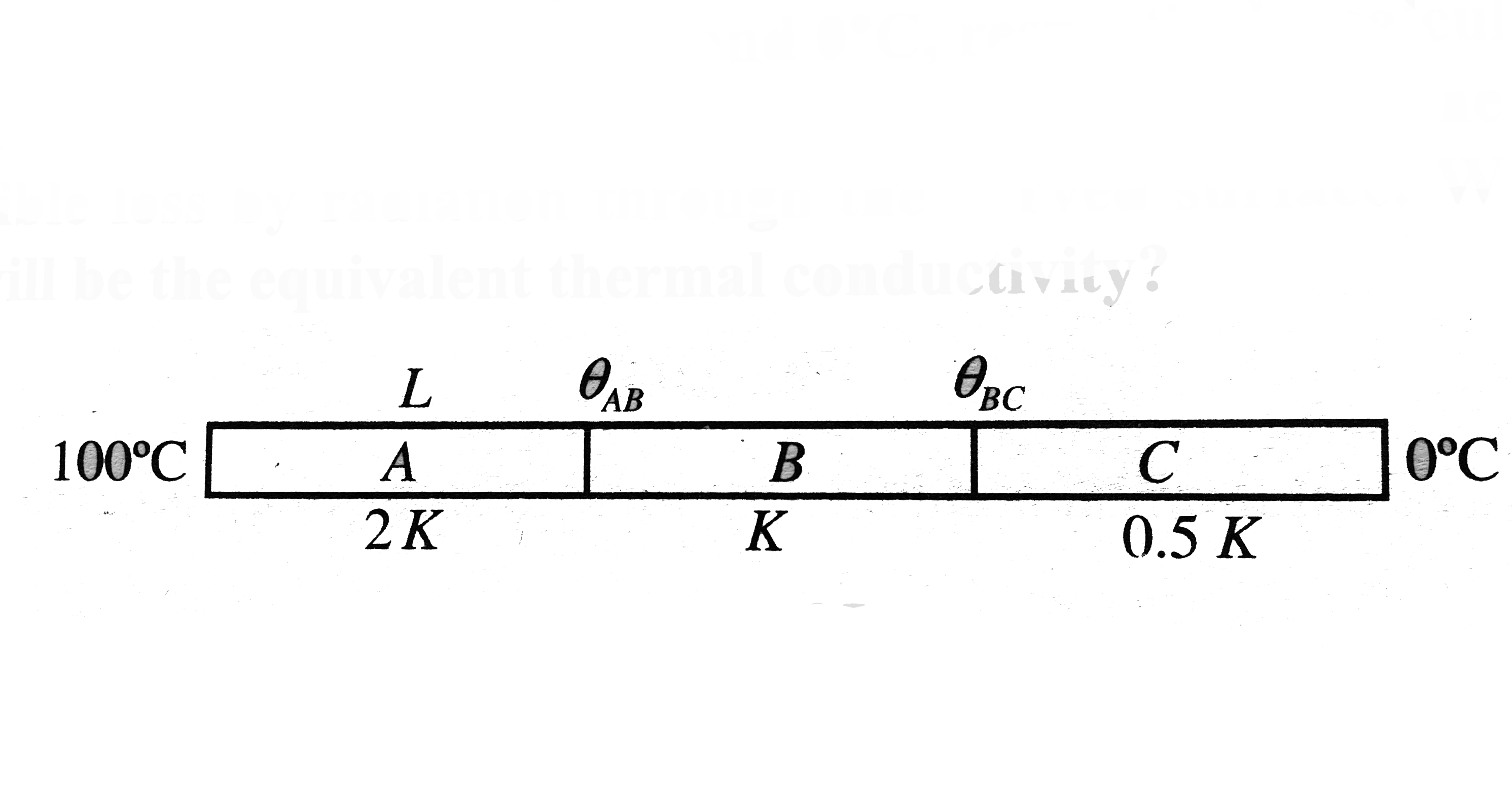
Three cylindrical rods A, B and C of equal lengths and equal diameters are joined in series as shown if Fig. Their thermal conductivities are 2K, K and 0.5K, respectively. In steady state, if the free ends of rods A and C are at `100^@C` and `0^@C`, respectively, calculate the temperature at the two junction points. Assume negligible loss by radiaiotn through the curved surface. What will be the equivalent thermal conductivity?

Text Solution

Verified by Experts

As the rods are in series, `R_(eq)=R_A+R_B+R_C` with `R=((L)/(KA))`
`R_(eq)=(L)/(2KA)+(L)/(KA)+(L)/(0.5KA)=(7L)/(2KA)` ..(i)
and hence, `H=(dQ)/(dt)=(Deltatheta)/(R )=((100-0))/((7L)/(2KA))=(200KA)/(7L)`
Now in series, rate of flow of heat remains same i.e.,
`H=H_A=H_B=H_C`.
So for rod A, `[(dQ)/(dt)]_A=[(dQ)/(dt)]`
i.e., `((100-theta_(AB))2KA)/(L)=(200KA)/(L)`
`theta_(BC)=((400)/(7))=57.1^@C`
Furthermore, if `K_(eq)` is equivalent thermal conductivity,
`R_(eq)=(L+L+L)/(K_(eq)A)=(7L)/(2KA)`
`K_(eq)=(6//7)K`
Promotional Banner

Topper's Solved these Questions

  • CALORIMETRY

    CENGAGE PHYSICS ENGLISH|Exercise Exercise 1.1|23 Videos
  • CALORIMETRY

    CENGAGE PHYSICS ENGLISH|Exercise Exercise 1.2|22 Videos
  • BASIC MATHEMATICS

    CENGAGE PHYSICS ENGLISH|Exercise Exercise 2.6|20 Videos
  • CENTRE OF MASS

    CENGAGE PHYSICS ENGLISH|Exercise INTEGER_TYPE|1 Videos

Similar Questions

Explore conceptually related problems

Three cylindrical rods A, B and C of equal lengths and equal diameters are joined in series as shown if Fig. Their thermal conductivities are 2K, K and 0.5K, respectively. Assume negligible loss by radiation through the curved surface. What will be the equivalent thermal conductivity?

Three rods A, B and C of the same length and same cross-sectional area are joined as shown. Their thermal conductivities are in the ratio 1:2:3/2. If the open ends of A and C are at 200^@ C and 18^@ C, respectively, then the temperature at the junction of A at steady state is

Three bars of equal lengths and equal area of cross-section are connected in series fig. their thermal conducitives are in the ratio 2:3:4 . If at the steady state the open ends of the first and the last bars are at temperature 200^(@)C and 20^(@)C respectively, find the temperature of both the junctions. .

Three bars of equal lengths and equal areas of cross-section are connected in series. Their thermal conductivities are in the ratio of 2:4:3. If the open ends of the first and last bars are at temperatures 20^(@)C and 18^(@)C respectively in the steady state calculate the temperature of both the junctions.

Twelve conducting rods from the sides of a uniform cube of side l. If in steady state, B and H ends of the cube are at 100^(@)C and 0^(@)C respectively. Find the temperature of the junction 'A' :-

Two rods A and B of different materials are welded together as shown in figure. Their thermal conductivities are K_(1) and K_(2) . The thermal conductivity of the composite rod will be

Three rods each of same length and cross - section are joined in series. The thermal conductivity of the materials are K , 2K and 3K respectively. If one end is kept at 200^@C and the other at 100^@C . What would be the temperature of the junctions in the steady state? Assume that no heat is lost due to radiation from the sides of the rods.

Three rods of same dimension are joined in series having thermal conductivity k_1 , k_2 and k_3 . The equivalent thermal conductivity is

In a steady state of thermal conduction, temperature of the ends A and B of a 20 cm long rod are 100^(@)C and 0^(@)C respectively. What will be the temperature of the rod at a point at a distance of 9 cm from the end A of the rod

Two rods of similar area of cross section and length are joined as shown in the figure. The ratio of their thermal conductivity is 2:3. The free ends are maintained at 100^(@)C and 0^(@)C respectivley. THE temperature at junction in steady state is
